Get Full Government Meeting Transcripts, Videos, & Alerts Forever!
Get email alerts on the Pensions topic
No spam. Unsubscribe anytime.
Utah Retirement System official explains why North Ogden’s net pension liability rises and falls
Summary
Corey Cox of Utah Retirement Systems briefed the North Ogden City Council on how actuarial assumptions, market returns and salary growth affect the city’s reported net pension liability under GASB 68.
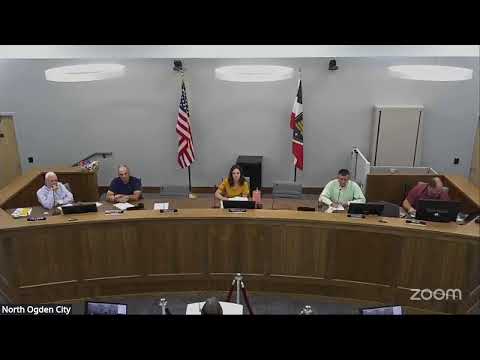
Corey Cox, director of legislative and government affairs at Utah Retirement Systems, told the North Ogden City Council on Sept. 9 that the city’s net pension liability reported under GASB 68 fluctuates because the number is a year‑end ‘‘snapshot’’ driven by market returns, actuarial assumptions and recent salary growth.
Cox opened with a broad explanation of how defined‑benefit pensions operate: member and employer contributions plus investment returns are pooled in a trust to prefund future monthly benefit payments. He said investment returns typically supply about two‑thirds of the fund’s long‑term growth. On a market‑value basis URS reported roughly $48 billion in 2024 and is “just over $50 billion” based on earnings through the most recent reporting period, he said.
Why the liability moves: Cox said actuaries estimate each member’s expected benefit using demographic assumptions (retirement age, mortality, salary increases) and economic assumptions (investment return/discount rate, inflation). URS uses a blended set of methods, including smoothing on the actuarial basis for contribution‑rate setting and a market snapshot for GASB 68. Changes to any assumption or actual market performance can push a plan’s reported funded status up or down.
The system’s assumed discount rate has been lowered over time, Cox said, from 7.5% a decade ago to 6.85% currently. Lowering the assumed return increases the present value of future benefits and therefore raises the reported liability; when returns exceed the assumption the liability tends to decline. He pointed to a strong 2021 investment year (about a 17.3% return) that temporarily moved some participant groups to a surplus, and more recent years that roughly met or exceeded assumptions.
Cox also said unusually large salary increases across local governments in 2022–24—he cited an observed average near 6.6% in one recent year versus a roughly 4.4% assumption—raise projected future benefits and therefore the liability. That effect shows up systemwide and is allocated to employers as a proportionate share based on covered payroll, he said.
Council members asked how the reporting requirement affects city budgets. Cox explained that contributions are remitted each pay period as part of employee compensation and that GASB 68 is an accounting disclosure that appears on municipal financial statements rather than a currently payable tax or assessment. To avoid sudden swings in employer contribution rates, URS smooths rate changes and has a contribution rate management plan that phases rate decreases or increases over time, he said. URS currently reports about 95% funding on an actuarial (smoothed) basis and about 94% on a market snapshot for combined systems.
Council members and attendees asked several technical questions, including which years count toward an employee’s final average salary and how employers should treat the annual disclosure. Cox said legacy (tier 1) public‑employee members use the highest three years for final compensation, while later hires typically use the highest five years, and reiterated that the GASB 68 disclosure is intended for transparency in financial reporting. He also summarized 2010s legislative changes that created the contributory ‘‘tier 2’’ structure for later hires and capped employer liabilities in legislation cited as a reason employees in the tier must contribute a portion of payroll.
Cox closed by offering to answer follow‑up questions and provide additional materials if the council wanted more detail on the city’s proportionate share or on contribution‑rate projections.