Get Full Government Meeting Transcripts, Videos, & Alerts Forever!
Get email alerts on the Budget Process topic
No spam. Unsubscribe anytime.
Knoxville council rejects resolution seeking explicit line-item amendment authority over mayor's budget
Summary
Councilwoman Parker introduced a resolution asserting city council's authority to submit line-item amendments and adopt an alternative budget to the mayor's proposal; after more than two hours of debate and legal opinions presented to the body, the resolution failed on a voice vote.
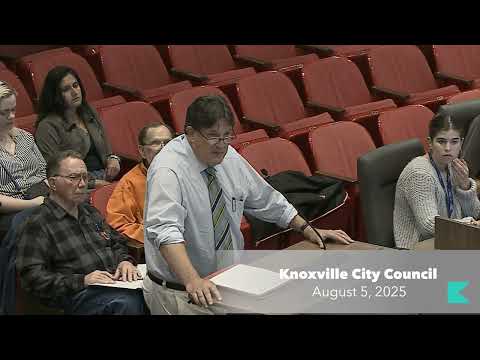
Councilwoman Parker introduced a resolution asking the City Council to record its understanding that council may amend the city budget by line item and may adopt an alternative budget ordinance when a majority rejects the mayor's proposed budget. The resolution, listed as item 11d on the agenda, drew a long debate about the meaning and limits of the city charter.
Parker said she brought the resolution "in hopes that it would allow us an opportunity to have a discussion about our budgeting process." She told colleagues she had attempted an amended budget ordinance in May and later received a written opinion from the law department saying that her amended ordinance conflicted with the charter. Parker argued the charter's broad delegation to council (she cited section 4.01) supports at least some line-item amendment authority and that appropriations ordinances require council to list nonprofit recipients and amounts precisely.
Council's attorney, identified in the meeting as Mr. Frost, told members he represents the body and not individual members. The city's legal position was presented by Mr. Swanson, who said the charter's plain text and a long-standing opinion by a prior law director (John Roach) entitled the mayor's budget to become the city's budget by operation of the charter if council fails to adopt a different budget before the statutory deadline. Swanson said, "The plain reading of section 9.01(f) of the charter is if the council shall fail to adopt the budget prior to the fifteenth day preceding the commencement of any fiscal year, it shall be conclusively presumed to have adopted the budget as submitted by the mayor." He also said that, in his view, council could not adopt a totally separate budget from the mayor's proposal under the current charter without litigation or a charter amendment.
Several council members questioned both the legal advice and the practical implications. Councilmember Roberto and Councilmember Thomas described longstanding council influence over line items through conversations with the mayor and during legislative budget hearings; they said they had seen council priorities incorporated in past budgets. Jeff Tallman, a member of the public who spoke in favor, said he supported strengthening council's legislative role and urged public discussion of budget priorities.
Other council members emphasized the charter's strong executive design and the practical limits of council authority absent a charter change. Councilmember Fugate summarized that the charter grants a strong executive and said a charter review committee would be the proper forum for structural change.
Parker said she expected the resolution would spark discussion rather than immediate change: "I have no expectations that this resolution will pass tonight. But I do find it unfortunate because I think, you know, initially, the goal is to bring it to council, for council to have a discussion about what the authority of council is, but, ultimately, it's to make the public aware." She repeatedly framed her motion narrowly around community agency grants, which she said the appropriations ordinance requires to be listed by nonprofit and amount.
After extended discussion, the council voted by voice on the resolution. The mayor called for those in favor to say "aye" and then asked for opposition; the motion failed on the voice vote.
Why it matters: The debate laid out competing readings of the charter and highlighted the difference between informal budget negotiations "off the dais" and formal legislative amendments. Council members who favor increasing council's formal amendment power said doing so could make budget choices more transparent; those opposed said the charter currently vests strong executive authority and that changes should come through a charter review or litigation.
Next steps: Councilmembers discussed forming a charter review committee; Vice Mayor Fugate said the committee would begin planning rules in August and hoped to return recommendations about charter review structure before year end. The vote on this resolution was a statement of council's views rather than a legal change to the budgeting process.