Get Full Government Meeting Transcripts, Videos, & Alerts Forever!
Get email alerts on the Public Works Sidewalks topic
No spam. Unsubscribe anytime.
Commission weighs expanded sidewalk reimbursement, temporary permit relief after widespread tree-root damage
Summary
Oregon City commissioners discussed options including longer completion windows, a temporary permit-fee amnesty and coordination to help residents fix sidewalks damaged by tree roots; staff will return revised code language and a limited-fee-resolution for commission approval.
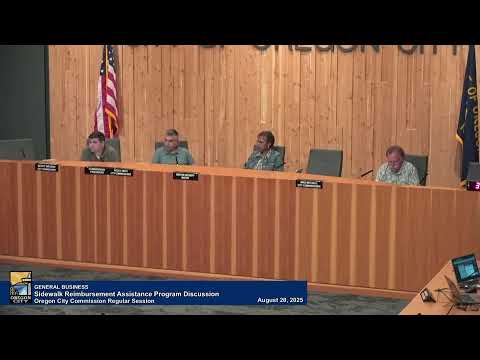
Oregon City commissioners spent extended time Aug. 20 addressing a surge of sidewalk repair notices tied to mature street trees. Public works staff and multiple residents described logistical, financial and equity challenges for homeowners required to repair sidewalks that the city code places on adjacent property owners.
Public works director Dana Webb reviewed current practice and the program’s mechanics: a single-property sidewalk permit costs $207, while group permits (three or more properties) carry one fee of $413; property owners participating in the city’s tree-related reimbursement program receive a 50% permit discount under current practice. Staff reported 89 properties in code enforcement citywide; 27 of those had already applied for permits, five had received second notices, and several neighborhoods reported clusters of affected properties.
Residents from the McLaughlin neighborhood urged expanded financial assistance and better coordination. Neighbors described difficulty lining up the same contractor, synchronizing permit pulls and scheduling work within the narrow windows historically provided by the city. One resident said contractors’ setup and mobilization costs make incremental panel replacements costly, and another urged that government help could be targeted to the largest-burden cases.
Commissioners discussed a set of near-term and medium-term options. The commission asked staff to return with redlined code amendments (item 9b) reflecting a longer construction window: staff will draft language that keeps existing permit-application timing but extends the time allowed to complete work (the commission directed staff toward a 180-day total window from initial notice in practice). Commissioners also asked staff to prepare a resolution creating a temporary, citywide permit-fee amnesty period (discussion focused on a roughly 60-day window for residents to pull permits with no fee) and to notify property owners on the enforcement list.
Commissioners and staff discussed alternatives to full panel replacement — for example, allowing grinding in more cases and evaluating slab-raising foams — and the constraints of prevailing wage rules (projects over $50,000 typically invoke Bureau of Labor and Industry requirements, which raise costs). Staff said administering an interest-free loan program would create substantial administrative overhead and recordkeeping requirements (liens on property would be required) and asked the commission to identify funding sources and program parameters if it wished to pursue that option.
Next steps: staff will return at the next meeting with a redline code amendment for the sidewalk reimbursement program (item 9b), a draft resolution to implement a limited permit-fee amnesty and an outreach plan to notify affected property owners of the available options. Public works emphasized they are available to meet on-site with residents to review conditions and answer questions.
Quote: "If we don't get it done tonight, we won't die on the vine here," Commissioner Rocky Smith said, urging the commission to provide timely direction so staff can return with concrete proposals.
Why it matters: Sidewalk repairs touch equity and safety concerns across neighborhoods. The commission’s choices will affect who bears repair costs, how quickly hazards are fixed and how the city manages recurring maintenance needs tied to street trees.
Ending: Staff will draft the code changes and a resolution for the commission’s next regular meeting and will reach out to property owners currently in the enforcement queue to explain the new timelines and any temporary fee relief.