Get Full Government Meeting Transcripts, Videos, & Alerts Forever!
Get email alerts on the General Government Operations And Appropriations topic
No spam. Unsubscribe anytime.
Guam Visitors Bureau asks Legislature for $11.1 million in temporary airline incentives to preserve routes
Summary
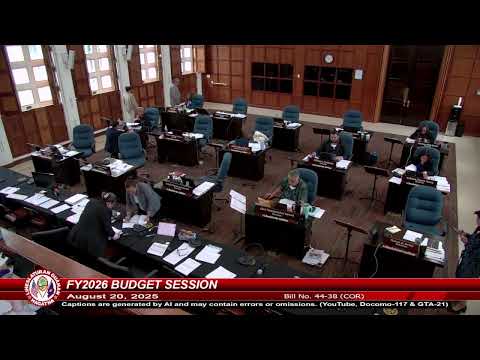
The Guam Visitors Bureau asked the Legislature’s Committee of the Whole for a supplemental $11.1 million to fund performance-based airline incentives after testimony from GVB and the Guam International Airport Authority detailed recent seat-capacity gains and limits on airport subsidies under FAA policy.
Regine Biscolli, president of the Guam Visitors Bureau, told the Guam Legislature’s Committee of the Whole that the bureau is requesting a supplemental $11,100,000 to fund temporary, performance-based airline incentives to help restore air service and visitor arrivals.
Biscolli said the next 18 months are critical because global aircraft shortages, delayed deliveries and competition from other destinations are constraining available seat capacity. “Incentives are not handouts. They are performance based agreements tied to seat capacity, tied to load factor and route duration,” she told senators, and said incentives already helped raise monthly seat capacity from Korea from about 39,000 in June to roughly 60,000 in August.
The bureau cited preliminary Oxford Economics figures showing roughly $1.158 billion in direct traveler demand, $1.439 billion in total economic impact, about 13,975 jobs supported and $374 million in taxes (preliminary 2024 estimates). GVB told the committee it expects the $11.1 million request to produce additional annual arrivals (GVB’s estimate: more than 329,000), an increase in economic impact (GVB estimate: $640 million), roughly 600 more jobs, and about $166 million in additional tax revenue.
Airport and GVB officials described how the incentives would work and the limits on what the airport can offer. Ricky Hernandez, director of the Guam International Airport Authority, said the airport is constrained by Federal Aviation Administration (FAA) policy: “The airport cannot pay an airline an incentive, or a subsidy. That's against federal, aviation administration, regulations and policies. All we can do is provide a discount on fees.” Hernandez said GIAA adjusted its air service development policy to allow fee discounts for new or materially expanded service; the airport has applied up to 50% discounts for unserved routes and lower percentages for routes it deemed “underserved.”
Senators pressed the panel on implementation details and accountability. Several lawmakers said airlines and some partners had understood earlier discussions to promise “50% off” landing fees; GVB and the airport said the correct phrasing was “up to 50%” and that some partners may have misheard the qualifier. Hernandez told the committee the airport has approved roughly $1.1 million in discounts for carriers through the end of the fiscal year and that the authority will sustain current rates through the first quarter, then reassess.
GVB officials described three types of programs: cooperative marketing promotions with airlines and travel agents; load-factor payments that pay airlines when flights achieve a target average load factor; and turnaround or direct-service support that shares risk with carriers when they up‑gauge aircraft or add new/seasonal service. Biscolli said the programs are intended to be temporary and performance-based, not permanent subsidies.
Several senators questioned whether the $11.1 million request should instead be directed to destination maintenance, parks, restrooms and other infrastructure that shape visitor experience. Biscolli and other GVB officials said the bureau supports destination management and funds those efforts from its regular TAF-funded programs, but argued the immediate constraint is airlift: “We can't continue to rely on the federal government and military spending,” Biscolli said, “we need to be self sustaining.” GVB said it had tapped reserve funds and internal savings to run FY25 incentives and now seeks supplemental appropriation to continue into FY26.
Committee members secured commitments from GVB and airport officials for regular oversight: senators requested monthly reports tracking applications, expenditures and outcomes for any supplemental funds. The panel agreed to return to the committee for informational updates and to work with the Legislature’s auditor on transparency and contract reporting.
No appropriation vote occurred during the hearing. The Committee of the Whole recessed at the close of the panel’s testimony and will consider amendments and budget items in subsequent sessions.