Get Full Government Meeting Transcripts, Videos, & Alerts Forever!
Get email alerts on the Infrastructure Power Transmission topic
No spam. Unsubscribe anytime.
Santa Clara council approves resolution of necessity for SVP 115 kV line easements after contested hearing
Summary
The City Council voted 6–1 to adopt a resolution of necessity to acquire easements on five Bassett Street parcels for Silicon Valley Power's 115 kV transmission project after a public hearing where the property owner's attorney objected to adequacy of appraisal and description.
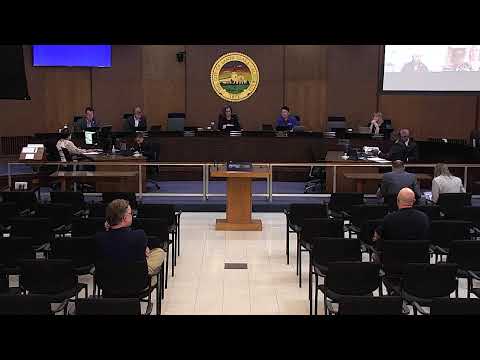
The Santa Clara City Council voted 6'to'1 on Aug. 12 to adopt a resolution of necessity authorizing the city to proceed toward acquiring easements on parcels at 3508, 3520, 3530, 3540 and 3550 Bassett Street for the Silicon Valley Power (SVP) 115-kilovolt transmission line project.
The action followed a public hearing in which SVP presented technical and procedural findings supporting the selected route and the need for the easements. Ali Jackman, SVP electric division manager, told the council the 115 kV line would run about 2.24 miles between the Northern Receiving Station and Kiefer Receiving Station, increase the system operational limit to about 1,300 megawatts and was necessary to meet projected load growth. Jackman said staff had negotiated with the property owner for more than nine months and had made a good-faith offer based on an independent appraisal.
Emily Breaux, attorney for HGIT Bassett Campus LP (the property owner), urged the council to reject the resolution, arguing that the city had not shown with the required precision that these particular properties were necessary for the project and that the summary appraisal and offer were deficient. Breaux said the owner had provided a letter and raised legal objections to the sufficiency of the project description and of the appraisal materials.
Gail Connor, the city's outside eminent domain counsel, responded that the appraisal summary complied with Government Code section 7267.2 and that the question of compensation was not before the council at the public hearing. Connor said the staff report and record contain substantial information supporting the required findings, and that a property owner wishing to challenge the findings must present evidence at the administrative hearing or risk being limited to the existing record in later court proceedings.
Council deliberations focused on whether the staff record contained sufficient factual support. Councilmember Park voted against the resolution; six other councilmembers voted in favor. Mayor Lisa Gilmore announced the motion passed 6'to'1. Jackman and city staff said they would continue voluntary negotiations for a negotiated easement even after the resolution.
The council's action authorizes making the findings required to commence eminent domain steps if negotiations remain at impasse; it does not set the final compensation amount. That amount will be determined in further negotiations or through the condemnation process if it proceeds to litigation. City staff told the council the acquisition process can take about 24 months and that, pending a court order, the city can seek an order of possession in roughly five months.
The council and staff also emphasized that the route selection and environmental review had been completed earlier: the council adopted the project's MND (mitigated negative declaration) and selected Route A on Nov. 12, 2024, and easements were needed along the southern segment where the line runs adjacent to private parcels.
The council directed staff to continue negotiations and noted the right of the property owner to pursue legal remedies.