Get Full Government Meeting Transcripts, Videos, & Alerts Forever!
Get email alerts on the Hr1 Medicai Plannedparenthood topic
No spam. Unsubscribe anytime.
Officials warn H.R.1 will strip billions from Medi‑Cal, threaten hospitals and Planned Parenthood
Summary
State health officials, hospital representatives and advocates told a joint legislative hearing that H.R.1’s work requirements, redeterminations, provider‑tax limits and a one‑year ban on federal funding for abortion providers could remove tens of billions in federal support for Medi‑Cal and disrupt care across California.
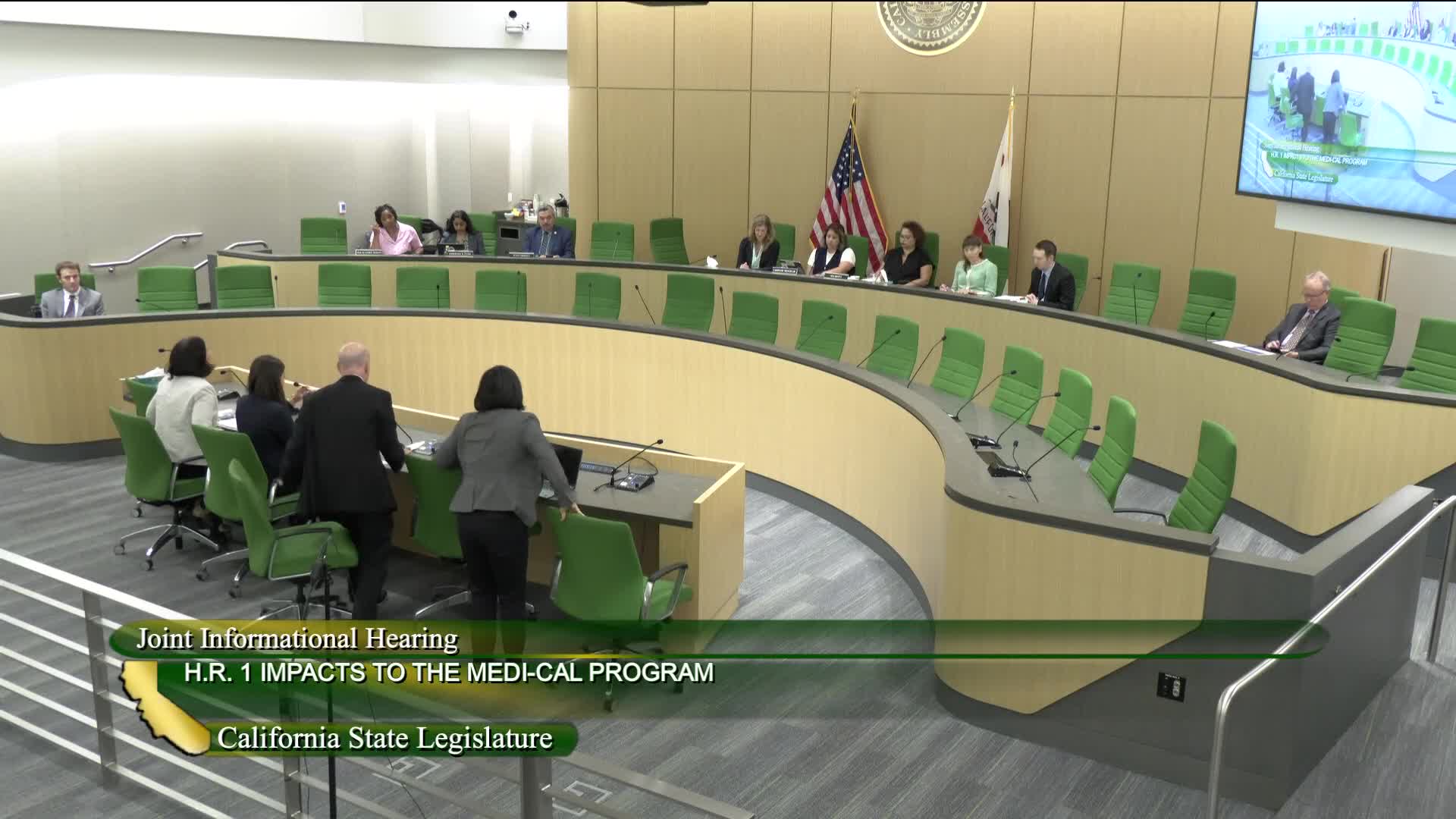
A joint informational hearing of the Senate and Assembly health committees heard July 4 that H.R.1 will sharply reduce federal funding for Medi‑Cal, introduce work and paperwork requirements that could remove coverage for millions of Californians, and — through provider‑tax and payment limits — threaten the financial stability of hospitals and safety‑net providers.
State and provider officials said the changes would hit rural and safety‑net facilities especially hard and could force clinic closures and service cuts. Michelle Boss, director of the Department of Health Care Services, told lawmakers, “Medi Cal serves nearly 15,000,000 Californians, roughly 35% of the state. This includes over 5,000,000 children and teens.” She said H.R.1 “puts tens of billions of dollars of federal funding at risk and could result in the loss of coverage for millions of Californians.”
The hearing focused on specific H.R.1 provisions that speakers said would have immediate and phased effects. Boss outlined eligibility and access changes including a work requirement for adults 19–64 that would begin, as written, Jan. 1, 2027; more frequent eligibility redeterminations (every six months rather than once per year for the ACA expansion group); reduced retroactive coverage; and new cost‑sharing for expansion adults. She estimated that the work requirement “may lose coverage for up to 3,000,000 Medi‑Cal members” and could “result in a loss of over 20,000,000,000 in federal funding.”
Speakers also described changes to state financing tools that help pay providers. Boss said H.R.1 imposes a moratorium on new or increased provider taxes, narrows allowable provider‑tax structures, and reduces the statutory cap on provider taxes over time. She said the law limits new state directed payments to at most 100% of Medicare rates for ACA expansion states and requires existing payments above Medicare to be reduced beginning in 2028. On provider‑tax reductions and payment limits, Adam Dorsey of the California Hospital Association warned that the bill “will result in between 66,000,000,000 and $128,000,000,000 loss in revenue to hospitals over a 10 year period.” Dorsey said the change would reduce hospital revenues by an estimated 14% to 30% of Medi‑Cal revenue for some hospitals and risk closures.
Planned Parenthood’s senior vice president of government affairs, Angela Pontes, described immediate operational effects from the statute’s one‑year ban on Medicaid payments to certain nonprofit providers that provide abortion services: “As the director mentioned, this law federally defunded Planned Parenthood overnight.” Pontes said roughly 80% of Planned Parenthood patients in California rely on Medi‑Cal and that the change would effectively strip “about $300,000,000 in federal funding” from a major reproductive‑health provider unless court injunctions remain in place. She and others noted preliminary injunctions have blocked implementation of parts of the ban but said litigation outcomes remain uncertain.
Speakers also highlighted immigrant‑coverage changes in H.R.1. Boss said the bill reduces enhanced federal matching for some emergency services and restricts federal funding for the full scope of coverage for many lawfully residing immigrants beginning Oct. 1, 2026, shifting costs to the state. Linda Wei of Western Center on Law and Poverty warned the measures would disproportionately affect people who gained coverage under the ACA expansion, including low‑wage workers and people experiencing homelessness.
Lawmakers and advocates pressed for practical planning and mitigation steps. Boss said the department is reviewing federal guidance, which H.R.1 says CMS must publish by June 2026 for some provisions, and that the state may seek transition periods where allowed. Many witnesses urged state revenue and policy options to preserve services, citing the scale of the funding losses. Dorsey and other provider representatives asked lawmakers to consider regulatory relief, operational efficiencies and additional state funding to stabilize the system.
The hearing included questions about timelines and implementation. Boss said some H.R.1 provisions take effect immediately while others phase in over 2026–2029; she gave projected implementation dates for work requirements (effective 01/01/2027 unless delayed by a state request) and cost‑sharing (effective 10/01/2028). Speakers repeatedly noted uncertainty in federal guidance and litigation outcomes would shape final impacts.
The panels did not take formal votes. Lawmakers said they will continue oversight hearings and explore harm‑mitigation options, including outreach, automation of eligibility systems, and potential state funding strategies to soften the projected losses.