Get Full Government Meeting Transcripts, Videos, & Alerts Forever!
Get email alerts on the Higher Education Capital Projects topic
No spam. Unsubscribe anytime.
Commission approves Tennessee State University engineering building early design and budget revision
Summary
The State Building Commission approved a budget and scope revision and early design presentation for a roughly 70,000-square-foot engineering building at Tennessee State University, to be sited on the former Clay Hall location with completion targeted for June 2027.
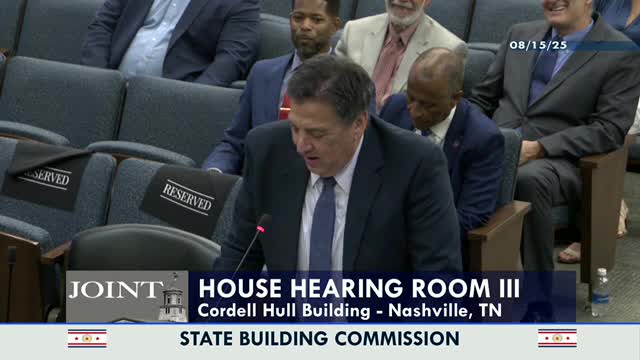
The State Building Commission approved a revision to the project budget, funding and scope and the early design phase presentation for a new engineering classroom building at Tennessee State University (TSU).
President Duane Tucker and architect Gary Askew presented the project, which is proposed on the former site of Clay Hall and would enable demolition of Torrance Hall. Askew described a building offering lab spaces (including a machine shop and makerspace), classrooms, faculty suites, a student commons and an engineering courtyard that opens to heavy-material and vibration-sensitive labs. He said the project is approximately a 70,000-square-foot building, is "in budget at this point," and is planned to proceed in November with an anticipated completion in June 2027.
Commissioners asked how the facility compares with engineering buildings at other historically Black colleges and universities and how the building would affect engineering enrollment. TSU representatives said the project was programmed around 945 students and designed to accommodate growth through a five-year planning horizon; at one point a commissioner asked if the five-year capacity equated to a roughly 25% increase and was told that characterization was correct. TSU described work to strengthen industry partnerships and recruitment to support enrollment growth.
A motion to approve the revision and early design presentation was moved, seconded and adopted by voice vote. The commission and TSU noted that additional phases or a master-plan amendment could follow depending on growth and funding; specific project budgets and construction approvals will return to the commission when available.