Get Full Government Meeting Transcripts, Videos, & Alerts Forever!
Get email alerts on the Public Art Murals topic
No spam. Unsubscribe anytime.
St. Petersburg council refers response to FDOT memo on pavement art after residents urge protections
Summary
After nearly two hours of public comment urging the city to protect murals and rainbow crosswalks, St. Petersburg City Council voted unanimously on Aug. 14 to send a review of a Florida Department of Transportation memorandum to the Housing, Land Use and Transportation committee for further study and a coordinated city response.
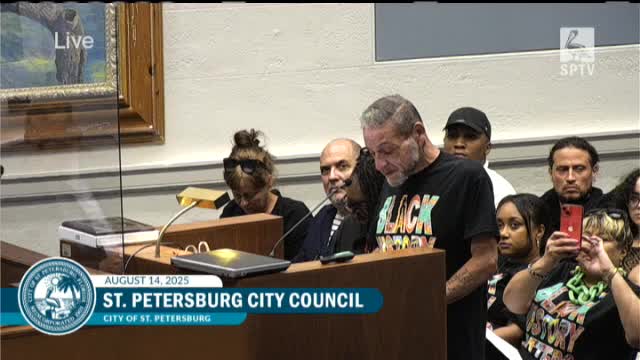
St. Petersburg City Council on Aug. 14 voted to refer to the Housing, Land Use and Transportation (HLUT) committee a staff-and-council review of a Florida Department of Transportation (FDOT) memorandum that advises removal of pavement and surface art. The referral came after more than two hours of public comment from residents, artists and business owners imploring the city to protect murals, rainbow crosswalks and other asphalt art that community members said reflect local history and support tourism and small business.
The referral motion, introduced by Council Member Brandy Gabbard, passed unanimously; six council members voted yes and two were recorded as absent. The committee discussion was requested to include city administration, legal counsel and options for alternative placemaking and public-art displays that would meet safety and traffic-control standards.
Why this matters: the FDOT memorandum dated June 30, 2025, instructs local governments to remove nonconforming “traffic control devices,” a category the state says may include pavement art, unless a local government obtains an exception. City legal staff and administration told council there is a process for “good cause” exceptions but that the FDOT memo also cites a statute that could be used to withhold state funding tied to traffic control devices. Residents and arts advocates say the murals and crosswalks are low-cost traffic-calming measures, local cultural landmarks and important economic drivers for tourism and small businesses.
Public comment: more than two dozen speakers addressed the council during open forum and during the new-business discussion. Artist and resident John Gascon said the murals are “not mere murals or decorative,” and called proposed removals “erasure” of voices and histories. “This move is a cut by the current administration; it’s not about safety,” Gascon said. Andy Oliver, pastor of Allendale United Methodist Church, tied the issue to broader civil-rights concerns, saying the murals “are not about paint, it’s about power.”
Representatives of local institutions and arts organizations also spoke. Terri Lipsey Scott, executive director of the Woodson African American Museum of Florida, warned the council that painting over street art would not erase the communities the works commemorate: “They can paint over our streets, but they cannot erase our faces,” she said. Janae Priebe, who oversaw installation of several ground murals including the Black Lives Matter mural, told the council that installations followed city and DOT safety guidelines and noted studies showing traffic-calming benefits. “We followed every protocol with precision because the safety of drivers, pedestrians, and cyclists is not something to be taken lightly,” Priebe said.
Business and tourism voices emphasized economic stakes. Rob Hall, executive director of Winter Pride Saint Pete, said the murals and crosswalks send a message to visitors that the city is welcoming: “It’s the mural that greets them before they ever speak to a single person. It’s that silent, powerful message that says, the city is for you.” Several speakers asked the council to consider legal pushback alongside technical solutions; one caller asked the city to consider joining litigation that other Florida cities had filed.
Administration and legal response: city staff told council they have provided an inventory of pavement art to FDOT and that the city has not removed any installations pending discussion. “We have provided an inventory to FDOT … and no, we’re not taking anything down right now,” a city staff member told council. Assistant City Attorney Ben James said the FDOT memo “calls for the removal of noncompliant traffic control devices, surface markings included, immediately,” but added the memo references a process for showing “good cause” that could allow installations to remain if the city obtains an exception.
Council action and next steps: Council Member Brandy Gabbard moved the referral to HLUT for a staff presentation with legal and administrative participation; the motion passed unanimously (six yes, two absent). The referral asks that the HLUT presentation address the FDOT memorandum dated 06/30/2025, outline a plan to comply with or challenge the memo’s requirements, and present alternative placemaking options and forms of public art that have clear connections to business districts or identifiable neighborhoods. City staff said they will continue discussions with FDOT, provide the council with the inventory already submitted, and bring the matter to committee for fuller analysis.
Councilmembers and speakers urged both an aggressive factual review of the safety evidence and legal options and careful attention to community values. Several speakers asked the council to record an official city position opposing removal; council members said the referral would create an appropriate forum to craft such a response while preserving opportunities to pursue exceptions or legal remedies.
The HLUT referral has no immediate effect on existing installations; the city indicated it will continue dialogue with FDOT and return to council with options at the committee meeting.