Get Full Government Meeting Transcripts, Videos, & Alerts Forever!
Get email alerts on the Education Research topic
No spam. Unsubscribe anytime.
ERC board approves multiple research proposals on career certifications, financial aid, dual enrollment, school health and pollution impacts
Summary
The Texas Education Research Center board approved seven research proposals on Oct. 25, 2025, unanimously or with minor amendments, including studies of industry-based certifications, financial-aid uncertainty, a dual-enrollment delivery model, school health investments, peer effects and pollution exposure.
The Education Research Center (ERC) board approved seven research proposals on Oct. 25, 2025, advancing studies on industry-based certifications, the role of financial-aid uncertainty in college application decisions, a centralized dual-enrollment model, the effects of school health staffing, peer effects on upward mobility and the academic impacts of pollution exposure.
The approvals cover projects from university and research partners including University of Texas Rio Grande Valley (UTRGV), UT El Paso, Washington University in St. Louis, the American Institutes for Research, Harvard and the University of Texas at Austin. Several approvals were unanimous; three proposals were approved with clarifying amendments requiring additional documentation or justification from researchers.
The actions move forward both quantitative and qualitative analyses. Holly Hurd presented a proposal, jointly led with UTRGV and UT El Paso, to examine how industry-based certifications (IBCs) awarded in high school align with CTE programs of study and local occupational needs. Hurd said the project will “investigate the provision of industry based certifications in high school and to determine how well they're aligned or misaligned with career preparation course taking.” She also said the team will study whether IBCs correspond to wage attainment within two years after high school.
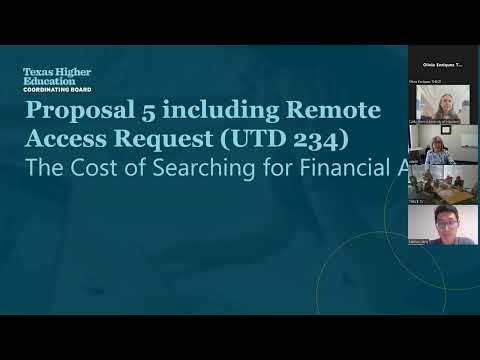
Nathan (PhD student, Washington University in St. Louis) proposed a study of financial-aid uncertainty and its role in undermatching. He described using the Texas top-10% automatic-admission rule to separate admissions uncertainty from aid uncertainty and wrote that the design “becomes a window into how financial aid uncertainty specifically is influencing application behavior.” The ERC approved that proposal without amendment.
Kyle Nearing of the American Institutes for Research presented an evaluation of the IDEAS (Increasing Dual Enrollment Access and Success) hub model. Nearing said the study uses a randomized control trial across community colleges, including Amarillo College and San Jacinto College in Texas, to measure impacts on dual-enrollment credits, high-school graduation and postsecondary outcomes. Board members asked for clarification on requested Texas Workforce Commission wage data; the board approved the proposal with an amendment requiring a short justification for the requested wage records.
Simone Maticna (Harvard) proposed linking ERC student and school records with Medicaid and other datasets to estimate the causal effects of school health investments — such as nurses and school-based health services — on student health, educational and long-term economic outcomes. The board approved Maticna’s project on the condition that the researcher supply a more detailed supplemental variable list in the ERC’s required template before data access is finalized.
A Harvard undergraduate, Juhi (senior thesis), presented a project to measure school-level “efficacy” and peer effects on upward mobility for low-income students using ERC records and linked wage data. Board members questioned whether an advisor needed to be formally listed for data access; the board approved the proposal and indicated it would follow up if adviser authorization were required.
Moo Yang Shin (UT Austin) proposed linking school- and student-level records to public air- and water-quality data to quantify how low-level pollution exposure affects student outcomes and to evaluate mitigation policies such as school-bus electrification. Shin told the board the ERC’s longitudinal data would permit both short-term academic outcome analysis and long-term wage linkage. The board approved the project and suggested Shin could consult related work previously done by Texas A&M researchers.
Votes at a glance - Proposal 4 (UTD 2 33): Study of industry-based certifications and alignment with CTE and workforce needs — motion to approve made by Rayyan; seconded by Kathy; outcome: approved (recorded as unanimous in meeting). - Proposal 5 (UTD 2 34): Financial-aid uncertainty and undermatching — motion to approve by Kathy; seconded by Celeste; outcome: approved (unanimous). - Proposal 6 (UTD 2 32/35): Evaluation of IDEAS dual-enrollment hub model (Amarillo CC, San Jacinto CC) — motion to approve by Angie with amendment to add justification for wage records; seconded by Holly (board); outcome: approved with amendment. - Proposal 7 (UTA 2 72): School health investments study (nurses, health services) — motion to approve with requirement to supply supplemental variable details in ERC template; mover: (motion recorded); seconded by Kathy; outcome: approved with amendment. - Proposal A (UTA 2 73): School efficacy and peer effects (undergraduate thesis, Juhi) — motion to approve by Kathy; seconded by Holly; outcome: approved. - Proposal 9 (UTA 2 74): Pollution exposure and mitigation impacts on student outcomes — motion to approve by Megan; seconded by Angie; outcome: approved. - Minutes and consent calendar: approved earlier in the meeting; board confirmed unanimous approvals for those items.
Discussion vs. decisions - Discussion items: presenters summarized research questions, designs and data sources; board members asked clarifying questions about specific data fields (TWC wage county fields, SAT/ACT availability, CBM and other student-preparation measures) and researcher plans to request or use those variables. - Directions/assignments: the ERC required three clarifications as conditions of approval: (1) IDEAS study must include a short justification for requested TWC wage records; (2) the school-health proposal must supply a detailed supplemental variable list in the ERC template; (3) the board indicated it would follow up about adviser authorization for the undergraduate proposal if needed. - Formal actions: the board voted to approve each proposal, with the three conditional amendments noted above. The meeting record indicates approvals were unanimous where recorded.
Why it matters The approved projects use ERC-linked administrative records to address policy-relevant questions for Texas education and workforce policy: whether high-school industry certifications align with local labor-market needs; how financial-aid uncertainty shapes college application behavior for disadvantaged students; whether a centralized dual-enrollment hub improves access and postsecondary success; the role of school-based health services in long-term student outcomes; peer effects within higher education; and student health impacts from air and water pollution. Findings from these studies could inform state policy discussions — including accountability measures that reference college- and career-readiness indicators, dual-enrollment expansion strategies and investments in school-based health services.
What’s next Researchers granted ERC access must return the required supplemental documentation or justifications specified by the board. Staff indicated the approved items will be forwarded to ERC administrative staff (Melissa was named as a recipient for submission materials) to finalize remote access and data-sharing steps.