Get Full Government Meeting Transcripts, Videos, & Alerts Forever!
Get email alerts on the Economic Development topic
No spam. Unsubscribe anytime.
Harney County court opens review of economic-development strategy, seeks to inventory local partners before hiring contractor
Summary
Harney County Court convened a regional work session to re-evaluate its economic development approach, inventory services provided by local and regional partners and consider whether to issue an RFP for a new economic‑development contractor using state lottery funds.
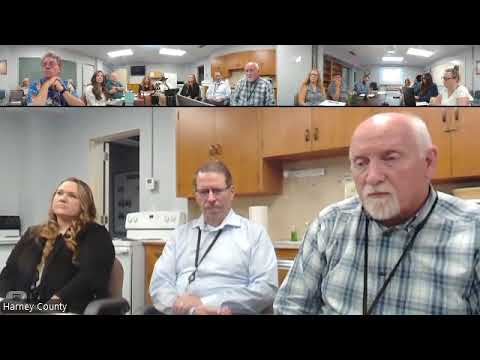
Harney County Judge Phil Hart opened a regional work session saying the county will "start over" on economic development and is considering whether to retain a new contractor to run a more proactive outreach and recruitment program.
"Our county is kind of reevaluating our economic development strategy," Judge Hart said, noting the county currently has lottery funds available and no active contractor after winding down the previous arrangement. He asked attendees to help identify services already provided by local organizations so any future contract would not duplicate existing work.
The nut graf: County officials said they want a contractor who will actively recruit business and industry, market Harney County assets and coordinate state and regional resources rather than merely react to incoming requests. The goal is to preserve local culture while expanding opportunities in manufacturing, food systems and tourism, and to use limited county lottery funds efficiently.
Commissioner Rob Frank said Harney County needs "someone aggressive" who will pursue opportunities rather than wait for them, and emphasized an interest in industry and manufacturing over retail to build community resilience. Frank pointed to value‑added agriculture and underused industrial property on the west side of town as potential targets.
Speakers at the meeting described an array of programs and resources already available to Harney County businesses. Feather Santustes, regional development officer for Business Oregon, described state programs and said most of Business Oregon's budget funds infrastructure (drinking water, wastewater) while a smaller portion supports incentives for traded‑sector firms. Tori Smith, deputy director at GEODC (Greater Eastern Oregon Development Corporation), and Christina Smith, GEODC commercial loan officer, outlined loan and gap‑financing options and the possibility of administering local loan funds.
High Desert Partnership (HDP) and BizHarney described small‑business supports, entrepreneurship cohorts and marketing under a local "Harney brand." Anna Gailey of HDP said the organization connects entrepreneurs to statewide advisors, training and capital. The Small Business Development Center (SBDC) and Eastern Oregon workforce partners described technical assistance, training and workforce development supports, including career‑technical education and short‑term training subsidies.
Representatives of the Burns Paiute Tribe spoke about potential collaboration and available tribal land. Chris Hicks, general manager of the Burns Paiute Tribe, urged the county to consider existing predeveloped facilities and ecotourism opportunities, saying "ecotourism... is like an untapped market." Steve Genovese, the tribe's planning and economic development director, flagged more than 1,200 acres of trust land and noted a vacant 20,000‑square‑foot industrial building on a 21.3‑acre parcel the tribe is studying for redevelopment.
County staff and presenters reviewed incentive and site‑marketing tools. Judge Hart and others described the county's effort to renew an enterprise zone with the cities of Burns and Hines; county staff explained that an enterprise zone can provide a property‑tax deferral for up to three years for eligible new construction, with negotiated arrangements possible in later years. Business Oregon staff and GEODC described Oregon Prospector as the state site‑listing tool where counties and site managers post commercial and industrial property data for site selectors.
Attendees also discussed local constraints and priorities: workforce shortages and the need to grow local talent via CTE and training programs; a housing shortage and a mix of older or non‑permanent housing; limited local contractor capacity for construction and trades; and transportation costs tied to Harney County's remote location. Christian Golden of the Eastern Oregon workforce board described work to "reduce barriers" between job seekers and employers and to bring targeted training to the county.
No formal motion was made at the session. County officials said the next step is for the Harney County Court to decide whether to pursue an RFP to hire an economic‑development contractor, to assemble a contact list and service inventory from meeting participants, and to hold follow‑up meetings that drill into financing, workforce and housing needs. Judge Hart said the county has roughly "$90,000 or so, maybe $100,000 or so" in state lottery funds to allocate for economic development work and that the court will discuss how to use that funding.
Ending: County officials said they will compile the contact and service information provided at the meeting, circulate it to partners, and bring a recommendation back to the county court about whether to issue an RFP and how to prioritize follow‑up work on enterprise‑zone renewal, marketing, workforce training and housing. Attendees asked that the county coordinate next steps and that HDP and GEODC help lead grant and financing conversations where appropriate.