Get Full Government Meeting Transcripts, Videos, & Alerts Forever!
Get email alerts on the Forensic Lab Budget topic
No spam. Unsubscribe anytime.
Forensic service agency earns full accreditation, warns of federal grant uncertainty for 2026 budget
Summary
The Indianapolis-Marion County Forensic Service Agency reported full international accreditation with zero findings, recognition for efficiency and a FY2026 budget that depends heavily on federal grants; leaders warned that award uncertainty could force cuts to grant-funded positions and supplies.
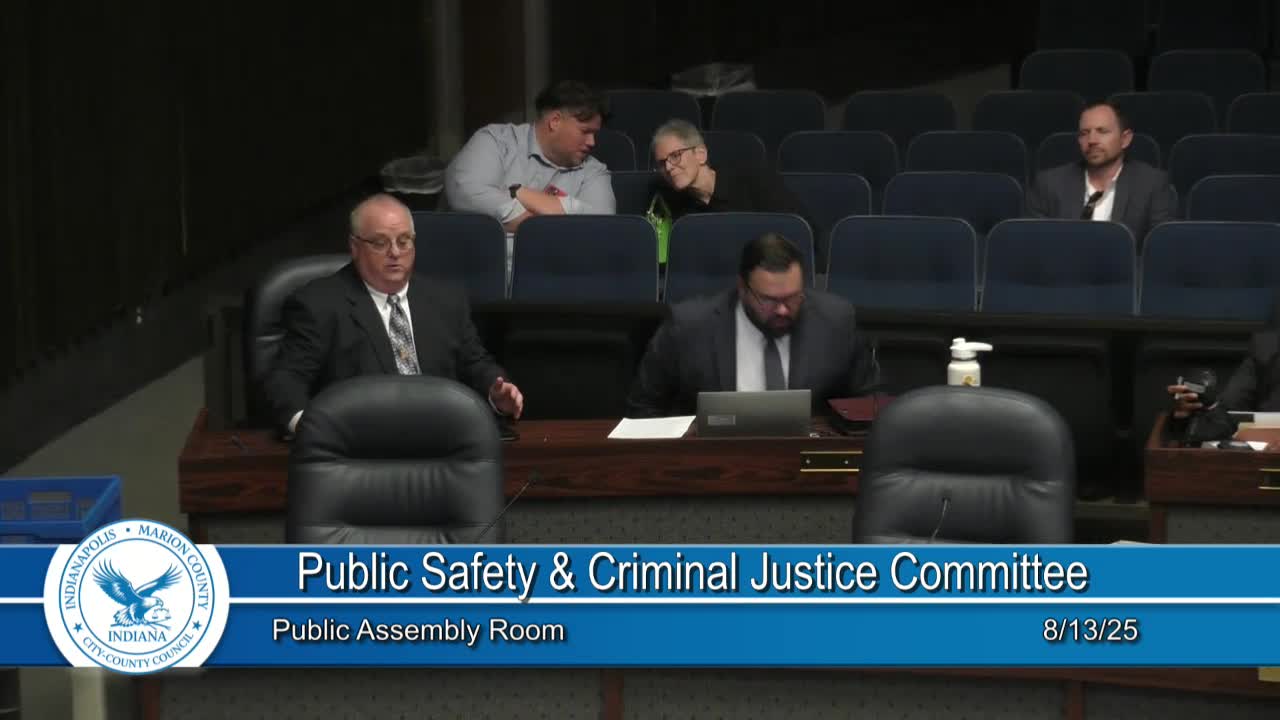
Richard Amberger, director of the Indianapolis-Marion County Forensic Service Agency, told the Public Safety and Criminal Justice Committee on Aug. 13, 2025, that the agency achieved full accreditation in 2025 with zero findings and received a national efficiency award, but cautioned that FY2026 operations rely substantially on federal grants that remain uncertain.
"The agency completed full accreditation in 2025, which I'm pleased to announce resulted in 0 findings," Amberger said, noting the assessment evaluated the agency against nearly 200 international standards. The agency also received the Project Foresight Maximus Award for performance and efficiency.
Amberger and Chief Operating Officer Kyle Swalls summarized operational successes: the laboratory completed nearly 12,000 requests in the prior year and analyzed more than 62,000 forensic items; the agency consolidated operations into a new facility; and training and community-outreach programs were expanded. Staffing stood at 75 allocated positions with 71 filled as of Oct. 1, agency leaders said.
On the budget, Swalls reported a proposed 2026 budget of about $12.8 million that is slightly down from 2025, but cautioned that roughly 20% of the agency—udget comes from federal grants. "If we do not receive federal funding at levels similar to the past, we may be forced to eliminate federally funded staff positions that work on sexual-assault and firearm cases," Swalls said. He also warned of potential shortfalls for routine supplies and instrument maintenance if grant awards are reduced.
Councilors questioned case backlogs, staffing and forensic evidence workflows. Amberger described ongoing efforts to reduce DNA and firearms backlogs through outsourcing, a laboratory reduction matrix, and targeted training; he said some sections (notably firearms in 2024) lost staff and are still rebuilding capacity. Both agency leaders urged the council to consider federal-grant timing when evaluating the agency's 2026 funding needs.
The agency did not request immediate county-level personnel reductions but cautioned that grant award decisions could require midyear adjustments if federal funds do not arrive at expected levels.