Get Full Government Meeting Transcripts, Videos, & Alerts Forever!
Get email alerts on the Town Governance topic
No spam. Unsubscribe anytime.
Hooksett Town Council workshop groups 16 goals; prioritizes budget outreach, water and infrastructure follow‑up
Summary
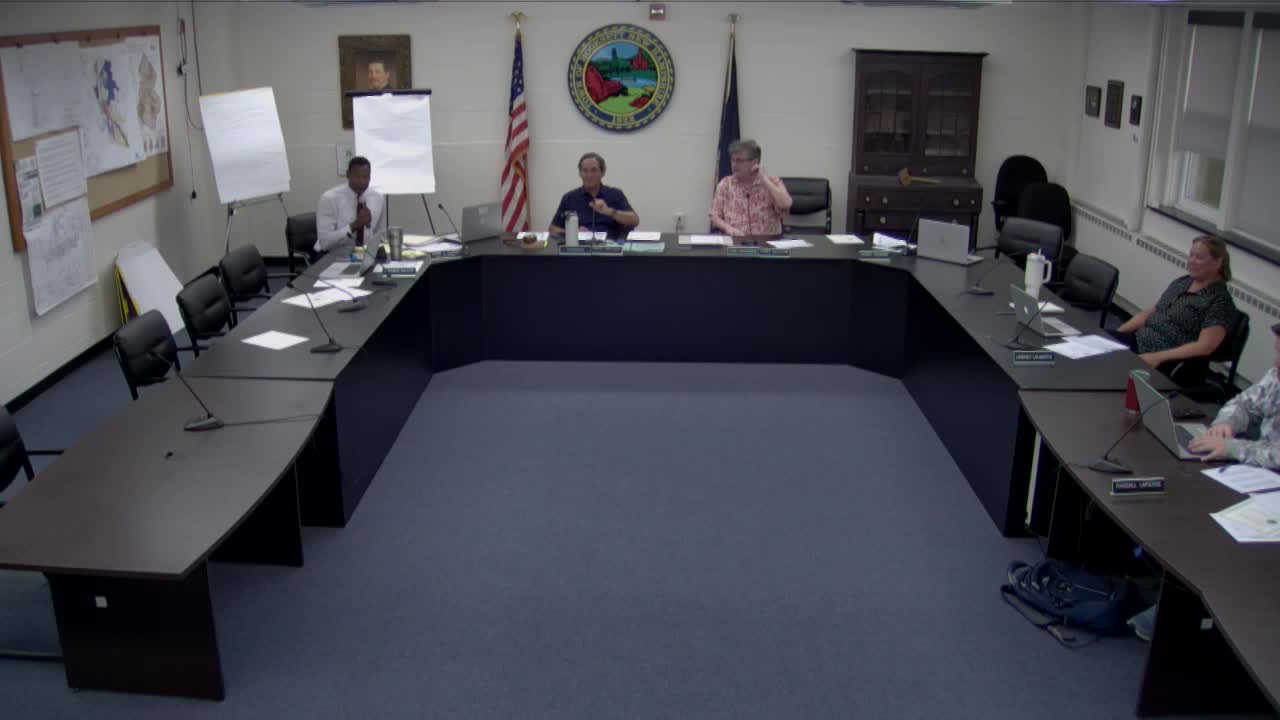
The Hooksett Town Council met in a workshop to review and prioritize 16 goals submitted by councilors and staff, then grouped and assigned those goals to smaller work teams for follow‑up.
The Hooksett Town Council met in a workshop to review and prioritize 16 goals submitted by councilors and staff, then grouped and assigned those goals to smaller work teams for follow‑up. Councilors placed passage of the municipal budget and public outreach about warrant articles and budget matters at the top of their short‑term priorities and directed staff and council representatives to pursue outreach and information from utilities, the New Hampshire Department of Environmental Services (DES) and local water precincts on water quality and infrastructure issues.
Council members organized the 16 goals into thematic categories — communication/outreach, safety/infrastructure, water resources, grants/financial capacity, open‑space/trails and development — then split the group into two teams (8 goals each) to develop more detailed action plans. Several items identified for near‑term follow up included contacting Eversource about double/abandoned utility poles, coordinating with code enforcement and the planning board on business parking lot striping and safety, and asking DES for renewed water testing and guidance for residents on Farmer Road and Auburn Road.
Why it matters: Councilors said better communication about warrant articles and the budget could increase voter understanding and improve the chances of getting a budget passed. Separately, prior water testing in parts of Hooksett identified elevated uranium and radon readings, so the council flagged coordination with DES and the Hooksett Village Water Precinct as necessary next steps for any town role in remediation or resident assistance.
Key directions and follow‑up the council recorded during the workshop included: splitting the 16 goals into two workgroups to develop categories and subgoals; asking staff or council designees to contact Eversource about removing obsolete poles and to request pole‑location/work‑order lists; asking staff to reach out to DES to reconvene public information and testing for affected neighborhoods (Farmer/Auburn/Palmer areas); asking the Hooksett Village Water Precinct for comment on reactivating a wellhead protection program; and requesting regular updates from the planning board and economic development committee on the College Park Drive/Cigna/Heads Pond properties now owned by developer Brady Sullivan.
On water: Councilors recalled a prior feasibility analysis funded in part with about $12,000 in ARPA funds that examined options for extending public water to parts of town. Speakers noted the earlier DES testing expanded from an initial cluster to a substantially larger group of houses when elevated uranium results appeared; the transcript indicates the study grew to roughly a few hundred homes (the speaker referenced “about 300 houses” when describing how DES expanded sampling). Councilors asked staff to seek DES guidance on next steps for residents and whether grant or other funding options exist to help households that choose remediation or new connections.
On infrastructure and safety: The council renewed its goal to press Eversource and other utilities to remove obsolete poles, citing sidewalk encroachment and safety hazards from poles left in place after new pole sets were installed. Councilors also asked code enforcement and the planning board to revisit parking‑lot striping and maintenance requirements (examples named included the Tap House seating, Home Depot, and Kmart Plaza), so worn striping that directs pedestrian/vehicle circulation is repainted. Martins Ferry Road and Auburn Road were cited as examples of locations needing funding review and possible alternative funding sources.
On grants and capacity: Councilors recommended a short‑term effort to create a “playbook” or template for grant seeking — who writes grants, timing, legal review requirements and common funding sources — and mentioned resources such as the Southern New Hampshire Planning Commission (SNHPC) Community Technical Assistance Program and NHMA materials as models to adapt.
On open space and conservation: The council endorsed leveraging neighboring plans (Bow and Pembroke) to develop a municipal open‑space/trail system, noted Hooksett is a gap in the Granite State Rail Trail, and discussed conservation easements for large undeveloped parcels while emphasizing the need to secure public access if land is conserved.
On development: Councilors asked for periodic updates from the planning board and economic development committee on the College Park Drive/Heds Pond/Cigna area, where the developer Brady Sullivan owns parcels. Councilors asked the planning board to return with progress reports and opportunities for council input so town policy preferences and infrastructure needs can be considered before plans are finalized.
Decisions vs. discussion: The workshop produced a series of council directions and assignments rather than ordinance votes or regulatory changes. Councilors agreed to (1) split the 16 goals into two work teams, (2) prioritize budget outreach and communication as an immediate objective, and (3) have staff and council liaisons contact outside agencies (Eversource, DES, water precincts, planning board) and return with more information. No binding ordinance or budget was adopted at the session.
Votes at a glance: The only formal recorded motion during the session was a procedural motion to adjourn at meeting end; it was moved, seconded and carried by voice vote.
What’s next: Councilors set a follow‑up process in which the two work teams will refine categories and subgoals, and staff will begin outreach to the named agencies and boards. Councilors also requested periodic updates so progress on the master‑plan objectives, water outreach and development monitoring can be reported at future council meetings.
Ending: The workshop concluded with councilors agreeing on priority categories and next steps to convert the list of 16 submitted goals into actionable short‑, mid‑ and long‑term work plans.