Get Full Government Meeting Transcripts, Videos, & Alerts Forever!
Get email alerts on the Subdivision Replat topic
No spam. Unsubscribe anytime.
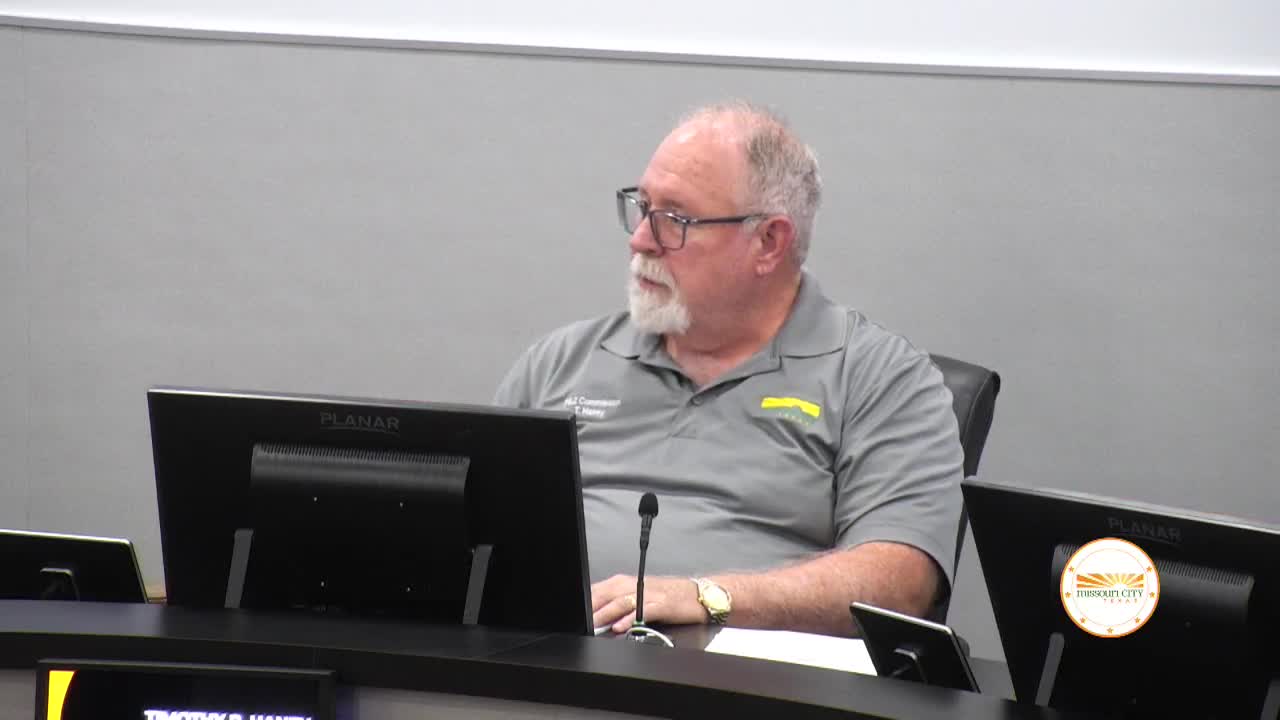
Missouri City planning commission denies replat of Oyster Creek Farms Estates after residents protest groundwater, lot-splitting concerns
Summary
The Planning and Zoning Commission voted to deny a proposed replat of Oyster Creek Farms Estates on Underwood after residents raised groundwater, well interference and notice concerns. Staff had recommended conditional approval pending an engineer—ertification of adequate groundwater.
The Missouri City Planning and Zoning Commission on Aug. 11 denied a proposed replat of Oyster Creek Farms Estates on Underwood, following public comment from residents who said nearly all neighboring owners within 200 feet oppose subdividing the property.
The commission voted to deny the replat after hearing that staff recommended approval only with conditions, including a certification by a professional engineer that adequate groundwater exists to support any additional wells the subdivision change would allow. The applicant listed in the agenda was Seth David Passoeba of Texas Tejas Surveying, filing on behalf of Alejandro Berman Reiser.
Staff told the commission that state law requires an engineer—ertification when a proposed subdivision would add private wells. "Due to the Texas code 212010, a certification by an engineer stating that adequate groundwater is available for the subdivision" was a stated condition, staff said. Assistant City Manager Shashi Kumar also told commissioners the city has no current capital plan or funding to extend public water and sewer to the area, and that the parcels sit in long-range plans but are not slated for near-term public utilities.
Neighbors who spoke at the public hearing said the subdivision, historically built with well-and-septic systems, cannot support more wells without harming existing users. Sharon Jerissa, speaking for a group of neighbors, said residents submitted signed protests from 10 of 11 lots within the statutory 200-foot notice zone and that the eleventh owner, who was out of town, is also against the replat. "We have presented you with 10 of the 11 lots protesting this division of the lot," Jerissa said, adding later that "it's 100% of all lots within 200 feet are against the subdividing of the lot."
Residents cited local hydrology and recent deeper redrilled wells as evidence that water tables have been falling, and also told the commission that a nearby municipal utility district (MUD) well pumps adjacent to the subdivision boundary. Those speakers said runoff and a leaking levee near Flat Bank Creek have caused red water and subsidence on some properties.
Commissioners raised procedural and precedent concerns, noting a separate board had earlier granted a variance allowing private water and wastewater systems. Staff confirmed a variance had been granted July 24 by a construction/adjustment and appeals board for the private water and wastewater disposal system. Commissioners said that, given previous denials of other subdivision requests in the area and residents' concerns, they were uneasy approving a replat that could enable more wells without the engineer's study in hand.
After discussion, a commissioner moved to deny the replat; a second was recorded and the motion passed. The commission did not record individual roll-call votes in the public transcript excerpt. The commission also withdrew consideration of a separate, related parkland dedication item because, with the replat denied, the dedication was no longer required.
Staff and commissioners said the applicant could return with the required engineering certification and related survey work; commissioners noted replat or variance requests can be resubmitted after the necessary technical studies are completed.
The hearing drew multiple residents and several sustained public comments; commissioners said the item had generated significant neighborhood engagement and questions about when previous approvals were made.
The denial leaves the property in its current platted status; any future replat approval would hinge on providing the groundwater certification and satisfying any city code requirements, including parkland dedication if a replat is later approved.