Get Full Government Meeting Transcripts, Videos, & Alerts Forever!
Get email alerts on the Court Budget Services topic
No spam. Unsubscribe anytime.
Marion Superior Court outlines FY2026 budget, highlights Family & Youth Intervention Center and expansion of legal kiosks
Summary
Marion Superior Court presenters described a largely flat funding request for county support, explained a larger grant-driven increase tied to the new Family & Youth Intervention Center and discussed legal kiosks, community service work and impacts from grant cuts.
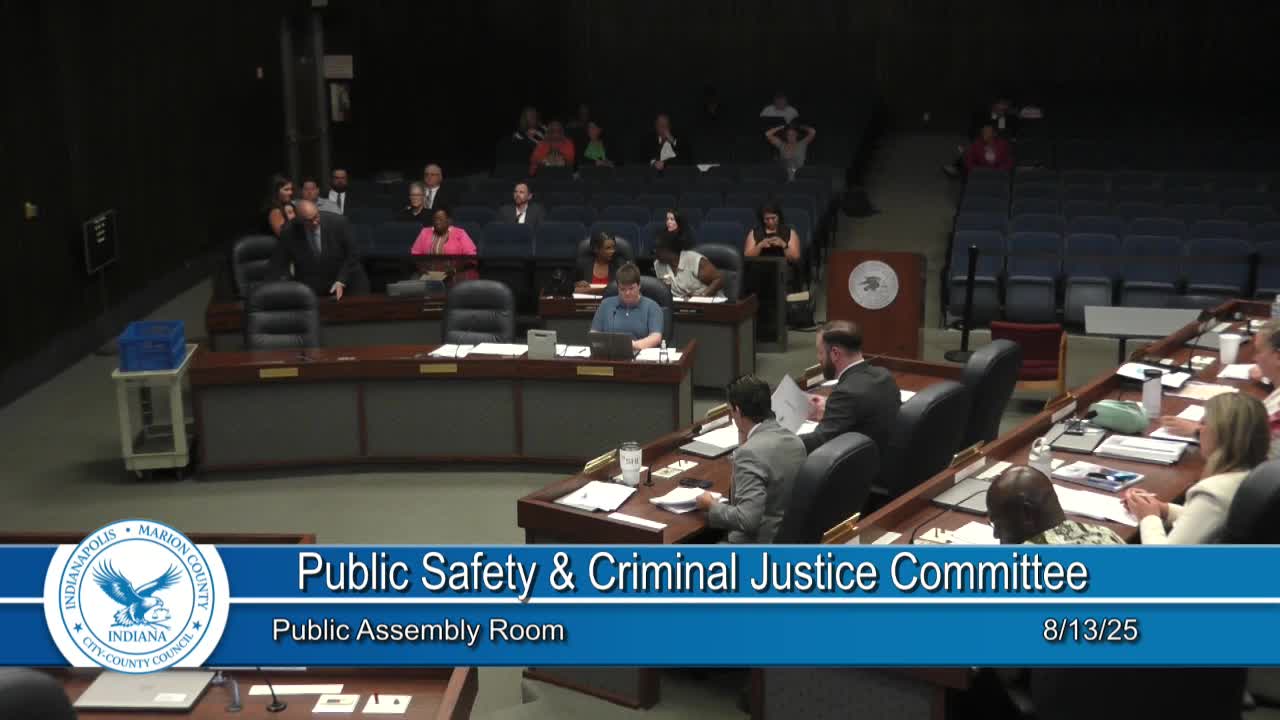
Marc Rothenberg, presiding judge of Marion Superior Court, told the committee on Aug. 13, 2025, that Superior Court is not requesting a general increase from the county but has seen grant-funded budget changes tied to new programs including the Family and Youth Intervention Center at 20 Fifth and Keystone.
"Since opening in June 2022, 34,000 visits have been clocked," Judge Rothenberg said of the court ffiliated Legal Resource Center, which offers self-represented litigants research assistance and navigators.
Rothenberg said the court's reported $698,000 increase in one budget character was largely driven by grant funding rather than a county request, and pointed to a $1,663,000 grant increase attached to the Family and Youth Intervention Center. He told councilors that some state grants supporting problem-solving courts were reduced by about 13% and that the court was seeking innovative ways to maintain services.
Councilors asked specific operational questions. Councilor Dan Boos inquired about eviction dockets and whether evictions were being funneled to a single court; Rothenberg explained eviction cases may be filed in small claims or superior court and said Superior Court Judge McMath handles a centralized eviction docket, though small-claims filings also occur. On legal kiosks used for probation reporting and self-service functions, Chief Kroll (probation) said her goal is to place a kiosk in every township but noted a recurring vendor cost: "If I can come up with about $14,000 a year, I can put 1 everywhere. It's a matter of about $15.75 dollars starting next year per kiosk per month," she said, and added that townships provide power and internet while the court covers kiosk costs.
On community service work, the court reported about 3,500 community service hours last year and ongoing monitoring by a designated staffer. Councilors raised concerns about year-to-year fluctuation in community service hours and potential needs for additional staff if volumes increase.
Rothenberg and court administrators also described indigency processes used to determine whether defendants should be assessed fees, noting a recent state appellate decision requiring indigency hearings to determine whether bond payments could be used to satisfy court costs. "Even if there is a bond paid, the court has to have an indigency hearing and determine whether someone is indigent," Rothenberg said.
Court staff offered to provide more detailed program and grant breakdowns to the council's fiscal members and encouraged councilors to visit the Family and Youth Intervention Center to see services and partnerships funded in part by the Indiana Criminal Justice Institute and other grants.
No formal action or vote on funding was taken at the committee meeting; the presentation was for review and follow-up information was requested by council members.