Get Full Government Meeting Transcripts, Videos, & Alerts Forever!
Get email alerts on the Budget Revenue Policy topic
No spam. Unsubscribe anytime.
Lawmakers debate business tax cuts, refund estimates and use of excess revenues as budget gaps emerge
Summary
Senators pressed budget and tax officials about who would benefit from a proposed half‑point business privilege tax reduction, how recent federal tax law changes might increase local tax refunds, and whether the government should use audited fund balances or the rainy day fund to cover agency shortfalls.
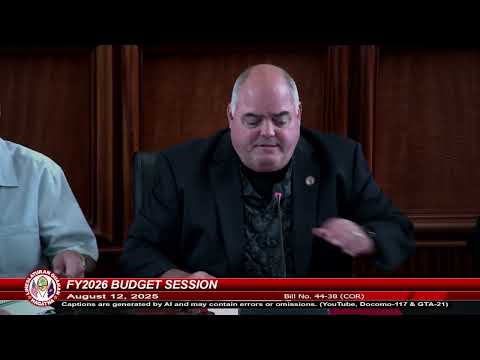
Lawmakers at a General Government budget hearing pressed revenue and budget officials for detail on a proposed business privilege tax (BPT) cut, the likely effect of recent federal tax law changes on local tax refunds, and whether surplus or audited fund balances should be used to plug shortfalls for agencies including the Guam Memorial Hospital (GMH) and behavioral health programs.
Senators challenged the framing that the BPT reduction primarily helps small businesses, pointing to data presented by revenue officials showing hundreds of taxpayers with gross receipts over $2 million. "It's not the small numbers that everyone believes it to be," said Director Lozama of Rev & Tax while answering senators’ questions about who would benefit. Officials reported roughly 680 taxpayers with gross receipts above $2 million; of those, dozens report multi‑million dollar revenues: 204 firms in the $5–$10 million band, 97 in the $10–$20 million band, 32 between $50–$200 million, and a small group of six in excess of $200 million.
Senators said that the combination of existing exemptions and the proposed half‑percent discount would shift benefits to profitable corporations. "We're not talking about the mom‑and‑pop Chodimart," one senator said, arguing the measure would mostly benefit larger firms. Officials confirmed that prior exemptions reduced the taxable base by roughly $3 billion, leaving an estimated taxable amount of about $6 billion in the sample cited.
Revenue officials also described a recent federal tax law change that could affect local collections and refunds. "We can only estimate at this time... personal taxes may change by about $8,000,000 and corporate returns about $10,000,000," said Mister Byrne, summarizing a preliminary estimate of the local effects of federal changes. Budget staff recommended increasing the line called "provision for refunds" to reflect a higher risk of refunds, with one official suggesting an additional $12 million be added and noting an $18 million judgment call tied to recent federal policy.
Panelists also returned to the question of fund balances and the rainy day fund. Officials said the current cash balance of the rainy day fund is about $56 million and that audited fund balances show an unassigned fund balance near $29 million. Some senators pressed policymakers to use fund balance dollars to cover pressing needs for GMH, public health, residential treatment and other programs; budget officials counseled caution, saying unassigned fund balance is finite and that the government should maintain a strong balance sheet.
On GMH specifically, officials acknowledged the hospital’s funding need and said statutory remittances tied to the BPT are calculated on the appropriation in the budget act, not on any year‑end excess. Senators asked whether excess revenues historically have been remitted to the hospital; officials said they have not remitted a share of excess revenues historically and that remittances are based on the adopted appropriation.
Lawmakers pressed for clearer fiscal offsets and urged staff to provide detailed fiscal notes showing which specific firms and revenue bands would benefit from the BPT change, and to quantify refinancing savings and refund pressure. No votes were taken during the hearing; several senators said they would pursue amendments to better target any tax relief and to restore local matches for federal programs where required to maintain federal funding.