Get Full Government Meeting Transcripts, Videos, & Alerts Forever!
Get email alerts on the Pud Accessory Setbacks topic
No spam. Unsubscribe anytime.
Planning commission denies request to loosen accessory-structure setbacks in Germany PUD
Summary
The Cottonwood Heights City Planning Commission on Aug. 6, 2025 denied a homeowner association request to amend accessory-structure setbacks within the Germany planned unit development, saying the issue is better handled as a citywide code text amendment.
The Cottonwood Heights City Planning Commission on Aug. 6, 2025 voted to deny a conditional-use permit request by Brent Johnson on behalf of the Jerney Master Association to amend accessory-structure setback rules in the Germany planned unit development.
Commissioners said the change would be precedent-setting and should be considered as a citywide zoning text amendment rather than a site-specific exception.
Staff said the application, listed as CUP-25-011, arose after homeowners in the Germany PUD built open-air accessory structures — pergolas, gazebos and similar features — on lots that are substantially smaller than the city’s standard R1A lots. Maverick, a city planner who presented an overview, told the commission that the Germany PUD lots average about 5,000–6,000 square feet, compared with the 8,000-square-foot standard for R1A zoning. Staff and the applicant met with the building and fire departments to confirm safety constraints and compliance requirements.
Brent Johnson, the applicant, said the association’s intent was to align rules with what he described as long-standing practices in the subdivision and to streamline requirements for smaller lots. "We're not trying to ask for any grandfathering in of structures that do not fit anything close to what's allowed under city code," Johnson said, adding that the HOA removed sheds from the application and limited the request to open-air structures. He told the commission there are roughly 36 accessory structures in the neighborhood; some have permits, some do not, and some will need removal if they cannot be brought into compliance.
Staff outlined the proposal discussed with building and fire officials: to permit reduced setbacks for open-air accessory structures within the Germany PUD, remove the required 6-foot minimum separation between structures in some cases, and set side- and rear-yard setbacks specific to the PUD (staff described a proposed 5-foot minimum in some circumstances). The building and fire departments provided conditional allowances but noted safety constraints: fire staff said there should be no gas pads under gazebos or pergolas and that some fire-resistance or opening limitations apply depending on proximity; building staff said reduced separation might be acceptable under code review but warned about openings and fire-resistance ratings when structures are close to property lines.
A resident commenter, Richard Herr, said his metal gazebo complies with the city's R1-8 standard and urged the commission not to impose a more restrictive height limit than the generally applicable zoning. "If the structures in our neighborhood are in compliance with R18, that we should not be forced to comply with something more restrictive that the HOA has just arbitrarily decided to make it," Herr said.
Commissioners debated whether the issue should be handled by a text amendment that would apply citywide rather than by granting a site-specific PUD change. Several commissioners noted that PUDs are intended to allow flexibility in design but warned that piecemeal exceptions could set a precedent and create inconsistent rules across neighborhoods. One commissioner suggested that if the commission found reduced setbacks appropriate for the Germany PUD, the same standard should be available to other smaller lots — an outcome that would require a formal code change.
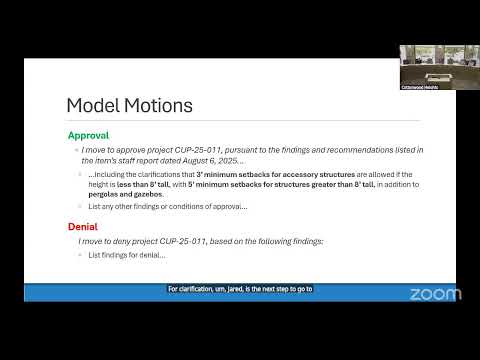
Commissioner Mills moved to deny CUP-25-011 "based on the finding that this would be precedent setting and we'd be better addressed as a text amendment in the code." Commissioner Paulson seconded the motion. The motion carried; recorded votes available in the actions section below. Following the vote, staff said the item would be tentatively added to the Aug. 19 City Council agenda for discussion and possible initiation of a text amendment.
The commission approved consent minutes for its July 16 meeting and closed the Aug. 6 session, noting the next planning commission meeting is scheduled for Sept. 3, 2025.