Get Full Government Meeting Transcripts, Videos, & Alerts Forever!
Get email alerts on the City Budget Employee Compensation topic
No spam. Unsubscribe anytime.
Roy City councilors review salary data, weigh tax and one‑time options to stop staff turnover
Summary
Councilors at a Roy City budget workshop focused on employee retention after staff presented a salary‑survey review showing turnover and pay gaps; councilors directed staff to model tax and pay scenarios ahead of a Truth in Taxation hearing on Aug. 19.
Mayor (name not specified) opened a workshop on the proposed Fiscal Year 2026 budget and told councilors the session was “a conversation that’s gonna help you to answer your questions to get you prepared so that you’re ready to take that vote on the nineteenth,” and asked them not to discuss how they would vote before public input is taken.
The meeting centered on employee retention and compensation after staff and councilors described a pattern of departures in public safety and public works and identified gaps between Roy City starting wages and those advertised by nearby jurisdictions. Councilors directed staff to prepare multiple budget and tax scenarios, including use and exclusion of a recently realized one‑time property sale, to present at the Truth in Taxation hearing on Aug. 19.
Why it matters: Council staff and the mayor framed employee turnover as a budget and operational risk for services such as fire, police and public works. Staff warned that without changes the city would face either service cuts or a property tax increase large enough to require public notice under state truth‑in‑taxation rules.
What staff presented
A staff overview and accompanying slides (presented by Matt and displayed by Britney) summarized the draft FY2026 general fund gap and a salary survey. The presentation said the draft budget first identified a need of roughly $7.75 million to balance the general fund but that figure had been narrowed in staff materials to about $450,000. The presentation also stated that, without additional cuts, the budget as proposed would require about a 9 percent property‑tax increase; Amber, city staff, later cited a more specific county estimate of about 8.77 percent.
Staff and the mayor highlighted turnover numbers that appear in the budget draft: “Over the past 12 months, we’ve had 25 full‑time employees leave for other employment. This equates to 16% of our full‑time staff,” and “Over the past 3 years, we have had 80 employees leave the city for other employment.” Those departures exclude retirements, the presenter said.
Salary survey findings and examples
The survey used by staff compared Roy positions with other cities and districts across the Wasatch Front but had limited comparable data for many Roy job classifications. The presenter said several critical entry‑level positions showed a significant gap between Roy’s starting pay and nearby postings: example figures cited during the meeting included an entry firefighter posting starting at $54,000 (Ogden) versus Roy’s $49,000; a public‑works maintenance starting wage in some jurisdictions at $22.75 per hour versus Roy’s $17.57; and other positions that had only one or two comparable matches in the sample.
The presenter emphasized small sample sizes for many job classes: “the rule of thumb is at least 30 data points for a minimum sample size to establish statistical significance,” and said many job titles in the survey had one or no true comparables.
Options discussed
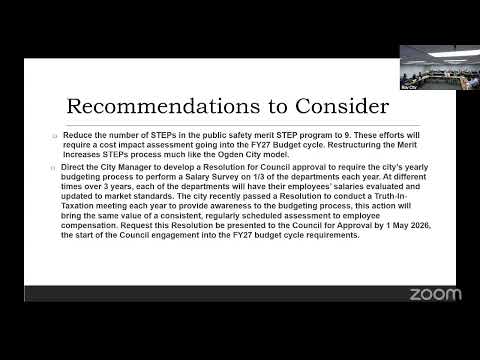
Councilors and staff discussed a combination of short‑term and longer‑term steps: (1) targeted near‑term increases to “stop the bleeding” in a handful of critical positions; (2) restructuring step and merit programs for general employees and public‑safety steps (one recommendation was reducing public‑safety steps from 12 to 9 to accelerate pay growth early in an employee’s career); and (3) adopting a formal schedule for periodic comprehensive salary surveys to avoid repeated ad hoc adjustments.
Staff cost estimates and constraints
Staff and councilors discussed cost estimates provided in the meeting: a typical annual COLA and step increase was estimated at about $1.2 million; a full rebaseline from a comprehensive salary survey was discussed in the range of roughly $1.7 million to $2.4 million; and a rule of thumb cited in the room was that a 1 percent property‑tax increase would raise roughly $50,000 in Roy. Councilors noted those figures would flow into the truth‑in‑taxation calculation and public hearing process.
Onetime funds and the ‘golden goose’ question
Councilors discussed a recent sale of city real property and the net proceeds staff proposed using in the current budget. Staff stated the property sold for $7.65 million with a cost basis and required transfers to the water fund; staff said the net available to the general fund was about $560,000 (the exact net was described as subject to accounting adjustments and public‑hearing requirements).
Several councilors cautioned against relying on one‑time proceeds to cover ongoing payroll costs. Others proposed using a portion of one‑time funds to target immediate, short‑term increases to lower‑paid employees while staff models sustainable options.
Council direction and next steps
Councilors did not adopt a final fiscal decision at the workshop. Instead they gave staff explicit direction to: prepare multiple scenarios for the Aug. 19 Truth in Taxation hearing showing (a) tax increases at several levels and what those levels would fund, (b) comparisons including and excluding the one‑time property sale proceeds, and (c) targeted short‑term compensation options for critical positions. The mayor asked that two council members be assigned to work with staff (Matt and Amber) and department heads to refine step‑program and salary survey recommendations. The presenter also requested that staff calculate the cost to fix eight specific positions identified as “bleeding” and report back within one to two weeks.
Adjournment
The council closed the workshop with a procedural motion to adjourn that passed unanimously.
Ending note
Councilors agreed there is no single, immediate solution and that the city will need a combination of targeted short‑term measures and a multi‑year plan to align pay scales with comparable jurisdictions while balancing the general fund. Staff will return with scenario costings and options for the Aug. 19 public hearing so the council can present choices to residents and, if needed, set a proposed property‑tax rate for truth‑in‑taxation notification.