Get Full Government Meeting Transcripts, Videos, & Alerts Forever!
Get email alerts on the Student Discipline topic
No spam. Unsubscribe anytime.
Mentor Exempted Village superintendent presents nine-part student-discipline plan after ad hoc review
Summary
Superintendent Keith Heath briefed the Mentor Exempted Village Board of Education on an ad hoc committee's report and nine recommendations to address bullying, social-media-related incidents, and repeat misbehavior; the board discussed matrices, anonymous reporting, parent outreach and a possible alternative-placement program.
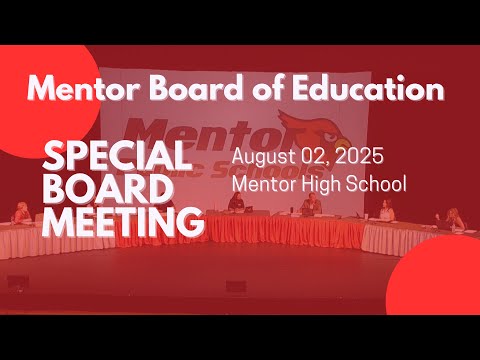
Superintendent Keith Heath on Aug. 2 presented an ad hoc committee's report and nine recommendations to address student discipline, social-media-driven incidents and repeat misbehavior in Mentor Exempted Village schools.
Heath told the board the district is finalizing end-of-year data and outlined steps that include districtwide discipline matrices, a simpler reporting system for students, expanded parent and student education on digital citizenship, proactive parent meetings for frequent offenders, improved transition planning between grade bands, student advisory groups, and a feasibility study of an alternative-placement program.
The plan is intended to align building practices and provide clearer expectations while preserving administrator discretion. "We can't suspend our way out of an issue. It's not the way it works," Heath said, framing the proposed mix of consequences and supports.
Why it matters: Board members said parents and students repeatedly flagged anonymous reporting and clearer consequences as priorities. The recommendations, if implemented, could change how repeated or social-media-related incidents are managed across elementary, middle and high schools and could affect use of suspensions, in-school alternatives and third-party behavioral supports.
Most important recommendations and next steps
- Discipline matrices: Heath said the district will finalize revised student-discipline matrices for each grade band and use them as guidance for administrators. The matrices will list minimum consequences for certain acts (for example, specified minimums for physical contact and for weapons or threats) but are not intended to remove administrator judgment in unique circumstances. The matrices will be reviewed with building administrators and communicated through a planned communication effort.
- Reporting options: The district will make the Safer Ohio School tip line more prominent on the website and review the tip line with PTA leaders. Heath said the district is also studying an anonymous internal reporting form (for example, a Google form or similar tool) to be implemented at low cost.
- Social media and parent education: The superintendent said the district will identify resources for student and parent education on social media and digital citizenship and will coordinate materials with the family engagement coordinator and student services staff. The board discussed using Cardinal Café sessions, social-work led parent nights and the expanded SRO (school resource officer) program as venues for education and outreach.
- School-based responses: The district will inventory PBIS (Positive Behavioral Interventions and Supports) and kindness initiatives already in place, meet with Kindland (the partner organization named in the report) to expand activities, and consider standardized use of in-school suspension where space and staffing permit.
- Proactive family engagement and transitions: Heath said administrative staff will contact families of students identified as the most frequent participants in incidents and will work with principals to carry no-contact agreements and behavior plans forward from elementary to middle school and from middle to high school to reduce incidents at grade transitions.
- Student advisory groups: The superintendent recommended continuing and expanding student advisory groups at the high-school level and starting groups at middle and elementary levels to gather student perspectives on bullying and discipline.
- Alternative-placement feasibility study: The district will study a longer-term alternative-placement program to provide short-term structured support for students removed from comprehensive classrooms. Heath listed potential partners (behavior specialists, Crossroads/Signature Health, ESCs) and said the CARES classroom already provides a model for some special-education placements. He said Garfield (a district-owned building under consideration) may offer space but would require infrastructure, safety and restroom work and would carry staffing and financial costs.
- Data and evaluation: The district will finalize a data link and baseline measures comparing pre-COVID, during-COVID and post-COVID years and will identify outcome measures to evaluate the effectiveness of each recommendation.
Board discussion and concerns
Board members asked for clarity on (1) how minimum consequences will be presented to parents, (2) where revised matrices will be posted, (3) how anonymous reporting will be implemented, (4) how no-contact agreements will be enforced during class transitions and (5) how disciplinary consequences interact with special-education protections and IEP requirements. Heath said some consequences for students with disabilities are limited by federal/state law but can be addressed within IEP processes and with alternative supports.
Heath emphasized communication: some items will roll out at the start of the school year; others will be phased in with principals and communicated to families through PTA channels, Cardinal Cafe9 events and school websites.
No formal board action was taken on the ad hoc committee recommendations at the meeting; the superintendent requested feedback and outlined implementation steps and data collection to measure impact.
Ending
The board continued into routine personnel and finance business after the discipline discussion. The superintendent and administration said they will return to the board with finalized matrices, the completed data link and updates on feasibility work for an alternative-placement program.