Get Full Government Meeting Transcripts, Videos, & Alerts Forever!
Get email alerts on the Housing Landlord Engagement topic
No spam. Unsubscribe anytime.
Larimer County highlights landlord engagement program to expand rental access and support reentry
Summary
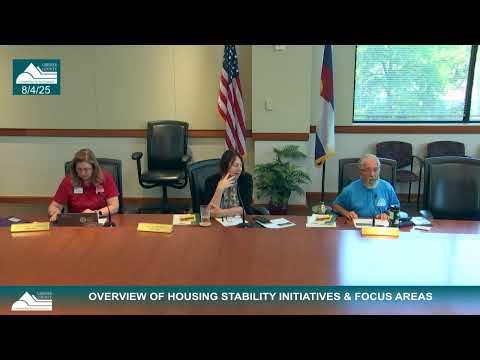
At an Aug. 4 Larimer County work session, county staff and partners reviewed the Housing Partners of Larimer landlord engagement program, detailing signing bonuses, risk-mitigation funds, landlord education and early program results while commissioners pressed for data, funding sources and follow-up on mobile-home and eviction questions.
Larimer County officials presented updates on the county’s Office of Housing Stability and its Housing Partners of Larimer landlord engagement program during a work session on Aug. 4, 2025, telling the county commissioners the program is intended to recruit and retain landlords willing to lease to tenants who face screening barriers and to coordinate regional housing efforts.
Laura Walker, Larimer County director of human and economic health, told the board the office is pursuing countywide coordination, land-use reform and expanded resources as part of a Larimer County housing strategy. Walker said the county has hired Root Policy to complete a housing needs assessment that, she said, responds to “senate bill 24 1 74” and is funded with a grant from the state Department of Local Affairs and contributions from the cities of Fort Collins and Loveland.
The assessment will feed local housing action planning, Walker said, and county staff also described work to implement funds from Proposition 123, a statewide ballot measure. The county “opted in and committed to preserving or creating 112 units across the 3 year commitment,” staff said, and county presenters said they were coordinating regionally through a Proposition 123 summit and ongoing collaboration with municipalities.
Why it matters: Larimer County officials said the program aims to increase the number of rental units available for people who otherwise face barriers—people using housing vouchers, justice-involved residents reentering the community, older adults and others—by giving landlords financial incentives, administrative support and a single point of contact for tenant referrals and follow-up.
Alexandra “Lexi” Valente, the county’s housing liaison and program coordinator for Housing Partners of Larimer, described the program’s incentives and services. “We’re trying to centralize all of our rental units, into 1 place,” Valente said, explaining the county’s aim to create a searchable, centralized set of rental opportunities and to make it easier for case managers and tenants to find housing. The program offers signing bonuses of $500–$1,000 (higher for landlords new to voucher holders or who accept Community Justice Alternatives referrals), $3,500 in risk-mitigation/damage funds per lease-up, referral bonuses for landlords who recruit other landlords, payment for interpretation at lease signings and coverage of the City of Fort Collins initial registration fee when applicable.
Valente said referrals to landlords come with wraparound supports: many tenants arrive with a housing voucher or rental assistance and a case manager who prepares an applicant cover letter and provides ongoing follow-up. Those supports allow the program to promote “holistic screening criteria,” she said: rather than disqualifying applicants for a single deficiency (for example, a low credit score), landlords are encouraged to consider overall tenant readiness and the supports available through the program. Valente also listed regular landlord education offerings—four formal sessions a year and periodic coffee chats—covering topics from energy-efficiency rebates to voucher processes.
Property owner Marcy, who identified herself as facilitator for Nova Stella (a small local property investor group), described working with the program in Loveland. Marcy said the program’s single point of contact mattered: “I can make 1 phone call and say, hey. I have a tenant that needs help… And she has been an awesome resource for that.” She described capital improvements to a small multiunit building she manages and said program staff have helped speed inspections, coordinate supports and respond when tenants need short-term help.
Mindy Walker, a supervisor with Community Corrections, said the partnership reduced stigma and helped match justice-involved residents who were housing-ready with landlords open to second-chance tenants. “This partnership and relationship has really helped us identify and connect landlords with individuals that are justice involved,” Walker said, adding that continued case management and home visits provide landlords with a local contact and follow-up if issues arise.
Program early results and outreach: Staff reported a modest but growing network since the program launched its site in August 2024. As of July 2025, the program reported 12 local landlords or managers under partner agreements, 36 properties (75 units), six completed lease-ups and 198 resource guides distributed (120 English, 78 Spanish). The county said the program has hosted nine landlord education events, distributed a newsletter (115 subscribers, 65% open rate) and made more than 75 unique landlord outreach contacts.
Commissioners’ questions and follow-ups: Commissioners pressed staff for additional data and clarified funding sources. One commissioner asked whether eviction filings have risen locally; staff said filings have not spiked in Larimer County but are continuing and that funding for eviction prevention has declined since COVID. Commissioners also asked for clarity on Proposition 123 revenue and on whether large sums exist for mobile-home park purchases; staff said they would follow up and that some of those state funds are difficult to access and subject to program rules.
Staff also flagged other regional work: the county is coordinating with the Northern Colorado Continuum of Care and Homeward Alliance on a homelessness strategic plan, and county staff said Root Policy will complete a housing needs assessment to inform local housing action plans required under the referenced state bill.
What’s next: Staff told commissioners they plan additional landlord outreach, continued education events and work to increase landlord participation and long-term sustainability. Commissioners suggested pursuing education, philanthropic partners and stable funding to maintain incentives and landlord supports. Staff said they will return with more details on eviction trends, Proposition 123 implementation and mobile-home park funding options.
The presentation and question-and-answer portion closed with county staff offering contact information and an invitation for landlords to meet individually with program staff to learn more.