Get Full Government Meeting Transcripts, Videos, & Alerts Forever!
Get email alerts on the State Budget topic
No spam. Unsubscribe anytime.
Committee hears state budget gains for shared revenue, municipal services, roads, water and a new film tax credit
Summary
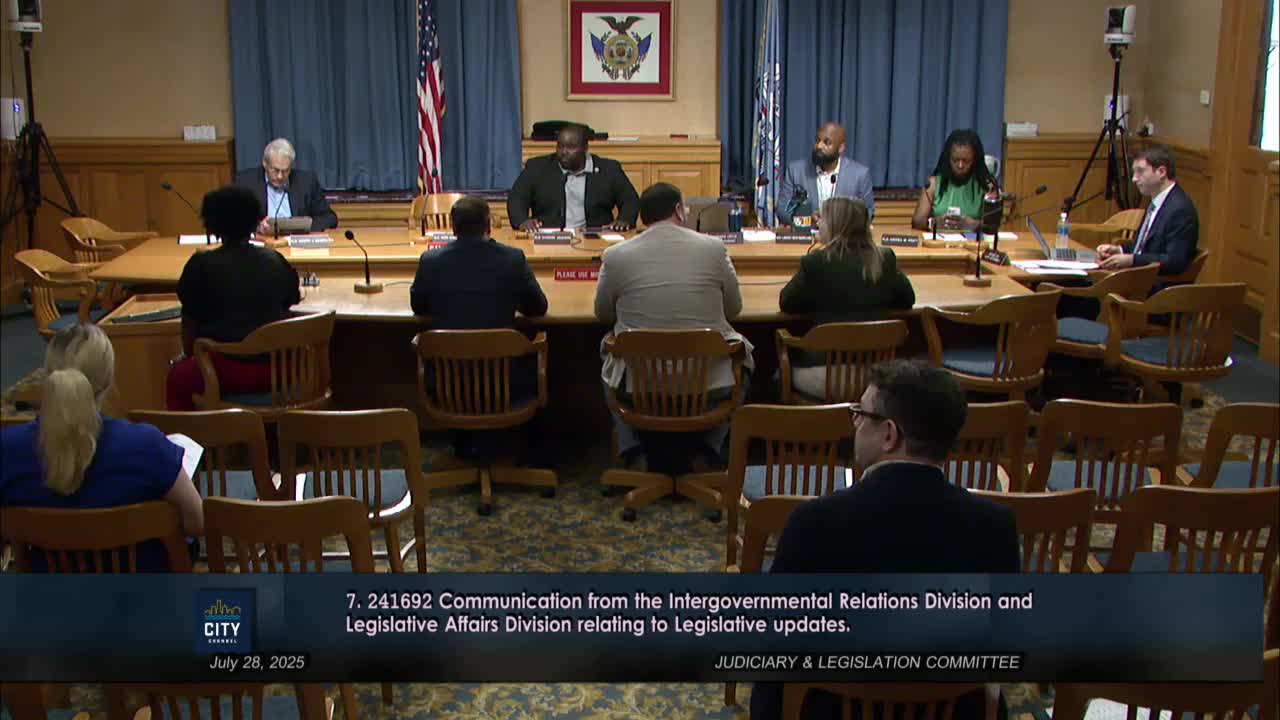
City intergovernmental relations staff briefed the Judiciary and Legislation Committee on 2025 state budget provisions that increase shared revenue, municipal services reimbursements, general transportation aids and environmental bonding authority, and create a state film office and tax credit program.
Katie Yeager, Intergovernmental Relations Division, told the Milwaukee Common Council Judiciary and Legislation Committee on July 28, 2025, that the recently passed state budget includes modest increases that will produce new revenue for the city, plus a new state film office and tax credit program.
Yeager said the budget calls for a 2.3% shared-revenue payment increase in the first year, followed by a 3.4% increase in the next year, with a state estimate of about 2.9% in 2027. "For the first time in over 20 years, the city is seeing annual increases in shared revenue payments from the state," she said.
Yeager also described an approximately $7 million increase in the state’s payments for municipal services—money the state pays municipalities that host exempt state properties—projecting that Milwaukee’s share will be roughly $900,000 once the Department of Administration and Department of Revenue finalize estimates. "This will push the reimbursement rate for the services the city's providing…to about 50% of the cost," she said.
The committee heard the budget also boosts general transportation aids (GTA) by about 3% in each year of the biennium. Yeager said, "A rough estimate, if all of those numbers stay the same, with a 3% increase, we could expect an increase of around $800,000 for the city." Committee members raised longstanding concerns that GTA funds have not kept pace with local needs.
Yeager said the Environmental Improvement Fund (EIF) received a major increase in revenue obligation bonding authority, rising from roughly $46,000,000 in the previous budget cycle to approximately $732,300,000 in the new budget. She described the EIF as a revolving loan program that provides low-interest loans for water infrastructure projects and said the increase will help draw down federal funds and reduce delays.
The briefing also covered a new state film office and tax credit program in the Department of Tourism. Yeager said the program will fund a director and other capacity to market Wisconsin and attract film and TV production. "This means jobs when TV production comes," she said, noting local stakeholders such as VISIT Milwaukee and IMAGINE MKE had advocated for the change.
Yeager and other staff also summarized smaller items the committee sought: protection of existing funding levels for the Milwaukee Summer Youth Jobs "Earn and Learn" program and some childcare investment language in the budget package. Committee members asked follow-up questions about which city departments would lead applications for EIF bonding and timing for grant applications; Yeager said Milwaukee Water Works and the Department of Public Works would coordinate those efforts.
Alderman James Bergellis and other members pressed for a clearer accounting of how much of statewide road funding reaches Milwaukee. Yeager and Jordan Permoco of Intergovernmental Relations acknowledged the city receives a small share relative to the miles of roadway it maintains and said they would follow up with more detailed calculations.
The presentation closed without committee votes; staff said they would return to the committee as needed on particular grant-application deadlines and department coordination.