Get Full Government Meeting Transcripts, Videos, & Alerts Forever!
Get email alerts on the Emergency Services District topic
No spam. Unsubscribe anytime.
Collin County commissioners call November election to create Emergency Services District No. 1
Summary
After a public hearing and broad public comment, Collin County Commissioners Court set boundaries based on municipal ETJ consents and voted 5–0 to call a Nov. 4 election to confirm creation of Collin County Emergency Services District No. 1.
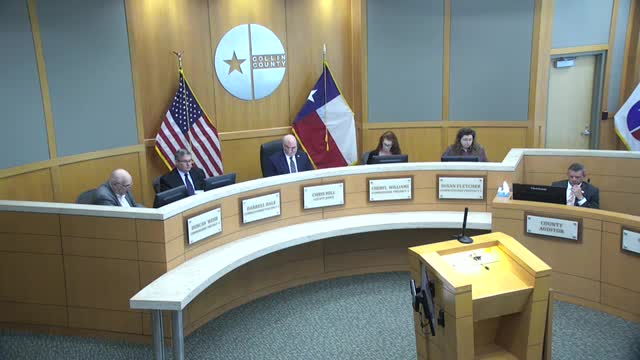
Collin County Commissioners Court on Tuesday voted 5–0 to set the boundaries and call a Nov. 4 election to ask voters to confirm creation of Collin County Emergency Services District No. 1.
County Administrator Yoon Kim opened the court’s public hearing by saying the county had received a petition on Feb. 6 and, after accepting it in open court on Feb. 24, gave notice to cities whose extraterritorial jurisdictions (ETJs) had been included. Kim said the petition proposed a district that would cover the county’s unincorporated area and city ETJs that consented to inclusion; several cities declined to consent. The commissioners’ immediate actions were to hold the public hearing, set the district boundaries based on ETJ consents, determine whether the proposed district would promote public safety, welfare and health as required by state law (Health and Safety Code §775.016), and call the election with ballot language.
The court heard more than two hours of public comment, including multiple statements from local fire leaders. Stuart Blassingame, identified as president of the Collin County Fire Chiefs Association, read a statement of principles that called for contracted fire and EMS services (not a county-run fire department), a five-member board appointed by commissioners, and steps to avoid “double taxation” for residents of municipal utility districts (MUDs).
Several residents and elected officials urged the court to avoid a coverage gap between when cities said they would stop providing contracted services and when an elected ESD board could begin operations. Commissioners repeatedly told the public that the court’s goal is “seamless coverage” countywide; Commissioner comments and staff responses indicated the court is working with municipal partners to extend contracts while the ESD process proceeds. Kim said McKinney had agreed to extend its contract, while Farmersville and Wiley were in conversation with the county. Princeton had provided notice of termination effective Oct. 1 and was still negotiating, Kim said.
Speakers at the hearing raised two recurring concerns: whether residents who live inside municipal ETJs but outside city limits (or inside MUDs) would be double-taxed, and how the county would pay for temporary gap coverage if cities withdraw before an ESD could begin collecting taxes. Kim and other county staff told the court they had taken the county’s resolution against double taxation into account when calculating preliminary taxable values. Kim said the court is not setting a tax rate; if voters approve the district the ESD board would set the initial rate. Using preliminary tax rolls and a conservative 90% capture of taxable value, staff estimated a 10-cent tax rate would raise about $9.5 million (staff emphasized the court is not setting a rate at this meeting). Kim also said the appraisal district could not provide fully certified estimates because its system is locked until it certifies tax rolls.
Public commenters offered a range of views. Some urged passage, warning of higher homeowners insurance rates, lower land values and reduced fire protection if the district is not approved. Others urged smaller, multiple districts instead of a single countywide ESD, citing variation in local needs and a risk of a “race to the highest tax rate.” Several people asked whether residents who live partly in two ETJs or in a MUD would be included and how contracts would be handled; staff said these are matters for the ESD board and for contract negotiations, but that MUD residents would vote and could be included subject to the court’s boundary decision.
After the hearing and short discussion among the commissioners, Commissioner Webb moved to adopt the court’s proposed order to set boundaries and call an election; the motion was seconded and approved unanimously. Judge and commissioners completed the formal vote, and the court directed staff to post the ballot language and take other steps necessary to place the measure on the Nov. 4 ballot.
The court’s action on Tuesday did not set a tax rate, appoint any board members, nor create the ESD until voters confirm it. Kim and other staff noted the earliest the district could begin operations (and levy a tax) would be its next budget year dependent on board appointments and statutory steps; they reiterated the court’s preference for minimizing any service gap and said county staff will continue to work with municipal partners to extend existing contracts where possible.
Votes at a glance Commissioners Court — Motion to set boundaries for Emergency Services District No. 1, determine feasibility and call a ballot election for Nov. 4, 2025. Motion: approve as presented. Result: approved 5–0.
Why this matters If approved by voters, ESD No. 1 would become a new special taxing district covering the unincorporated parts of Collin County and ETJs where cities consented. The ESD could levy a property tax to fund fire and emergency medical services in parts of the county where municipal contracts are ending or insufficient to meet demand; the decision shifts the financial decision to local voters and a future ESD board rather than to the county commissioners’ court to set a rate.
What the court did not do The court did not set an ESD tax rate, appoint any members to an ESD board, or change any existing municipal or city contracts. Those issues were identified as matters for the future ESD board, the voters, and ongoing contract negotiations with cities.
Proper names mentioned Collin County; County Administrator Yoon Kim; Collin County Fire Chiefs Association; municipal utility districts (MUDs); City of McKinney; City of Farmersville; City of Wiley; City of Princeton.
Sources and evidence - County Administrator presentation on the petition, ETJ consents, and preliminary taxable-value estimates (public hearing) - Public-comment record and on-the-record remarks by citizens and agency representatives - Commissioners Court roll call vote (5–0 to call election)
Provenance topicintro: {"block_id":"block_428.16","local_start":0,"local_end":183,"evidence_excerpt":"So at this time, we will move to our public hearing on the creation of the County Emergency Services District number 1. That is item 2 a on our agenda...","reason_code":"topicintro"} topicfinish: {"block_id":"block_7008.01","local_start":0,"local_end":93,"evidence_excerpt":"Motion carries 5 to 0. So there will be an ESD election in November as you've heard about today...","reason_code":"topicfinish"}