Get Full Government Meeting Transcripts, Videos, & Alerts Forever!
Get email alerts on the Rental Inspection Program topic
No spam. Unsubscribe anytime.
Richmond committee delays residential rental inspection ordinance after hours of public comment
Summary
The Land Use, Housing and Transportation Standing Committee heard a lengthy presentation and public testimony on a proposed residential rental inspection program (RRIP), debated criteria and implementation concerns and voted to continue the ordinance to September for amendments.
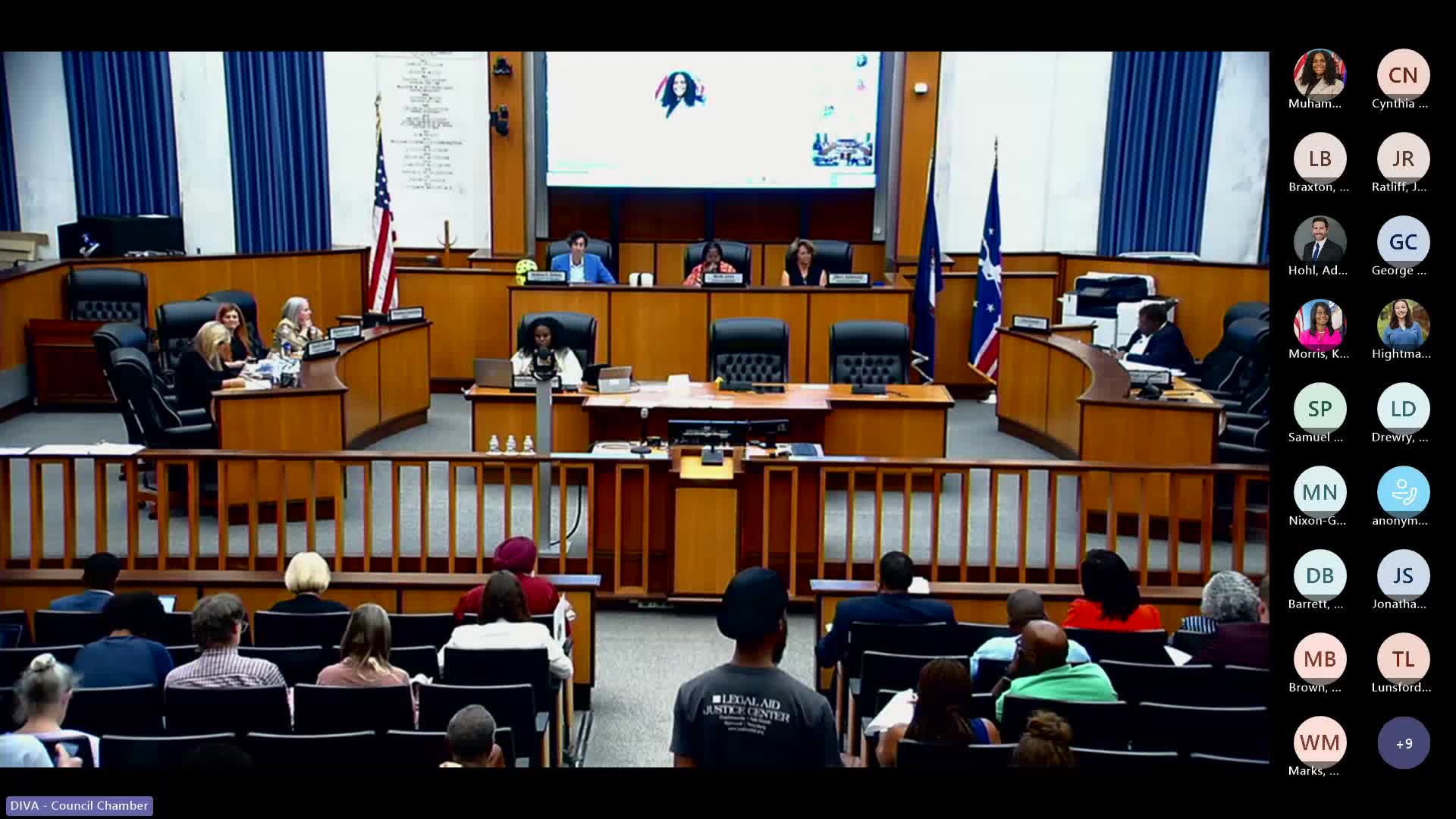
The Land Use, Housing and Transportation Standing Committee on Tuesday heard detailed staff testimony and nearly three hours of public comment on a proposed residential rental inspection program and voted to continue the ordinance to the committee's September meeting for amendments.
Kevin J. Bonk, director for planning and development review, told the committee the ordinance would establish a city-run program to permit proactive inspections of residential rental dwelling units under authority in the Code of Virginia. "It is something that promotes safe, decent, and sanitary housing in residential rental dwelling units, in a matter consistent with law and authority set forth in, these sections of Code of Virginia," Bonk said, and described the program's main features: an initial proactive inspection, periodic inspections no more than once per calendar year, transfer-triggered inspections, and a 10% sampling rule for properties with 10 or more units with a requirement to inspect all units in a complex if a sampled unit contains a violation. Bonk said new-construction units or units that passed inspection would be exempt from periodic and transfer inspections for 48 (as stated in the presentation).
The presentation stressed that the ordinance itself would only establish the RRIP; no properties would be inspected until council separately designates inspection districts or specific parcels to include. "There are no units that will be inspected if this ordinance is adopted," Bonk told the committee. Any future additions of units to the program must come back to council as separate ordinance action, he said.
Public testimony divided mainly between tenant organizers and public-housing residents urging adoption and landlords and industry groups urging a narrower, targeted approach. Omar El Kadafi, identifying himself as "a senior community organizer at Legal Aid Justice Center and a public housing subject matter expert," said the proposal would help residents who fear retaliation and lack practical remedies. "They know they don't have to fix anything now," he said, describing examples he has seen where tenants hesitate to report problems.
Multiple tenant organizers and residents, including Rachel Hefner (tenant organizer who said she has worked two and a half years on this issue) and Anita Devon (a Gilpin Court resident), described health and safety problems they said could have been prevented or mitigated by inspections. "It took me a year just to get maintenance to come to my place to fix the mold, and my son was sick for a whole year," Devon said.
Opposition came from several landlord and industry representatives who supported targeted enforcement against so-called "bad actors" but warned the proposed language was broad enough to stigmatize neighborhoods and capture responsibly managed properties. Latoya Washington, speaking as a property owner, said the ordinance as drafted "raises serious concerns, particularly for small independent landlords like me who operate on very tight budgets." The Homebuilding Association of Richmond, the Virginia Apartment Management Association and the Richmond Association of Realtors each urged narrower criteria, exemptions for professionally managed properties, and clearer ties between the triggers listed in the ordinance and actual building-code violations.
Committee members pressed staff on several points raised in testimony: the data available to justify districts, whether emergency response calls can be matched to building-code violations, the mechanics of inspecting large multifamily complexes and the program's limits with respect to preventing evictions or controlling rents. Bonk and other staff said they can provide police, fire and building-violation data for a four-year lookback and that tenant petitions would be an appropriate, discretionary factor to weigh in drafting districts. The presentation acknowledged implementation constraints, including current inspection staff capacity and the need for an operational plan to handle temporary housing or relocation when units are found unsafe.
Several speakers suggested specific ordinance edits. Paul Fleisher of Virginia Organizing recommended replacing the draft's use of the term "blighted" with "deteriorating" (citing Code of Virginia language), requiring tenant notice in addition to owner notice when districts are created, shortening a proposed 90-day waiting period before initial inspections, and raising the minimum number of units inspected in very large developments above the proposed floor of two units.
After the public hearing and discussion, the committee voted to continue the ordinance so staff can draft amendments reflecting the concerns raised. Councilor Arthur Burton moved to continue the paper to the September Land Use, Housing and Transportation Standing Committee meeting; the motion passed with recorded votes of Burton: Aye; Vice Chair Robertson: Aye; Chair Jones: Aye.
The committee directed staff to return with proposed amendments and additional data on the criteria that could be used to select districts, an implementation plan that describes inspection capacity and temporary-housing options in case units must be taken offline, and language options addressing tenant notifications and rights education.