Get Full Government Meeting Transcripts, Videos, & Alerts Forever!
Get email alerts on the Tax Increment Financing topic
No spam. Unsubscribe anytime.
Council holds public hearing on proposed Pearl District TIF plan; multiple routine items approved
Summary
At a Tulsa City Council meeting, Partner Tulsa presented a proposed ad valorem increment (TIF) district for the Pearl District; council held a public hearing and then approved a set of routine appointments, plats, rezonings, donations and budget ordinances.
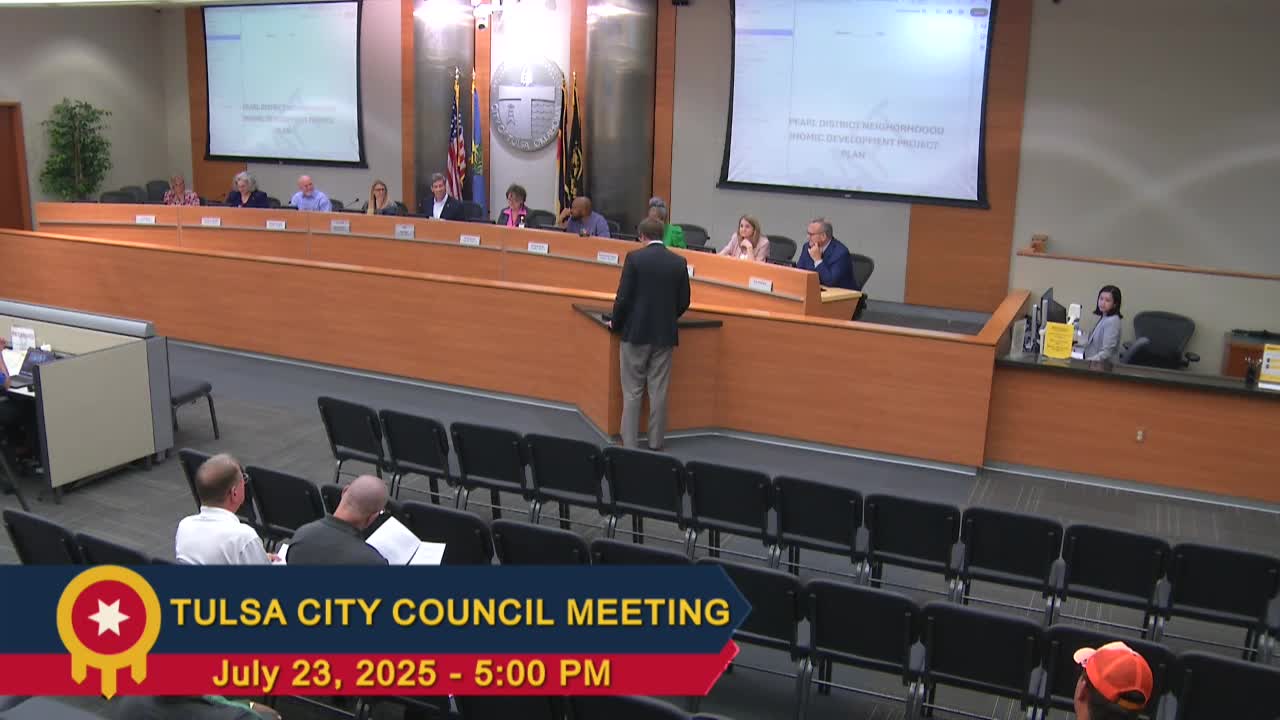
Jeff Sabin, of the Center for Economic Development Law, representing Partner Tulsa, detailed a proposed Pearl District Neighborhood Economic Development Project Plan and answered council questions during a public hearing at the Tulsa City Council meeting.
Sabin said the plan would establish a single ad valorem increment district—commonly called a tax-increment financing (TIF) district—covering the neighborhood east of downtown known as the Pearl District. “What we're trying to do with the Pearl District neighborhood project plan is kind of something similar to what the city did with their downtown districts,” Sabin said, describing priorities that align with the city’s 2019 sector plan and a small-area plan adopted by the Tulsa Metropolitan Area Planning Commission (TMAPC).
Sabin told the council the small-area plan identifies four priorities: stabilize and revitalize existing residential areas with an emphasis on homeownership and housing affordability; retain existing businesses and increase mixed-use commercial and retail opportunities; increase safety and security; and improve targeted infrastructure to support health and catalyze development. He said Partner Tulsa intends to use a pay-as-you-go financing structure for most projects and does not expect to borrow against future increment for the majority of projects, though property owners could seek conduit debt on a case-by-case basis.
Under the proposal, the increment district would run for up to 25 fiscal years—the maximum allowed under Oklahoma’s TIF enabling statute, Sabin said. Projected private redevelopment of about $200 million over 10–15 years could generate up to $96 million in incremental property tax revenues over 25 years, he said. The draft project budget caps TIF-eligible expenditures at $83 million; Sabin said the budget would allocate roughly one-third to public infrastructure improvements, about one-third to development financing assistance for private projects, and set aside 10% of the increment for Tulsa Public Schools.
Sabin described governance and oversight: staff advisory committees and the Tulsa Authority for Economic Opportunity (TAO) board would review and approve individual project expenditures and development agreements. He said the city would be the official entity to administer the project plan while TAO would hold and manage the TIF revenues as special funds, not as part of the city’s general fund.
Sabin said affected taxing jurisdictions participated on the review committee and voted in favor of the project; he also noted TMAPC gave a positive recommendation. Partner Tulsa staff were present in the chamber to answer questions, he said.
After the public hearing, the council exited the hearing; the transcript records the hearing and subsequent exit but does not show a final council vote adopting the project plan at this meeting.
During the same meeting the council approved a range of routine items by roll call, including minutes, appointments and reappointments, plats and rezonings, several ordinances on second reading and budget amendments, and donations to parks and events. Public commenter John Huffines spoke in support of several mayoral items and donors to Tulsa Parks, saying the Bernstein Foundation and local churches “help Tulsa be her best.”
Votes at a glance - Item 1a–1b: Receipt and filing of minutes for the June 25 regular meeting — approved by roll call. - Item 2a–2c: Appointments and reappointments (Beverly Carmichael to Tulsa Airport Authority; Tyler Duncan to Tulsa Authority for Economic Opportunity; Jeff Dunn to Tulsa Utility Board/Tulsa Metropolitan Utility Authority) — approved by roll call. - Item 4b–4g: Donations to Tulsa Parks and related mayoral items (including gifts noted from the Bernstein Foundation, Braden Park Baptist Church, and HF Sinclair) — approved by roll call. - Item 5a–5c: Authorities/boards/commissions items (final plat for North Tulsa Community Building; rezoning applications) — approved by roll call. - Item 7a–7i: Ordinances on second reading, including zoning changes and budget amendments (examples noted in agenda: rezoning ordinances, a $350,000 supplemental appropriation for Tulsa Animal Services; grants to Tulsa Police drug fund; $25,000 for Urban Leaders Fellowship; utility/storm sewer easement closings) — approved by roll call. - Item 8b: FY25–FY26 Vision for Arts program — approved by roll call. - Item 8c–8e: Travel/donation authorizations and related items (including Council travel authorization and donated travel/hosting from the city of Amiens, France) — approved by roll call.
No final council action to adopt or reject the Pearl District project plan is recorded in the transcript excerpt for this meeting.
Notes: The presentation and Q&A on the Pearl District plan included financial projections and governance design but did not conclude with a recorded council vote adopting the project plan during the televised portion of this meeting.