Get Full Government Meeting Transcripts, Videos, & Alerts Forever!
Get email alerts on the Sewage Planning topic
No spam. Unsubscribe anytime.
Perry County officials, DEP outline multi‑municipal Act 537 sewage planning and funding needs
Summary
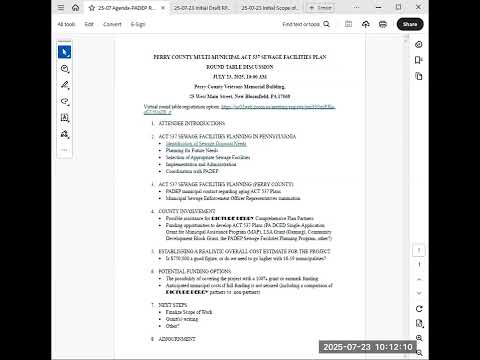
Perry County planning staff and state Department of Environmental Protection officials on Wednesday discussed a proposed multi‑municipal Act 537 sewage facilities planning effort that organizers said could include 16 to 19 municipalities and would require well sampling, sewage management program development and a coordinated funding strategy.
Perry County planning staff and state Department of Environmental Protection officials on Wednesday discussed a proposed multi‑municipal Act 537 sewage facilities planning effort that organizers said could include 16 to 19 municipalities and would require well sampling, sewage management program development and a coordinated funding strategy.
"We're looking at anywhere from, like, 16 to 19 municipalities here in the county," said Jason Fenerty, Perry County planning coordinator with the Tri County Regional Planning Commission, during the virtual round table. Fenerty led the discussion about consolidating updates to municipal Act 537 (sewage facilities) plans.
The discussion focused on why the county seeks a coordinated approach and what implementation would involve. The nut graf: officials said many municipal Act 537 plans in the county are decades old, that a new joint effort could lower unit costs through shared consultant work and that the planning step is necessary to unlock state and federal funding for construction or system upgrades.
State engineers and attorneys told attendees the planning process will require household sampling and follow‑up testing to identify needs. "Each municipality would have to sample 15% of their existing wells. That would be the Tier 1 study," said Zach Richards, geologist for DEP's Clean Water section. Richards said Tier 1 sampling would test for nitrate/nitrogen, total coliform and fecal coliform; elevated coliform results would trigger a larger Tier 2 sampling effort.
DEP staff said the agency can assist with technical review and guidance but cannot provide direct project funding. Brian Schlotteroff, sewage planning chief for DEP's South Central Regional Office, said DEP staff will review consultants' task activity reports (TARs) and the draft plan once a consultant is selected. "We are here to assist to help you guys along for each municipality," Schlotteroff said.
Speakers offered a range of cost estimates. Participants cited prior multi‑municipal efforts that cost about $300,000 for six municipalities; county staff presented a planning budget estimate in the $350,000 to $750,000 range for a larger effort. Greg Rogalski, a consultant with Pennoni Associates, estimated that a per‑municipality planning cost on the order of $40,000 could be a reasonable unit figure depending on final scope and participation.
Funding options discussed included PennVEST low‑interest loans for construction, multiple state planning grant programs and the Marcellus/Act 13 planning funds. Rachel Resnick, a planner with the Pennsylvania Department of Community and Economic Development (DCED), said DCED's Municipal Assistance Program (MAP) commonly requires a 50% local match but can sometimes be combined with other funding sources; she said DCED staff can coordinate with DEP on funding strategies.
Several participants described how an up‑to‑date Act 537 plan opens eligibility for construction grants and loans, and how an adopted plan clarifies municipal responsibilities for sewage management. DEP staff emphasized enforcement tools but said enforcement is a last resort. Angela Brandt Sitter Davis, assistant counsel for DEP's Clean Water program, said, "If necessary, we would end up in Commonwealth Court with a petition to enforce the order," describing the legal path DEP might use when a municipality fails to update an official plan after repeated requests.
Speakers also discussed alternatives for implementation and long‑term operations. Several DEP speakers recommended a regionalized sewage management program — either shared county‑level services, a sanitary authority or a commission — to centralize inspections, pumping schedules and enforcement. County and consultant speakers said regionalization could reduce per‑unit costs and increase access to specialized expertise.
Organizers outlined next steps: finalize a scope of work and TAR for grant applications, seek grant funding (potentially with 50% match), issue an RFP once funding is secured, select a consultant with Act 537 experience, and coordinate public participation and municipal adoption. Jason Fenerty said the county will reach out to municipalities that have not yet adopted the county comprehensive plan known as "Picture Perry"; DEP staff said adoption of Picture Perry was a county prerequisite for participation in the multi‑municipal project as proposed.
No formal vote or action was taken at the round table. Participants agreed to follow up with written scope materials and to pursue grants and consultant procurement if municipalities commit to participate.