Get Full Government Meeting Transcripts, Videos, & Alerts Forever!
Get email alerts on the Parking topic
No spam. Unsubscribe anytime.
Meridian council and MDC begin multi‑month review of Destination Downtown parking plan
Summary
Council members and Meridian Development Corporation representatives opened a multi‑month review of a Destination Downtown parking master plan, focusing on data, “85%” occupancy guidance, short‑term operational tweaks and options for enforcement, residential spillover and timing of future actions.
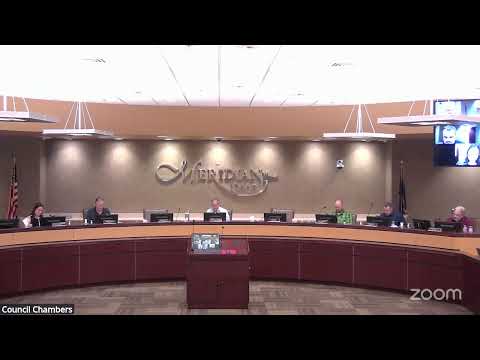
Meridian City Council members on July 22 began a planned multi‑month review of the Destination Downtown parking master plan prepared by Meridian Development Corporation (MDC) and consultant Rick Williams Consulting, focusing the initial session on the plan’s parking recommendations and next steps.
The meeting opened with Councilman Mikaela Taylor explaining the council’s role as a feedback provider to MDC: “What we’re providing here is feedback, not necessarily our recommendations, but this is feedback for MDC because this is an MDC document,” Taylor said. Taylor asked the council to take the plan in digestible pieces over the next five to six months.
MDC project manager Chris Danley summarized outreach and the subcommittee work that fed the parking analysis, and introduced Rick Williams Consulting’s lead on parking, Owen Ron Kelly. Danley said the parking element focused on the historic downtown and relied on stakeholder meetings, event engagement, online surveys and an on‑the‑ground utilization audit. “The subgroup compiled numerous parties…they got together multiple times,” Danley said, describing about a 7–8 month effort on parking.
Owen Ron Kelly said consultants performed a turnover and utilization audit that included license‑plate observations to estimate how long vehicles stayed in stalls. Kelly described an industry rule of thumb the report used: when occupancy reaches about 85 percent, user experience deteriorates and people circle looking for spaces. “When your parking supply becomes 85% or greater occupied…that’s when it becomes…a negative impact on the user experience,” Kelly said. The consultants mapped block faces and lots by occupancy and identified “hot spots” that reach that level.
Council members and MDC staff framed the plan as a menu of strategies rather than a single prescriptive program. Danley described the recommendations as layered by timing, cost assumptions and implementation responsibility. He said the plan did not recommend building new structured parking or wide‑scale metering immediately, but did list items for consideration such as improved signing/wayfinding, standardized time limits, EV and bicycle parking and pilot programs to move employee parking to peripheral lots.
Council members pressed consultants on enforcement and behavior change. Kelly said posted time limits can work for infrequent visitors, but regular users and employees often ignore limits absent periodic enforcement. “If there’s no repercussions for staying four or five hours in that three hour stall…behavior kind of deteriorates quickly,” he said. Councilman Taylor asked whether signage alone can change behavior; Kelly and Danley urged a combination of clarity, consistency and at least periodic enforcement to preserve turnover for retailers.
Longtime council member Councilman Overton, referencing past parking committees he served on, said Meridian currently has enough parking overall but faces concentrated demand around particular sites such as the post office and a private school. Overton and other council members endorsed short‑term, low‑cost actions first — clearer signing, striping and consistent time limits — and reserved judgment on measures such as residential permit zones or license‑plate enforcement until after further discussion and analysis.
Council members and MDC staff also discussed voluntary, business‑led programs to prioritize customer parking. Kelly described a “customer first” program used elsewhere where downtown businesses agree to ask employees to park off‑site and use promotional signage to encourage customers to use the closest stalls. Several council members suggested a business improvement district or downtown organization could implement such programs.
The council asked staff and MDC to return with more fine‑grained recommendations and an implementation timeline. Danley urged councilmembers to identify items in the plan they “really like” and items they want delayed or removed to help MDC refine a document the city could formally adopt, either by resolution or some other mechanism.
Councilman Taylor closed the discussion by noting the plan will be discussed topic‑by‑topic over the coming months, giving council members time to provide more targeted feedback.
Ending: The council did not take formal action on the plan at the July 22 session. MDC and consultants will return for the next work session on parking and subsequent monthly sessions covering other Destination Downtown topics.