Get Full Government Meeting Transcripts, Videos, & Alerts Forever!
Get email alerts on the Public Assembly topic
No spam. Unsubscribe anytime.
County attorney, sheriff and commissioners agree to draft guidance on protests; commissioners ask for panhandling ordinance
Summary
After extended discussion about public gatherings at county facilities and panhandling at intersections, the commission asked staff and the sheriff's office to develop clear, flexible guidance on permissible time, place and manner restrictions and asked staff to prepare a panhandling ordinance for future consideration.
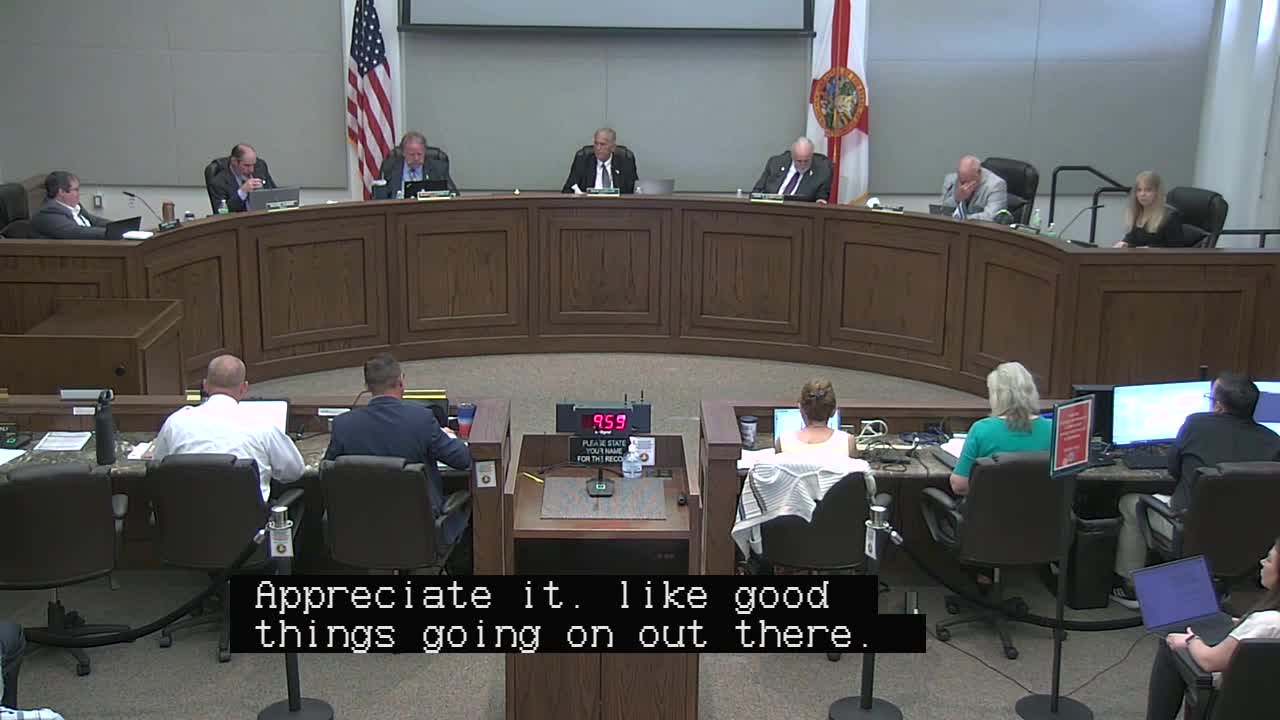
The Okeechobee County Commission discussed when and where citizens may assemble at county properties and how to address aggressive panhandling during a lengthy Aug. 14 agenda item that drew comments from the county attorney, the sheriff's office and multiple commissioners.
County counsel summarized constitutional limits: "reasonable restrictions as to time, place, and manner of speech are permissible, as long as those restrictions are justified without reference to the content of the regulated speech, are narrowly tailored to serve a significant government interest, and leave open ample alternative channels for communication of the information," counsel said on the record.
Staff said they have been designating reasonable nearby locations for groups seeking to assemble outside county buildings, and the sheriff's deputies handle situations requiring on‑scene enforcement. Several commissioners said the current, staff‑driven approach generally works but asked for a written county policy to reduce recurring complaints about protesters locating in front of doorways or setting up tents.
"We have to meet in the middle somewhere to make this point happen," the sheriff said, urging a practical, safety‑first approach that preserves constitutional rights while keeping buildings accessible.
Commissioners also raised frequent complaints about panhandlers approaching stopped vehicles at red lights and commercial intersections. County counsel advised that panhandling can be regulated more tightly than protests and recommended the commission consider a prescriptive ordinance that prohibits aggressive panhandling and limits panhandling at certain locations (sidewalks, transit stops, rights of way, parking lots and parks) while providing enforcement mechanisms.
By consensus, the commission directed county staff and the sheriff's office to draft a clear set of guidelines — including mapped, designated spaces near county buildings for assemblies and a process staff will follow when demonstrations expand beyond those boundaries — and to return to the commission with the proposed policy. Commissioners also asked staff to prepare an enforceable panhandling ordinance for future consideration.
Why it matters: The guidance seeks to protect constitutional assembly rights while preventing obstruction of government services and improving deputy and public safety. A formal panhandling ordinance would give enforcement agencies a clearer tool than case‑by‑case response.