Get Full Government Meeting Transcripts, Videos, & Alerts Forever!
Get email alerts on the State Legislation topic
No spam. Unsubscribe anytime.
City’s IGR director calls 2025 session “incredibly challenging”; arena funding falls short
Summary
St. Paul’s intergovernmental relations director told the council that the 2025 Minnesota legislative session left the city short of major priorities such as arena renovation and downtown tax tools, but delivered a $700 million bonding bill that included local allocations and some project-specific funding.
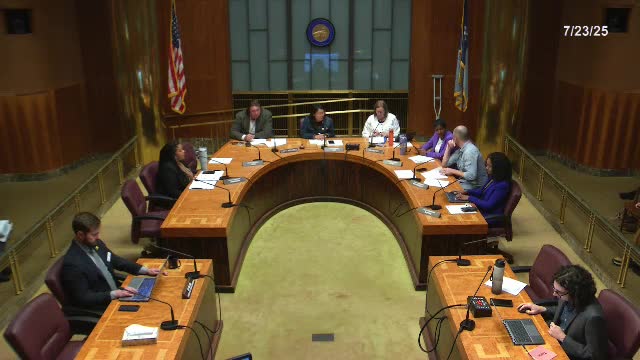
Bryn (Bryn House), the city’s intergovernmental relations director, briefed the St. Paul City Council on the 2025 Minnesota legislative session on July 22 and described an “incredibly challenging legislative session” that produced a mix of wins and losses for the city.
House told council members that leaders could not reach joint budget targets until mid-May and that the session’s timing and fiscal pressures limited how much the state could fund local priorities. “Because session didn’t really start until a month in… we were already behind,” she said.
Major local requests for this year included funding for an arena complex renovation and broader downtown revitalization tools. House said the city was unable to secure state funding for the arena renovation despite identifying a funding mechanism intended not to draw on general funds. She told the council the city had reduced its initial ask mid-session but still “was unable to get anything despite coming up with a unique funding source.” House said the arena and other downtown priorities remain the city’s top capital requests for the next session.
On the capital side, House said the legislature did pass a roughly $700 million general obligation (G.O.) bonding bill and included approximately $10.5 million in cash appropriations; among allocations she highlighted was funding that will allow $500,000 to be disbursed to the city for the Marion Park skate park (funding authorized earlier but re-allocated to get dollars out the door).
Other notable outcomes House summarized: - A proposal for local redevelopment tools and a downtown “cub credit” did not advance; the session authorized no new redevelopment TIF for first-class cities this year. - The state increased the gross receipts tax on cannabis (from 10% to 15% in the law) and eliminated the proposed share of local government cannabis aid, removing a revenue source cities had expected to help with enforcement and licensing responsibilities. - Several administrative changes and grant programs passed that cities may apply for, including funding for Emerald Ash Borer response, library and park systems, and a Metro-area transit funding reallocation; Metro Transit operations funding was reduced in the session’s package. - The legislature removed the requirement that public bodies provide remote meeting access accessible from a private residence (House summarized this as: public bodies no longer must open an elected official’s remote location to the public). House also noted changes to data-practices provisions and the privacy classification for judicial officials’ personal information.
House told the council the most significant near-term work is to press the state on the city’s capital priorities in 2026 and continue to pursue the arena funding, downtown redevelopment tools and other items that were not funded this year. She said the city will re-submit stalled requests to the state capital-budget system for possible inclusion in the 2026 bonding cycle.
Council members thanked House for the report, asked for more front-end engagement on next year’s agenda-setting and urged outreach to legislators, and council vice president Kim asked staff to provide follow-up details on the downtown priorities and implications for city programs and projects.