Get Full Government Meeting Transcripts, Videos, & Alerts Forever!
Get email alerts on the Enterprise Data Sharing topic
No spam. Unsubscribe anytime.
Connecticut advances DataLink CT secure data enclave to centralize interagency sharing
Summary
The Data Analysis Technology Advisory Board reviewed progress on DataLink CT (formerly P-20 WIN), reporting that a Microsoft Azure-based secure data enclave is under development, with technical build by state IT and changes to legal agreements planned to govern sharing.
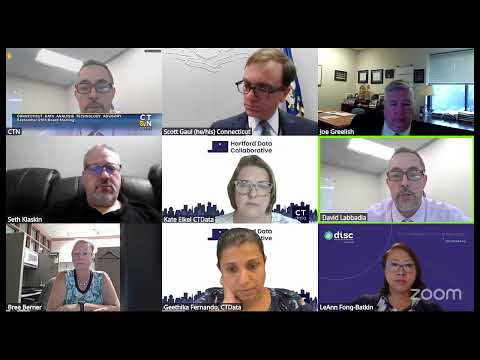
The Data Analysis Technology Advisory Board reviewed progress on DataLink CT on Oct. 25, 2025, as staff described an in‑house build of a secure data enclave intended to standardize interagency data sharing while preserving privacy and security.
Board members were told the enclave is being developed in Microsoft Azure, will use segmented storage labeled by sensitivity (described to the board as “red, yellow and green”), will integrate with the state’s Axway secure file transfer system, and will migrate the Data Ladder matching tool into the cloud to perform secure PII matching. Adriana Sanchez Domenici, project manager for DataLink CT, said, “we're developing this environment in Microsoft Azure,” and described an agile development and testing approach with the Bureau of Information Technology Solutions (BITS).
The enclave’s technical work is being done in‑house by BITS, while the Office of Policy and Management (OPM) will oversee governance and processes. Katie Breslin, data governance coordinator, described a concurrent legal and governance effort: updates to an enterprise memorandum of understanding (EMOU), a more project‑specific data sharing agreement, and a new data use license to clarify roles and responsibilities for data providers and requesters. Breslin said the EMOU functions as “the rules of the sandbox” and noted that changes tied to the enclave will be adopted after the environment is live.
Board discussion addressed operational and trust questions. Scott Gaugham, the board chair and chief data officer for the state, said OPM now administers the program after it moved from the state college system in 2020 and was codified in public act 25‑119 of 2025. Board members from the Department of Administrative Services (DAS) and BITS confirmed joint ownership of the Azure tenant and day‑to‑day technical responsibilities. A DAS representative told the board the Azure environment will live in the enterprise tenant and the DAS/BITS team will own the underlying technologies.
Board staff stressed that the project is iterative: the team is testing components as they are built, coordinating with participating agencies to gather requirements and address agency needs, and simultaneously updating policy documents including data quality and classification policies, a privacy policy under review, and data retention/destruction guidance. The project team said they will update the EMOU, the data sharing agreement structure and roll out a data use license so that roles (operating group, integration hub, participating agencies, data recipients) and applicable laws are clear for each project.
Next steps include finishing development and testing, finalizing updated legal agreements, continuing agency outreach and training, and returning to the board with more detailed materials. Staff asked the board to identify any items for deeper follow up; members asked for further sessions on governance, agency participation, and implementation timelines.
The board did not take a formal vote during this discussion. The project team said they will return with more detailed schedules for adoption and agency onboarding.