Get Full Government Meeting Transcripts, Videos, & Alerts Forever!
Get email alerts on the Investment Performance topic
No spam. Unsubscribe anytime.
CIO and consultants review investment performance; plan hits long‑term return above discount rate
Summary
SFERS reported estimated assets near $37–38 billion and a 10‑year return around 8.4%, above the system’s 7.2% discount rate. Staff and consultants discussed private‑vs‑public benchmark effects, tracking error and the relationship between strategic allocation and performance.
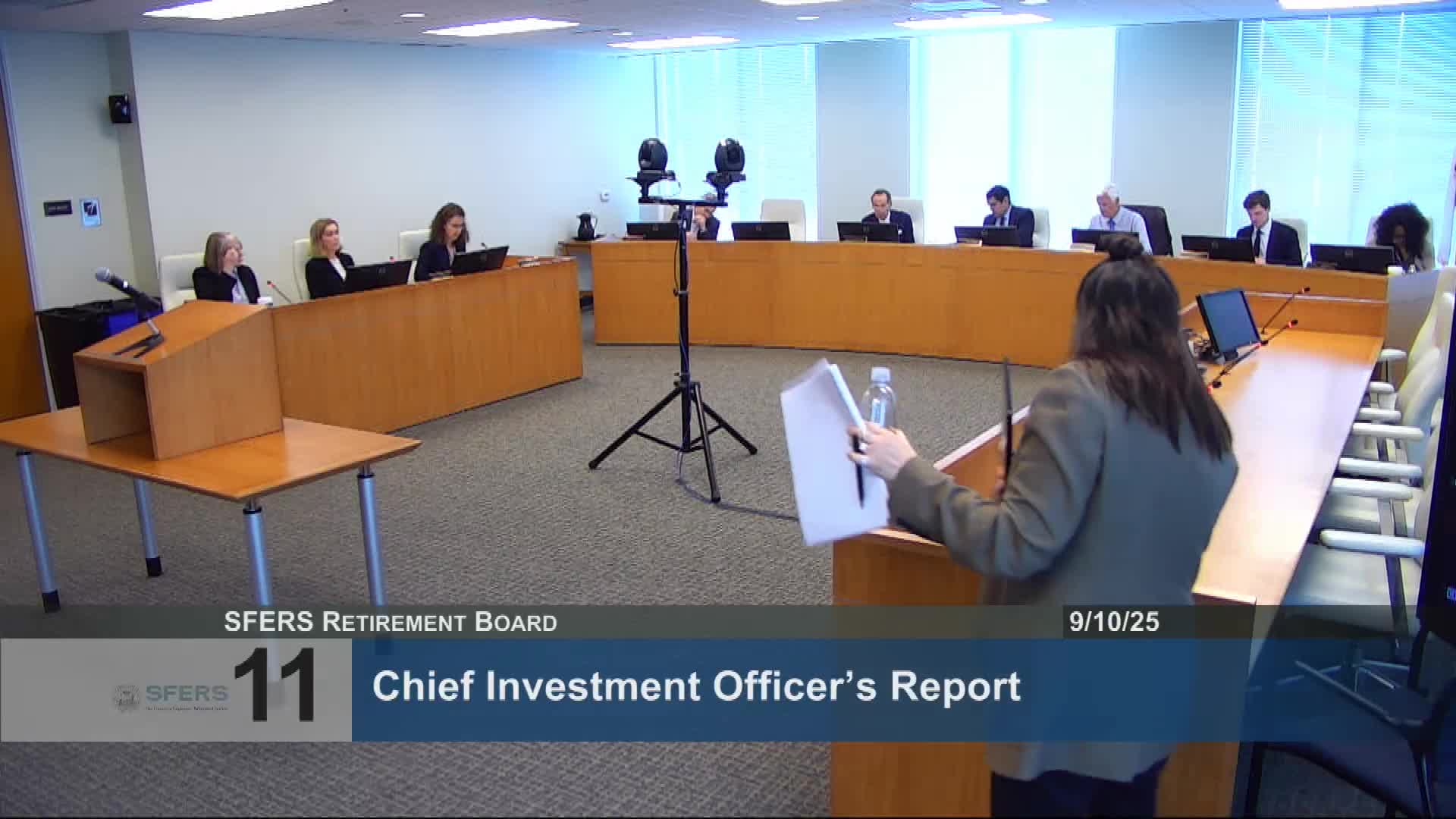
San Francisco Employees’ Retirement System staff and consultants presented an overview of the fund’s performance for the quarter ended June 30, 2025.
Director Romano (CEO) told the board estimated assets stood around $37–38 billion. Kallen Investment Management and Wilshire (consultants) reported a 10‑year return of about 8.4%, above SFERS’ actuarial discount rate of 7.2%. On a fiscal‑year basis ending June 30, the plan returned 7.9% and the second quarter was reported at 4.3%.
Consultants and staff emphasized that shorter‑term underperformance relative to the policy (strategic) benchmark is driven largely by private‑market valuation timing and the plan’s deliberate tilt toward private assets. The private‑market premium embedded in the policy benchmark (a public‑market proxy plus an illiquidity premium) produces benchmarking peculiarities when public markets rally strongly while private valuations lag.
Consultants flagged that the total‑fund tracking error relative to the policy benchmark is modeled around 4% forward‑looking and explained that measured tracking error is expected given the plan’s asset mix. Staff said the system remains within its policy rebalancing ranges; the funded ratio reported in the packet was about 95%.
Board members pressed staff and consultants for more educational sessions; staff agreed to provide a deeper, November session on benchmarking, risk attribution and the interplay of private‑market smoothing effects with time‑weighted performance measures.