Get Full Government Meeting Transcripts, Videos, & Alerts Forever!
Get email alerts on the Property Tax Rate topic
No spam. Unsubscribe anytime.
Finance committee recommends $1.20 property tax rate, forwards $1.16 proposal with no recommendation
Summary
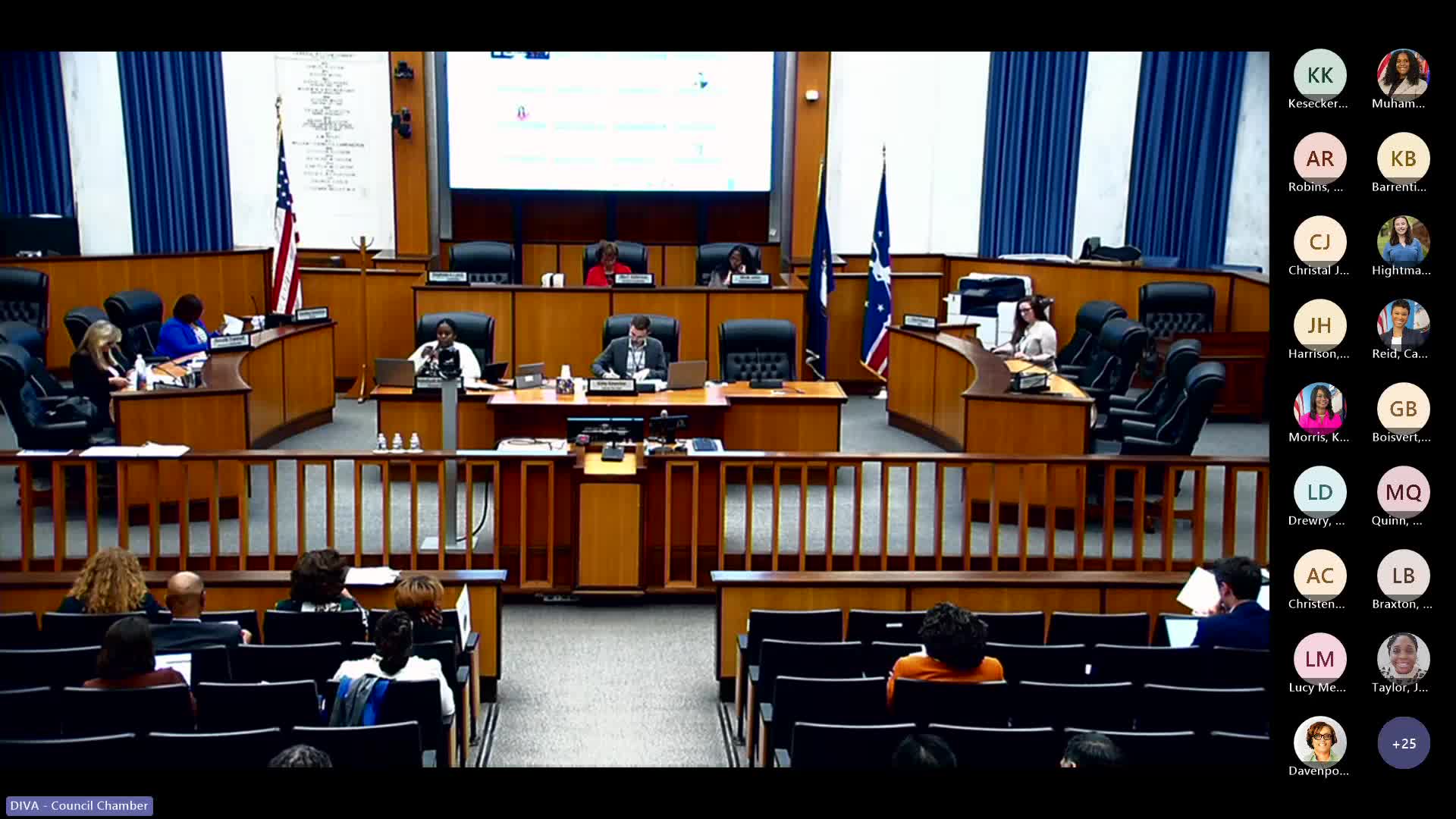
The Richmond City Finance and Economic Development Standing Committee voted to recommend the mayor's proposed $1.20 per $100 valuation property tax rate to full council and to forward a competing $1.16 proposal with no committee recommendation after a largely contested public hearing.
The Richmond City Finance and Economic Development Standing Committee on an administrative motion voted to forward the mayor’s proposed $1.20 per $100 of assessed value property tax rate to full council with a recommendation to approve and to forward a separate proposal to set the rate at $1.16 with no committee recommendation.
The committee's action follows a joint public hearing on two rival ordinances — ordinance 2025207 to set the rate at $1.20 and ordinance 2025208 to set the rate at $1.16 — that drew a mix of public commenters, including union representatives and neighborhood residents who urged different outcomes.
Why it matters: The committee and city administration said the budget adopted by council was built around the $1.20 rate, and reducing the rate would shrink the revenue base used to pay for city services, collective bargaining commitments, capital projects and reserves. The administration told the committee that one penny of the rate represents about $4.3 million in revenue; moving from $1.20 to $1.16, the administration estimated, would remove roughly $17.3 million from the budget plan.
Public comments were sharply divided. Felicia Boney, representing the Virginia State Council of SEIU and other local affiliates, opposed lowering the rate, saying cuts would threaten the city’s ability to pay a living wage for contracted and city workers and to fund affordable housing and eviction-prevention programs. Several senior residents and homeowners from the city’s Eighth District opposed a higher rate, saying rising assessments and utility bills are already creating financial strain. Crystal Jordan, a public school employee and participant in a housing program, urged a lower tax rate and requested targeted relief for residents who live and work in Richmond.
Administration presentation: An administration official briefed the committee on the fiscal context, saying property taxes account for roughly 57–60% of general fund revenues and that other funding sources (state and federal) are declining. The official described pressures from rising personnel and health-care costs, a constrained debt-service cap and capital needs, and noted that the real estate rate has not changed since 2008. The administration recommended retaining $1.20 to preserve planned services and capital projects; it also said that cutting the rate now would erode funds set aside for the capital improvement plan and could complicate the city's ability to respond to emergencies or major infrastructure failures.
Committee action and votes: The committee voted to forward ordinance 2025207 (set rate $1.20) to full council with a recommendation to approve. Recorded ayes included Councilmember Stephanie Lynch, Vice Chair Jones and Chair Robertson. The committee also voted to forward ordinance 2025208 (set rate $1.16) to full council with no recommendation; that motion passed on a recorded vote with Councilmember Lynch and Vice Chair Jones voting aye and Chair Robertson voting no.
What's next: Both ordinances will proceed to the full City Council for final action. Committee members and administration said they will prepare comparisons of household-level impacts for residents and describe the specific budget items that would be affected by any change in the rate.
Ending note: Committee members acknowledged deep concern from residents about assessments, utilities and rising housing costs and signaled a desire for clearer, consumer-friendly materials explaining how rate changes would translate into household bills.