Get Full Government Meeting Transcripts, Videos, & Alerts Forever!
Get email alerts on the Solid Waste topic
No spam. Unsubscribe anytime.
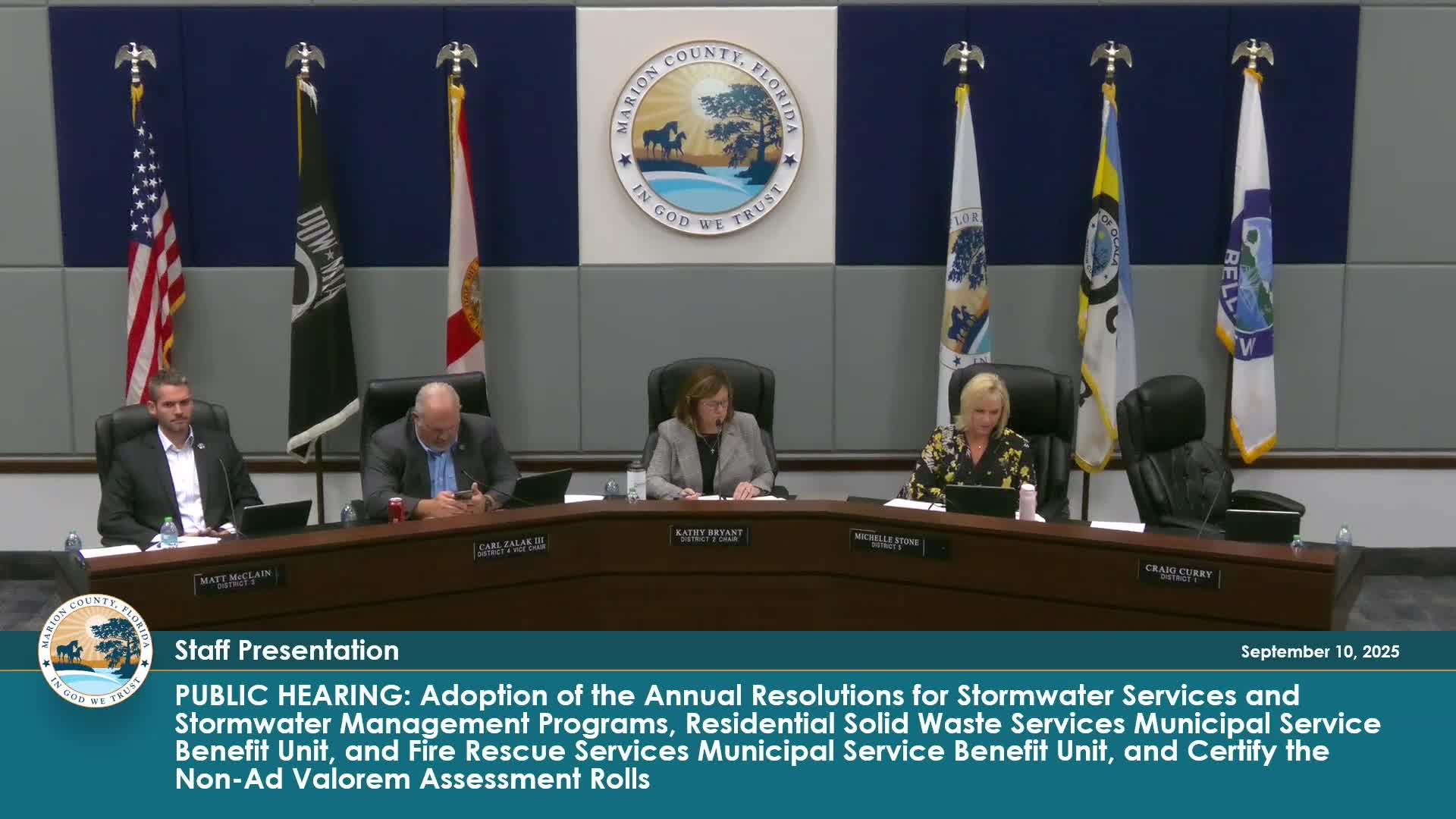
Marion County adopts $215 residential solid‑waste assessment after public outcry; vote 3‑2
Summary
After a lengthy public hearing during which dozens of residents urged alternatives, the county commission approved a residential solid‑waste special assessment increase from $87 to $215 per unit (effective FY 2025‑26); the motion passed 3‑2 with Commissioners Bryant and Zalick dissenting.
The Marion County Board of County Commissioners voted 3‑2 to adopt an annual resolution raising the residential solid‑waste assessment from $87 to $215 per dwelling unit and to certify the associated non‑ad valorem assessment roll.
Solid Waste Director Mark Johnson told the board the department has run deficits for several years, used reserves to balance operations and faces a looming need to secure additional disposal capacity. The county previously purchased prepaid airspace at another landfill (Heart of Florida) at about $8 per ton; that low‑cost capacity has been consumed by higher volumes since 2019. Johnson and department staff said recent tonnage growth and inflation have eroded fund balances and that, without action, the county would need to buy or build additional capacity within the coming decade.
Staff presented two broad rate models: a single one‑time increase to $215 that staff said would leave a larger reserve (projected to sustain operations and permit/construct an expansion over a 10‑year horizon), and a phased approach (smaller increases in earlier years leading to higher rates later) that would yield lower immediate reserves but smaller short‑term impacts for ratepayers. Finance staff (Mounier) also presented scenarios that would defer capital timing or infuse one‑time funding—examples included an option using $7.4 million in unallocated ARPA interest to reduce near‑term increases.
Public comment was extensive and strongly critical of a single, immediate 147% increase for many residents on fixed incomes. Speakers raised these recurring concerns: (1) seniors and fixed‑income households will be disproportionately harmed by a sudden large increase; (2) new development should pay a larger share ("growth pays for growth"); (3) recycling and alternative disposal options (waste‑to‑energy, shipping baled refuse) should be revisited; (4) more and clearer public communication about recycling centers and services is needed; and (5) litter and illegal dumping remain major visible problems.
Staff answered multiple public questions during and after the hearing: the assessment is levied on improved, usable parcels (staff later confirmed 169,883 improved parcels in the assessment), recycling centers are available at 18 county locations, and commercial tipping rates have been raised recently to generate additional revenue. Staff also said many alternatives were studied (pay‑as‑you‑go purchases of capacity, buying tonnage in bulk, waste‑to‑energy, partnering with cement kilns) but concluded reopening/expanding county capacity was the most cost‑effective option based on current market information.
Commissioner Stone moved to adopt the resolution and certify the assessment roll at $215 annually (a 10‑year planning horizon was discussed); the motion was seconded and passed 3‑2, with Commissioners Bryant and Zalick opposed. Commissioners discussed that the county attempted to hold rates down for many years (the assessment was unchanged at $87 for 17 years) and said the new figure aims to create stable funding for capacity and storm/debris response. Commissioners Bryant and Zalick said the increase was too large for a single year and preferred a phased approach.
The board instructed staff to provide detailed follow‑up materials and promised ongoing review; staff noted the board would revisit solid‑waste capital planning and reserve levels in future workshops.