Get Full Government Meeting Transcripts, Videos, & Alerts Forever!
Get email alerts on the Food Waste Ban Expansion topic
No spam. Unsubscribe anytime.
MassDEP outlines phased plan to expand food-waste disposal ban, emphasizes capacity and school support
Summary
John Fisher, deputy division director of solid waste at the Massachusetts Department of Environmental Protection, told stakeholders on Oct. 25 that MassDEP is considering a two‑stage expansion of the state’s food‑waste disposal ban, first eliminating the commercial threshold and later including residential collections if municipalities meet program standards.
John Fisher, deputy division director of solid waste at the Massachusetts Department of Environmental Protection, told stakeholders on Oct. 25 that MassDEP is considering a two-stage expansion of the state’s food-waste disposal ban that would first eliminate the commercial threshold and later bring residential food scraps into scope if municipalities meet program standards.
Fisher said the agency is “at a bit of a transition point” for food‑waste programs in Massachusetts and floated dates only as earliest possible milestones: a first stage (commercial generators) not sooner than 2028 and a potential second stage (residential) no sooner than Nov. 1, 2030. He repeatedly characterized the proposal as preliminary and said any regulatory change would require a multi‑year public rule‑making process with public comment and hearings.
The proposal would lower the current commercial threshold — now a half‑ton per week after the 2022 revision (the original ban had a 1‑ton threshold in 2014) — toward a de facto zero threshold for commercial food material. Fisher said MassDEP would likely write in allowances for “incidental” food waste (for example, offices or medical buildings with small amounts of cafeteria waste) so that entities that are not food businesses would not be expected to set up full collection programs. Schools with cafeterias would likely be covered under the commercial stage.
Fisher emphasized that a zero commercial threshold would not mean immediate enforcement for every banana peel in a trash load. MassDEP inspects loads at transfer stations, waste‑to‑energy facilities and landfills and applies action levels to determine when to pursue compliance. He said the zero threshold would make it easier to demonstrate that an entity disposed of banned material without requiring proof of a specific pounds‑per‑week figure, but enforcement would still be targeted at significant quantities and directed at businesses, institutions or government entities — not individuals.
Capacity and infrastructure concerns
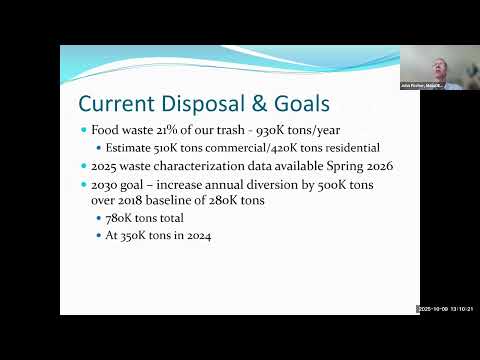
MassDEP presented recent statewide figures to justify a phased approach. Fisher said Massachusetts disposes of roughly 930,000 tons of food material in the trash annually, with an estimated split of about 500,000 tons from commercial sources and a little over 400,000 tons from residential sources (the agency noted uncertainty in these estimates). The state’s 2030 solid‑waste goal calls for an additional 500,000 tons diverted annually over a 2018 baseline, putting the target at about 780,000 tons per year.
Current statewide capture was reported at about 350,000 tons through 2024, and MassDEP’s summary of in‑state management capacity totaled roughly 500,000 tons per year. Fisher and participants noted the distribution of capacity is uneven: anaerobic digestion capacity was estimated at about 360,000 tons, composting approvals near 90,000 tons (but likely overstated versus operational throughput), and other pathways such as animal feed and donation have uncertain and likely understated figures. Fisher said that mix leaves a gap — roughly 160,000 tons — between current diversion and potential capacity in Massachusetts, and that additional distributed capacity and shorter haul distances will be needed to capture smaller commercial generators and residential collections cost‑effectively.
Stakeholders raised siting, financing and regulatory barriers as a critical constraint. Phil (identified in the meeting as “Phil at Goddard Town of Born,” role: town official) urged MassDEP to identify state‑owned parcels (DCAM or other state property, including divested military parcels) and to work with agencies such as the Division of Capital Asset Management and Maintenance and MassDOT to create demand for compost products. Several speakers said permitting and local zoning — notably Residential/Agricultural (RA) zones — create practical limits on new compost facility locations, and attendees recommended targeted state support for siting and capital funding.
Grants, loans and technical assistance
Fisher reviewed programs MassDEP offers to expand infrastructure and increase compliance: Recycling Business Development Grants (capital grants; historically up to $400,000 for processing and $100,000 for collection equipment, with potential for larger awards), a revolving Recycling Loan Fund (loans commonly up to $500,000 and up to $1.5 million for anaerobic digestion), the Recycling Works Massachusetts technical assistance contract, and the Sustainable Materials Recovery Program (equipment grants and a recycled dividends payment program for municipalities).
MassDEP said it plans to prioritize funding and program design to support an expanded ban if that path is chosen, including expanded equipment grants for schools and more financing options for compost and anaerobic digestion processing and collection.
Schools, donation and prevention
Fisher and multiple participants stressed that preventing food waste and increasing donation and rescue are top priorities. Schools were identified repeatedly as a key sector: MassDEP’s Green Team and Recycling Works provide education, small equipment grants and technical assistance; participants urged robust school‑focused outreach, hands‑on sorting education and grant support to reduce contamination and increase capture.
Several attendees recommended legislative and policy steps beyond the waste‑ban rulemaking: clarifying date‑labeling rules to reduce unnecessary disposal, increasing protections and incentives for food donation, and addressing PFAS and plastic‑label contamination that can block composting projects.
Stakeholder concerns and next steps
Speakers from haulers and compost operators (including Alex Pagani of Casella and representatives identified as compost operators) warned about contamination risks if single‑stream approaches or lax acceptance standards are allowed, and urged rules and facility practices that prevent plastic contamination of organics. Multiple participants called for a series of deep‑dive working sessions with operators, haulers, municipalities and lenders to model capacity, seasonal flows and the routeing and cost realities of hauling in dense urban areas.
MassDEP said it will hold further organic subcommittee meetings, expand outreach beyond that group, and post the meeting recording, slides and a written meeting summary. The agency also said it will prepare a refined proposal after this round of stakeholder input and that any regulation change would follow the department’s standard public rulemaking process (draft regulation, public comment, hearings, responses to comments and promulgation), a process MassDEP said typically takes about two years.
Ending
Fisher asked stakeholders to send follow‑up comments by email and said MassDEP will post materials and next‑step dates when available. He reiterated that the proposal is a starting point for discussion and that the agency will continue stakeholder engagement as it refines any regulatory approach.