Get Full Government Meeting Transcripts, Videos, & Alerts Forever!
Get email alerts on the Public Health Opioids topic
No spam. Unsubscribe anytime.
Marion County proclaims Fentanyl Awareness and cites expanded treatment capacity
Summary
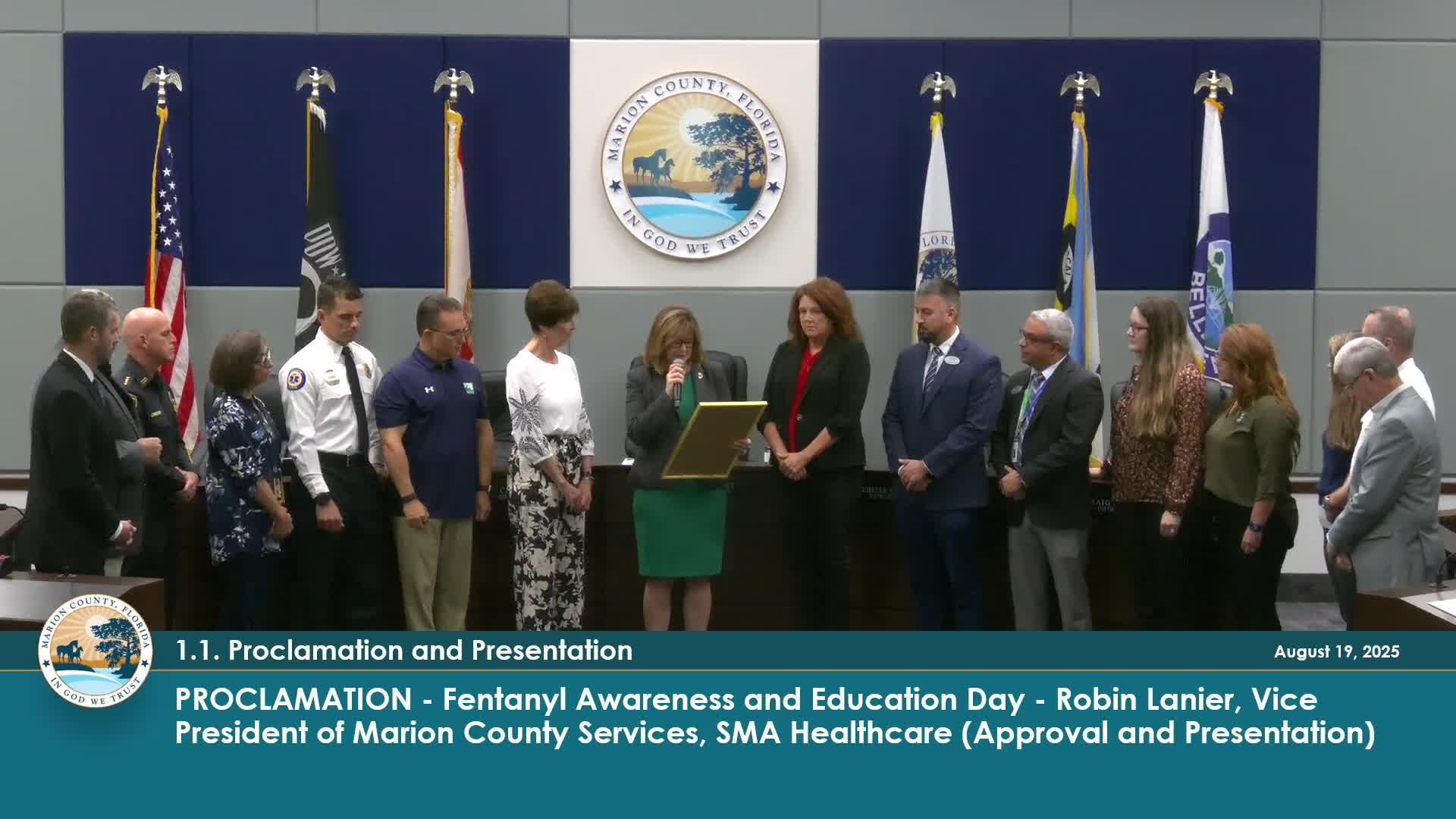
The Marion County Board of County Commissioners proclaimed Aug. 21, 2025, as Fentanyl Awareness and Education Day and heard updates from treatment providers, law enforcement and partners about expanded local treatment capacity and outreach.
The Marion County Board of County Commissioners on Aug. 19 proclaimed Aug. 21, 2025, Fentanyl Awareness and Education Day and heard agency updates about local treatment and overdose-response programs.
The proclamation highlighted fentanyl’s potency and called for expanded education, prevention, treatment and recovery services. Commissioners said the county will use regional opioid settlement funds to support evidence-based programs, and the proclamation named local partners including SMA Healthcare, Marion County Fire Rescue and the Department of Health.
Why it matters: County officials framed the proclamation as part of a continuing community response to the opioid crisis and as a mechanism to direct settlement dollars toward local treatment and prevention. The commission said coordination among law enforcement, fire rescue, hospitals and nonprofits is central to keeping people alive and linking them to treatment.
Treatment providers gave progress reports. Robin Lanier of SMA Healthcare told the board that SMA increased residential treatment capacity from 56 beds to 97 beds, a roughly 50% expansion, and that the organization now accepts women with infants. Lanier said SMA’s peer program — working with Ocala Fire Rescue and Marion County Fire Rescue — recorded 2,222 contacts in emergency departments on overdose calls last fiscal year and that 65% of those contacts entered treatment and remained for at least 90 days.
Ocala Police Department representatives described a long‑running “amnesty” program that allows people to turn in drugs or paraphernalia to officers without arrest, and said it has been part of a broader shift away from arrest‑centric responses and toward treatment and diversion. Officials credited the program and interagency partnerships with saving lives and reducing repeat arrests for some people with substance use disorders.
Commission discussion and next steps: Commissioners praised the collaborative work, asked for additional status detail on treatment bed growth, and noted the county’s work through the regional opioid settlement committee to prioritize funding for prevention, treatment and recovery. The proclamation requests that residents participate in education and prevention efforts and signals the board’s intent to continue coordinating settlement dollars with community partners.
Ending: The proclamation was read and signed by the board and Clerk of Court Gregory C. Harrell. Commissioners encouraged residents to attend events connected to Fentanyl Awareness and Education Day and to seek county and partner resources for prevention and treatment.