Get Full Government Meeting Transcripts, Videos, & Alerts Forever!
Get email alerts on the Nations Udo topic
No spam. Unsubscribe anytime.
Council advances Nations neighborhood rezoning and UDO on second reading after large, contested public hearing
Summary
After hours of public testimony from residents, neighborhood association leaders, business owners and developers, the council approved on second reading Roland Horton’s Nations neighborhood rezoning package and accompanying UDO as substituted. The bills passed second reading 26–7–4 after a substitute and promises of further amendments on third.
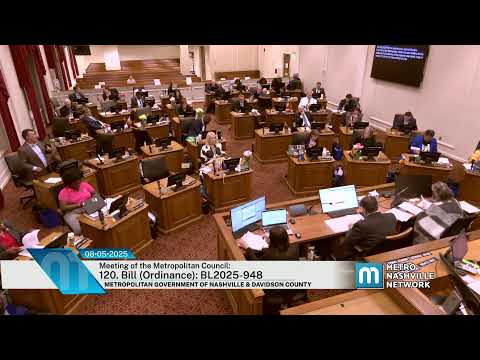
The Metropolitan Council advanced a comprehensive rezoning and unified development ordinance (UDO) for the Nations neighborhood on second reading after a lengthy public hearing that drew hundreds of supporters and opponents and more than two dozen speakers.
The package includes three companion bills (BL2025-830, BL2025-831 and BL2025-832) that would apply a new overlay/UDO across roughly 329.32 acres of the Nations and change base zoning in many areas to accommodate missing-middle housing types, tree and stormwater requirements, and design standards the sponsor says will preserve neighborhood character while expanding housing choices.
Sponsor Councilmember Roland Horton described the effort as the result of nearly two years of community meetings and revisions. In remarks on the council floor, Horton said the plan adds required open-space and impervious-surface standards, triples tree-density requirements, and introduces height and design standards intended to limit so-called "tall-and-skinny" houses while allowing more small-scale multifamily and accessory dwelling units.
Supporters at the public hearing said the plan responds to Nashville’s housing shortfall and would add smaller, more affordable housing choices while protecting walkability, trees and stormwater. Eric Patton, an area resident, told the council the plan "builds on" the Nations' existing mixed-use character and said opposition was largely coming from property owners fearful of change. The Nations Neighborhood Association’s leaders and board members — including Richard Andrews (NNA president) and Emily Fountain (NNA board) — publicly supported the plan and described a long engagement process that included multiple meetings and regular communications with members.
Opponents warned the rezoning would permit large multifamily buildings in interior blocks, increase traffic and stormwater runoff, and accelerate displacement. Lauren Magley, a commercial real estate broker and Nations resident, described the proposal as a blanket upzoning to RM40 across roughly 2,000 residential parcels and said very few residents participated in the association vote that supported the plan. Several speakers asked the council to defer the bills to allow more outreach, infrastructure planning and clearer limits on developer bonuses and building scale.
On the floor the council approved a housekeeping substitute and then took the substituted bills to a roll-call vote. The council clerk reported the vote as 26 in favor, 7 opposed and 4 abstentions, advancing the package on second reading. The sponsor and other council members said further amendments are expected on third reading and that the planning and zoning committee will take additional testimony and consider technical changes before final passage.
What the UDO would do (as described by sponsor and planning staff) - Apply a Nations UDO to roughly 329.32 acres with a mix of residential, commercial and some industrial parcels. - Require impervious surface/lot open-space standards to reduce stormwater runoff where none currently apply in RS/R districts. - Triple the residential tree-density requirement compared with current code and include incentives for tree preservation. - Change some base zones to allow more missing-middle housing types (duplexes, small multiplexes, accessory dwellings) to increase supply. - Include developer "bonus" provisions that were described in testimony as allowing additional height if specific standards are met; sponsor said neighborhood-priority amendments addressing potential height bonuses were being prepared for third reading.
Why it matters The Nations package is among the largest geography-specific rezoning efforts put before Metro Council in recent years. Supporters argue it is a targeted way to produce more housing options and protect small-business corridors; opponents contend the scale of the change and the process raise risks of displacement, insufficient infrastructure investment and erosion of existing neighborhood character.
Next steps The bills passed second reading as substituted. The sponsor indicated amendments are planned for third reading and that the planning and zoning committee will consider technical changes and additional public input before a final vote.