Get Full Government Meeting Transcripts, Videos, & Alerts Forever!
Get email alerts on the Animal Policy Backyard Hens topic
No spam. Unsubscribe anytime.
Spring Hill approves tighter backyard-hen rules after public debate; amendment removing per-hen setback wins
Summary
After an extended public hearing and debate, the Spring Hill Board of Mayor and Aldermen adopted Ordinance 25‑18 (amending Section 10‑102 of the Municipal Code) on second and final reading. The board accepted several staff-proposed changes and approved a late amendment to remove the per‑hen incremental setback; the ordinance passed 5–4.
Spring Hill’s Board of Mayor and Aldermen voted 5–4 on Aug. 18 to adopt Ordinance 25‑18, revising the city’s rules on keeping backyard hens by amending Section 10‑102 of the Spring Hill Municipal Code.
The vote followed a public hearing in which neighbors and owners described both compliance and enforcement problems under the current rules. Speakers said the revised rules in the packet—minimum coop and pen sizes, a baseline 25‑foot setback from neighboring residences and limits tied to lot size—represent a compromise but left some residents concerned about enforcement and potential odor or runoff issues.
City staff and several board members emphasized that the packet’s primary protections are the 25‑foot setback and a prohibition on locating coops or runs inside building setbacks. Staff (Miss Sanders) told the board the per‑hen incremental setback included in the draft was based on a review of industry standards and sample ordinances from other U.S. cities, and could be reduced or removed by the board.
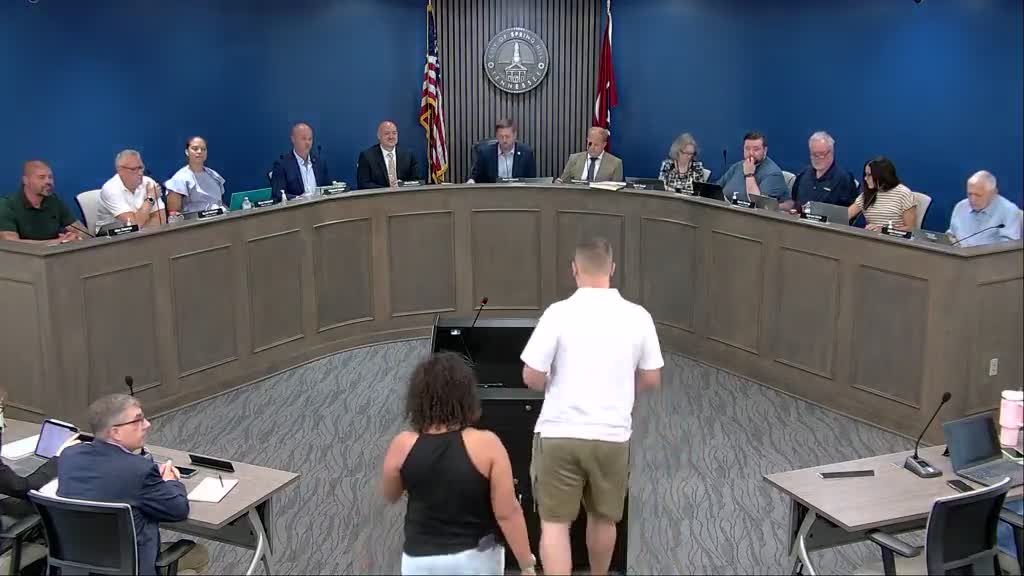
Public testimony was mixed. Isaiah Fruit Jr., who identified himself as the property owner whose coop drew neighbor complaints, told the board he is currently in compliance with permit requirements and supports some of the stricter elements in the proposed code, including larger setbacks and limits on numbers of hens. Neighbors described experienced problems including roaming hens, a possible rooster, odor and fly bait issues; several speakers urged better enforcement rather than looser rules. Tom McLennan and Mike Horvath, among others, said they favored the packet amendments (citing minimum coop and pen sizes and the 25‑foot setback) but asked that any grandfathering be limited or clarified.
On the board floor, Vice Mayor Linville moved to amend the ordinance to incorporate the packet changes. After that motion carried, Alderman Fuquay moved a second amendment to eliminate the additional per‑hen incremental setback (originally 5 feet per hen beyond a baseline). That amendment passed on a 6–3 roll call of the amendment. After further discussion about enforcement capacity, resource tradeoffs and neighborhood impacts, the board voted 5–4 to adopt the ordinance as twice amended.
The ordinance will replace the prior local language for backyard hens with the updated minimum coop and pen dimensions, the 25‑foot setback requirement, and the other provisions included in the staff packet, except for the eliminated per‑hen incremental setback. The ordinance text, as adopted, and an implementation/enforcement plan will be available in the city clerk’s office once finalized.
Board members who spoke publicly during discussion included Vice Mayor Linville (mover of the packet amendment), Alderman Fuquay (mover of the per‑hen setback amendment), Alderman Murray (second to key motions), Alderman Canapari and Alderman Warner. Staff who addressed the board included Miss Sanders (codes/planning) and city administrator staff members present during the conversation.
The board’s debate repeatedly returned to enforcement capacity: several members said existing staff may not be able to police more complex setback schemes, and warned that enforcement-by-neighbor‑complaint risks inconsistent outcomes. Those enforcement concerns were a key reason some members voted against the ordinance.
The adopted changes will apply to new permits and to the code sections specified in Ordinance 25‑18; the ordinance does not create an automatic grandfathering provision except as explicitly stated in the adopted text.
The board’s action followed a larger agenda that included other ordinances and resolutions (see the Votes at a glance summary).