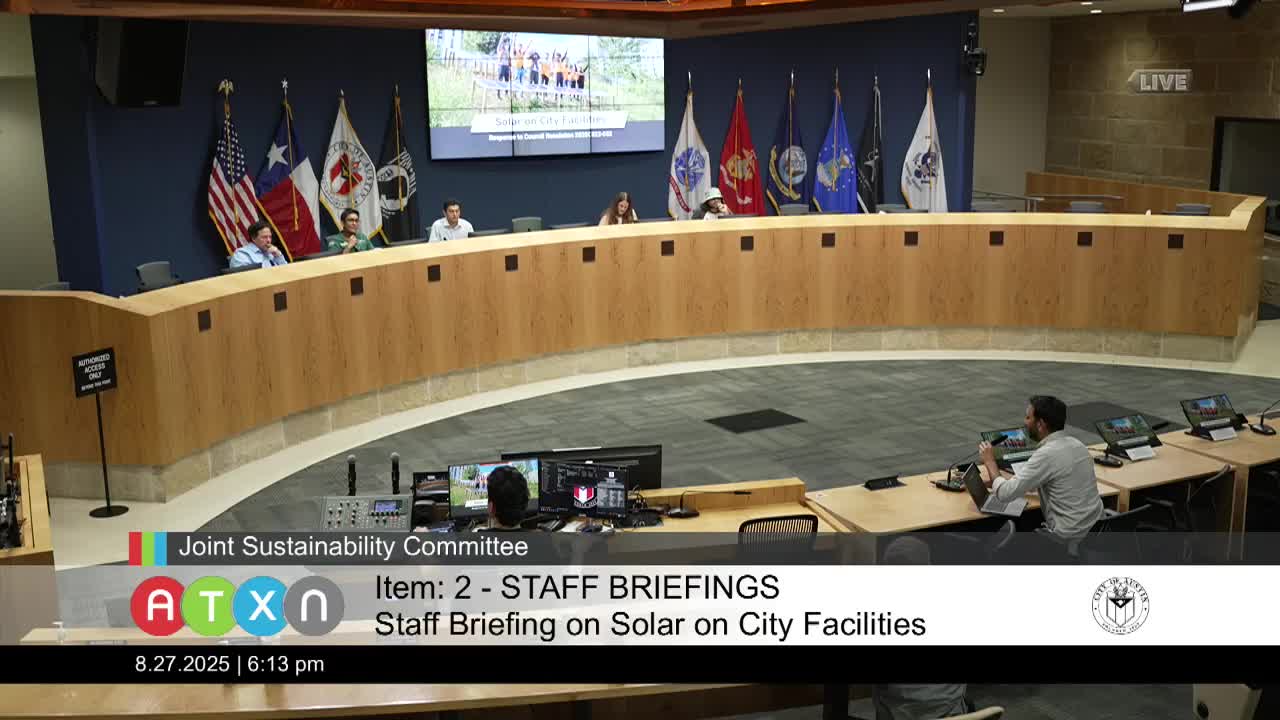
City staff outline multi-site plan to install solar on Austin facilities, warn of tightening federal deadlines

5689837 · August 27, 2025

Loading...

AI-Generated Content: All content on this page was generated by AI to highlight key points from the meeting. For complete details and context, we recommend watching the full video. so we can fix them.

Summary

City staff briefed the Joint Sustainability Committee on a multi-site approach to rooftop and parking-lot solar for city properties, describing procurement options, consultant support and a compressed federal tax-credit timeline that increases project risk.

City staff told the Joint Sustainability Committee that they have begun site screening and financial modeling for a multi-site solar program across city facilities and are moving quickly to preserve federal tax credits that help make those projects viable.

The work responds to a council resolution passed in May directing staff to analyze city property and recommend solar generation opportunities, prioritizing general fund properties; to calculate annual energy cost savings and dedicate equivalent funding to environmentally beneficial projects; and to evaluate opportunities on properties owned or operated by other local governments within the Austin Energy load zone, staff said. "The work we're doing is in response to a council resolution that was passed in May, and council directed the city manager and staff to, to do a number of things," Rohan, a city staff member leading the project presentation, told commissioners.

Staff described a three-step approach: inventory and assess city facilities for solar potential (rooftops, parking lots and adjacent land); issue a multi-site request for proposals (RFP) and evaluate ownership models; then select proposals and build, including operations and maintenance. The city has hired the Rocky Mountain Institute (RMI) under a professional services exemption to support site screening, portfolio-level financial modeling and procurement strategy; Rohan said RMI previously helped San Antonio on a comparable project.

Rohan cited San Antonio as a case study: that city contracted for roughly 13 megawatts across 42 rooftops and parking sites with about $30,000,000 in upfront investment and modeled $7 million–$11 million in net savings over 25 years. San Antonio used a single master developer contract and a separate operations-and-maintenance agreement, Rohan said.

Federal policy shifts are central to the timeline. Rohan summarized that the Inflation Reduction Act (IRA) greatly expanded the value of solar tax credits and introduced the direct-pay mechanism that lets non‑taxpaying entities such as cities capture credits (about 30% for solar). He warned, however, that more recent federal legislation phases out or tightens some clean-energy tax credits and introduced new foreign‑entity rules with uncertain guidance. "Projects must either commence construction by July 4, 2026, or be placed in service before 2027," he said, cautioning that guidance from Treasury will affect how the city demonstrates commencement.

On the question of how to show construction has started, Rohan said Treasury guidance suggests that for projects under about 1.5 megawatts "expending 5% of the project budget is sufficient" to demonstrate the start of construction, though the physical‑work test remains unclear and the city will seek legal advice.

Staff outlined three ownership models to be evaluated in procurement: a city‑owned model (city purchases systems using debt), a power‑purchase agreement (PPA) with a third party selling energy to the city at a fixed price, or use of Austin Energy's residential/commercial standard offer (a roof‑lease model paid to a system host). Rohan said staff is coordinating with building services, Austin Energy, finance and procurement to streamline processes and engage building managers early.

Commissioners asked about pairing batteries with solar. "I have found it worthwhile to consider pairing a solar installation with, like, a backup battery," said Commissioner Varun Prasad of the Urban Transportation Commission. Rohan replied that batteries are being considered but, given the tight tax‑credit timeline, staff is prioritizing getting solar built now and making sites "battery‑ready" as a likely Phase 2, noting that San Antonio and other cities have phased batteries into follow‑on work.

On procurement design, staff said they expect to use a multi‑site RFP to achieve economies of scale and that San Antonio's process included a request for qualifications to narrow vendors before issuing detailed bids. Commissioners asked for vendor‑screening criteria to protect quality and encourage subcontracting that meets local procurement goals; Rohan said the RFP is still being developed and staff will try to accommodate a review by the Joint Sustainability Committee if timing allows.

Next steps: staff said a memo to council will be issued September 2 and that staff plan to present to the Council's Climate, Water, Environment and Parks Committee in the coming months; they aim to develop and release an RFP in the next few months to move quickly to preserve tax‑credit eligibility. "We're moving, you know, really fast, especially in city terms," Rohan said. "We are trying to align multiple departments and stakeholders to make sure that we get solar built as fast as possible and are able to leverage those tax credits."

The committee discussion also flagged follow‑up needs: legal review of tax‑credit commencement tests, details on vendor qualifications and subcontracting expectations, and clarity about how any future operations and maintenance contracting would be structured.