Get Full Government Meeting Transcripts, Videos, & Alerts Forever!
Get email alerts on the County Budget topic
No spam. Unsubscribe anytime.
Bexar County approves higher judicial supplements; commissioners hear wide-ranging public-safety and court staffing budget requests
Summary
The Bexar County Commissioners Court on Aug. 26 unanimously approved a package raising county-paid judicial supplements and reclassifying several magistrate posts, and heard detailed budget requests from the sheriff, district attorney, constables and several court offices on detention staffing, aviation, prosecutor retention and court-support positions.
BEXAR COUNTY, Texas — The Bexar County Commissioners Court on Aug. 26 unanimously approved a resolution and a package of judicial pay adjustments that will raise the county'paid supplements for some judges and reorganize several temporary magistrate positions, then spent more than two hours hearing detailed budget requests from the sheriff, the district attorney, constables and other county offices.
The court voted "aye" on a bundled motion to: approve a resolution expressing the court's support and collaboration with the judiciary; increase the county supplement for district court judges from $18,000 to $25,000 annually effective Oct. 1, 2025; raise the maximum county supplement for a Fourth Court of Appeals justice from $9,000 to $12,500 annually effective Oct. 1, 2025; and delete a set of magistrate posts while adding a comparable set of associate-judge positions at the request of the criminal district courts.
Tina Smith, with the county manager's office, told the court the changes follow recent state legislation. "Senate Bill 293'increased the base salary for district court judges from $140,000 to $175,000 effective Sept. 1, 2025," Smith said. "This is the first pay raise that the district court judges have had since February 2013. The law also allows the court to increase the county supplement, which is what will be paid by the county." Smith presented county cost estimates and effective dates tied to the new state base.
Why it matters
The state increase in base pay for district judges triggers automatic and discretionary county-level adjustments across several locally funded judgeships (county courts, probate courts and many associate or magistrate positions). Commissioners stressed that approving the maximum discretionary supplement would help retain experienced jurists locally and create parity across multiple court types. County staff estimated the total fiscal impact to county operations at roughly $1.8 million annually if the court adopts the full maximum supplements on top of the state increase.
What the court approved (vote synopsis)
- Motion: Approve the resolution of support for collaboration with the judiciary; increase the county supplement for district court judges from $18,000 to $25,000 effective Oct. 1, 2025; increase the maximum county supplement for a Fourth Court of Appeals justice from $9,000 to $12,500 effective Oct. 1, 2025; and delete specified magistrate positions and add the requested associate-judge positions per the criminal district courts'request. - Mover: Commissioner Calvert. Second: Commissioner Rodriguez. - Outcome: Approved (motion carried by voice vote; court recorded unanimous "aye"). - Fiscal notes (presented by staff): automatic state-driven increases effective Sept. 1, 2025 total about $1.3 million; the additional county supplement increase adds roughly $500,000 for a combined impact near $1.8 million annually (county staff estimates).
Key discussion points and clarifications
- Discretion vs. automatic change: Smith and commissioners clarified that the state pay increase itself takes effect Sept. 1 and automatically raises many salaries tied to the district court base; the county must separately decide whether to raise the county-paid supplement (the discretionary component) and by how much. The court's motion targeted the county supplement change (18,000 to 25,000) and related parity decisions.
- Magistrates to associate judges: The criminal district courts requested that a set of magistrate positions (including drug-court and criminal-law magistrates and several full- and part-time magistrates) be reclassified to associate-judge positions. Smith said the classification change is intended to achieve pay parity and standardize duties; the court approved the package as moved.
- Chain-of-command and budget coordination: Judge Sakai (presiding) described a new coordination process to direct judicial budget requests through a designated deputy county manager (Thomas Guevara) and the county manager's office before they come to the court, aiming to reduce ad-hoc individual requests and ease administrative friction between judiciary staff and county budget analysts.
Other major budget presentations
After the judicial action the court heard extended departmental presentations and requests. No final votes were taken on these departmental asks at the work session; commissioners asked staff to prioritize and return recommendations during the formal budget process.
Sheriff's Office (public safety staffing and aviation)
Sheriff [speaker identified in the record as "Sheriff"] and Assistant Chief Raul Garza outlined a multi-bureau package focused on detention staffing, patrol growth tied to unincorporated population growth, investigative capacity and aviation operations:
- Detention: The sheriff requested 70 additional detention deputies (50 deputy positions, 10 corporals and 10 sergeants) to staff the South Tower and reduce daily mandatory overtime; an immediate request was for 10 sergeants (to be released from contingency sooner) to provide 24/7 supervisory coverage for the South Tower.
- Patrol and investigations: Requests included adding patrol deputies to subdivide current large patrol districts (proposed increase from 16 to 22 patrol districts), additional law-enforcement sergeants and investigators (financial crimes, child-safety, violent-crimes, animal-crimes and public-integrity investigators), and dedicated SCORE deputies to work precinct-level problems (one SCORE deputy per commissioner precinct).
- Aviation: The sheriff reported a state reimbursement grant to purchase an aircraft but asked the court to approve up-front operational funding (requested roughly $500,000) to cover hangar rental, fuel, routine maintenance, insurance and training while the county purchases the aircraft and seeks reimbursement. The sheriff described daily operational reliance on partner helicopters (DPS, SAPD) and argued the county needs its own aviation capability for pursuits, searches and critical elder/child searches. Commissioners asked for further detail on usage data, response-time metrics and hangar/maintenance options (including potential shared hangars with other agencies such as DPS or SAPD).
District Attorney: recruitment and reclassification request
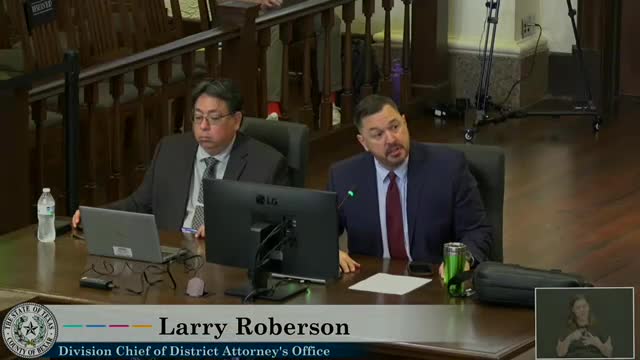
District Attorney Joe Gonzalez presented a budget-neutral reclassification proposal aimed at retaining experienced prosecutors amid statewide competition. Gonzalez said the DA's office is roughly 30 prosecutors short, many leaving for higher pay in surrounding rural counties that have access to SB 22 funds; he asked the court to reclassify 67 "first-chair" prosecutor positions from one pay tier (A10) to a higher tier (A11). Gonzalez said the measure would cost approximately $688,000 but the office can free contingency positions and other vacancies to offset the increase, making the request budget neutral. He warned that losing institutional prosecutorial experience would slow charging decisions and could affect public-safety outcomes; he also reported recent progress reducing the charging backlog (a decline of several hundred cases in the prior weeks).
Managed Assigned Counsel (MAC)
Jim Bethke, executive director of the managed assigned-counsel program, requested four additional office assistants (A4 positions) to handle attorney assignments, complaints and voucher processing for a large and growing caseload of appointed counsel. Bethke said year-to-date the office had processed more than 10,600 felony vouchers and expects voucher volume to rise; the MAC team also handles thousands of manual case assignments and hundreds of complaints. He asked the court to fund these positions at competitive pay so the program can meet statutory and grant-driven workload demands; commissioners asked staff to consider e-invoicing improvements and evaluate whether technology could reduce some processing time.
Constable, Precinct 1
Constable Tejeda spoke in favor of adding 10 deputy constables and two administrative clerks to handle warrants and civil-process duties under Senate Bill 38 (changes to service timelines) and to address geographic travel demands in Precinct 1. Tejeda said average daily deputy travel in the precinct approaches 200 miles per deputy and that the new duties (including the incoming squatter/forcible-possessory complaint workflow) will increase demand for deputies responsible for warrants, civil process and courthouse security.
County courts, specialty courts and presiding-court support
County court judges requested several personnel changes: creating a chief staff attorney position to reflect existing duties (ad-delete request for an Attorney II to a Chief Staff Attorney for salary parity), reclassifying an experienced senior court support specialist to a court coordinator, and adding a drug-court magistrate (specialty court magistrate) to support large specialty dockets.
Judge Sakai and specialty-court presenters emphasized the Veterans Treatment Court's size (the Texas Veterans Commission report showed 210 veterans in the program in 2024 and the program recently celebrated its 1,000th graduate) and asked for an associate/magistrate position to provide continuity and reduce turnover-related training costs.
Other operational requests
- Civil district courts: a request to reclassify a senior-court specialist to better support presiding-system reporting and to increase a contracted-services line for domestic-violence symposium support.
- District clerk: requested an additional mental-health clerk to manage CMAG-related evaluations and sealed mental-health records; staff said the office faces a backlog of sealed evaluations and that timely distribution to prosecutors and defense is critical for discovery and downstream courtroom scheduling.
- Justice of the Peace, Precinct 1: requested reclassification of a lead-clerk to a supervisor to split civil and criminal supervision duties; court staff provided queue data showing large civil e-file and in-person volumes and argued the supervisory role would increase efficiency and warrant output.
- Elections: the elections office requested reclassification of a long-serving asset clerk (18 years) to an asset-manager classification (NEO3) to reflect responsibility for about $20 million in voting equipment; the office also requested a senior public-relations position to expand voter-education, media and stakeholder outreach and argued that a full-time PR employee can be more cost-effective than repeated short-term contracts.
What commissioners asked staff to do next
Commissioners did not adopt department-specific staffing packages at the meeting beyond the judicial supplements motion. Instead they asked budget staff and the county manager's office to:
- return prioritized recommendations for the sheriff's multi-million-dollar program-change requests and identify which items might be phased or placed in contingency (the sheriff estimated program changes near $4 million if all asks were funded); - review the DA's reclassification proposal and the MAC staffing request for budget neutrality and grant implications; - provide follow-up detail on aviation operational costs, hangar options and evidence of current partner usage and response times; and - assess whether technology (e-invoicing, improved case- and voucher-processing tools) can reduce administrative headcount needs for voucher processing and discovery distribution.
Votes at a glance
- Motion 2 a, b, c and d (judicial resolution; increase county supplement for district court judges from $18,000 to $25,000 effective Oct. 1, 2025; increase Fourth Court of Appeals county supplement from $9,000 to $12,500 effective Oct. 1, 2025; reclass/delete and add magistrate/associate-judge positions per criminal district courts): Mover Commissioner Calvert; second Commissioner Rodriguez; outcome: approved (voice vote; court recorded unanimous "aye").
Context and next steps
The Commissioners Court is in the work-session phase of the FY2025-26 budget process; many departmental requests must still be refined, prioritized and placed into the formal budget ordinance later this fall. Several items presented (aviation startup operations, detention staffing, prosecutor retention measures, voucher-processing capacity and specialty-court magistrates) carry direct implications for public safety, jail population management and legal operations. Commissioners directed staff to return with narrower options, cost offsets and, where applicable, data to justify operational changes (for example, helicopter utilization metrics, voucher-processing time-savings estimates, and any available return-on-investment for Padilla/Powell adviser functions).
— Reporting from the Bexar County Commissioners Court budget work session, Aug. 26, 2025. —