Get Full Government Meeting Transcripts, Videos, & Alerts Forever!
Get email alerts on the Public Safety Fire Department topic
No spam. Unsubscribe anytime.
Lakeville Fire Department reports May spike, highlights training, staffing and new equipment
Summary
At a City Council meeting, Fire Chief Meyer presented the department's second-quarter report, saying the department handled 1,083 runs in Q2, saw an unusually high 437 calls in May, added full-time and pay-on-call staff through a SAFER grant, and rolled out EV response training and vehicle fire blankets.
At a Lakeville City Council meeting, Lakeville Fire Chief Steve Meyer presented the fire department's second-quarter report, saying the department responded to 1,083 runs in the quarter with a May spike of 437 calls and 362 in June.
Meyer told council members that medical and rescue calls accounted for about two-thirds of the department's call volume and that overlapping incidents have been a notable operational factor. He said the department tracked multiple overlapping incidents during the quarter, including incidents involving two, three and four simultaneous calls that required paging additional stations.
The report highlighted three significant responses: a Memorial Day house fire on Ivory Lane that began in a garage and extended into attic space; a railcar fire where recycled paper bales ignited and required coordination with Progressive Rail to access and extinguish the burning material; and a vehicle/garage fire at a Kenosha-area group home that required evacuation of three residents who were bedridden or had limited mobility. Meyer said both engines were on scene in less than six minutes for those calls and praised crews' coordination with police on evacuations.
Meyer described operational metrics including response and alarm-processing times. He said emergent EMS calls and structure fires show faster dispatch-to-arrival times when two engines are staffed, and that the department arrives ahead of ambulances about 62 percent of the time. Meyer said the department does not currently track whether a Basic Life Support (BLS) or Advanced Life Support (ALS) crew was required for each call in a manner that can be easily reported.
On training and equipment, Meyer said the department completed Electric Vehicle (EV) response training and has placed two vehicle fire blankets (one on each engine) to help contain burning EV batteries while crews cool the vehicle. He listed other training completed in the quarter: a live-burn exercise in May, water-rescue and drone training in June, fire-inspector and fire-officer classes for staff, and mental-health-awareness training for personnel.
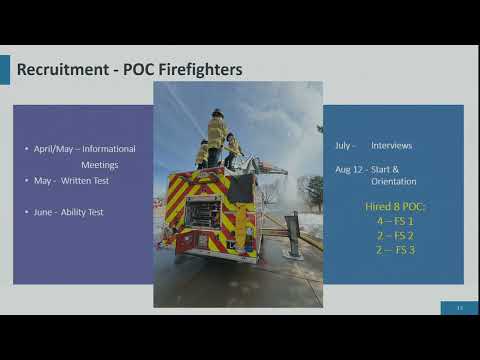
Meyer said the department received a SAFER grant that funded 16 full-time firefighter hires (15 positions tied to the SAFER grant) and that a badging ceremony was held for six firefighters who completed probation. The department also recruited eight pay-on-call firefighters (distribution among stations was described in the report) and recorded three retirements in June: John Clancy (Lieutenant, Station 4), Dan Harlicka and firefighter Steve Meyer (both Station 4). Meyer said the retirements dated to hires in 2005 and showed a long-term progression for the staff and their families.
On capital and outreach work, Meyer said the fire station design team is meeting weekly on the new station layout, and staff are exploring a mentorship program with the Chamber of Commerce and the school district to provide ride-alongs and career introductions for interested high-school juniors and seniors. He also noted continuing community events and inspections work, including food-truck inspections and school outreach for fire prevention (the department said it taught fire extinguisher use to sixth-graders).
Meyer closed by thanking the council for support and offered to stand for questions. Councilmembers asked about EV-battery fire risk and rooftop solar; Meyer said Lakeville has seen a small number of battery-related incidents typically tied to damaged batteries or third-party chargers and that rooftop-solar-related fires have not been an issue locally at the scale seen in other regions.
The presentation did not include a formal council action; it was received as informational.