Get Full Government Meeting Transcripts, Videos, & Alerts Forever!
Get email alerts on the Homelessness topic
No spam. Unsubscribe anytime.
San Antonio proposes $26.1 million for new Homeless Services & Strategy department, funds low‑barrier shelter for one year
Summary
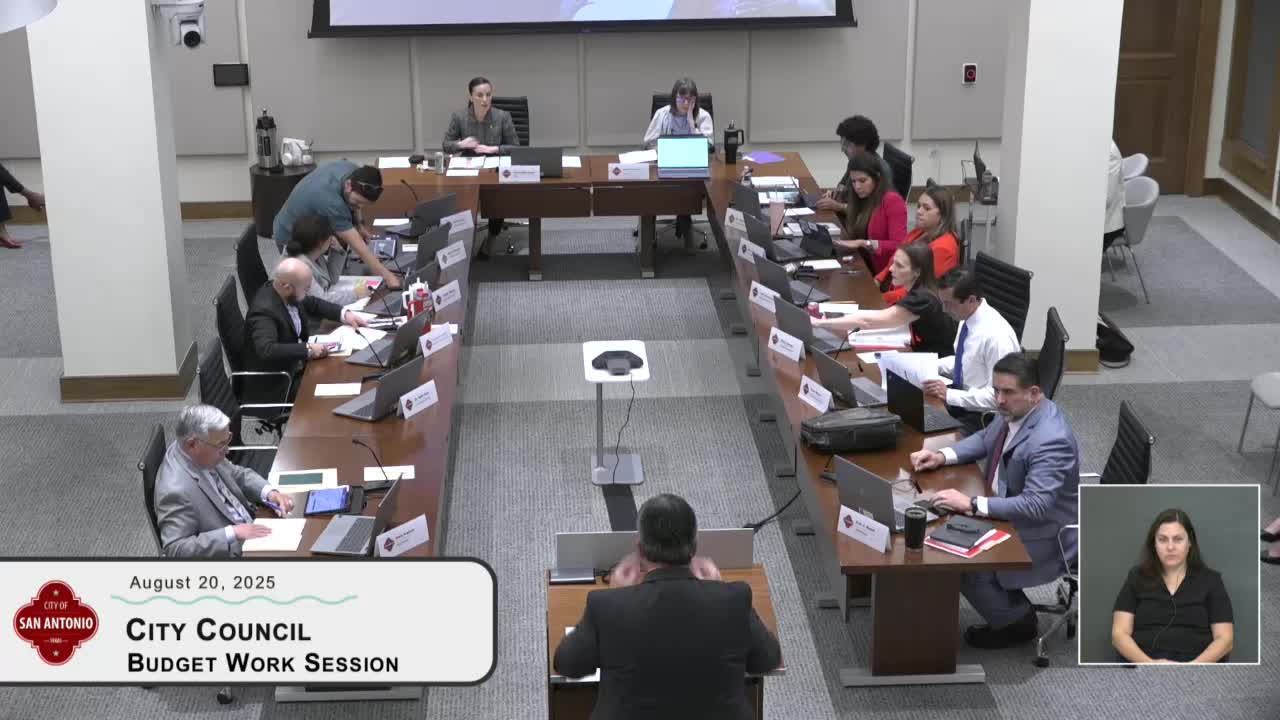
The City of San Antonio on Aug. 20 presented a FY2026 budget proposal that would fund a newly created Homeless Services and Strategy Department with $26,100,000 and direct $4,800,000 to extend operation of a downtown low‑barrier, hotel‑based shelter for one additional year.
The City of San Antonio on Aug. 20 presented a FY2026 budget proposal that would fund a newly created Homeless Services and Strategy Department with $26,100,000 and direct $4,800,000 to extend operation of a downtown low‑barrier, hotel‑based shelter for one additional year.
City officials said the new department — housed under existing human services resources and staffed with 43 positions — will focus on reducing unsheltered homelessness, decreasing family homelessness and preventing new episodes of homelessness through prevention, diversion and cross‑system coordination.
The department will "work upstream in the areas of prevention and diversion ... to include financial assistance, case management, housing stability services, and legal services," Director Mark Carmona told the council. Carmona, who introduced the department, described partnerships with local nonprofits, health and justice system partners and the San Antonio Housing Trust.
Patrick Steck, the department's assistant director, told the council the FY2026 proposed budget for the homeless response system totals about $30,500,000 when other departmental and indirect costs are included. Of the $26,100,000 carried inside the new department, Steck said roughly $21,500,000 would be contracted services and $4,500,000 would fund staff salaries and operational costs.
Steck said roughly $8,200,000 is budgeted for investment on the Haven for Hope campus, about $1,000,000 for other shelters (including battered women’s services) and $5.2 million for a low‑barrier, non‑congregate shelter. The city estimates indirect public safety costs related to homelessness at roughly $23,200,000, of which about $20,000,000 are estimated police costs and about $3,000,000 are fire/EMS costs.
The low‑barrier shelter operates in a leased hotel downtown; Steck said the building has 313 rooms and that the nonprofit operator Sam Ministries has historically operated 185 rooms. Over a two‑year funding period the shelter reported 266 "positive exits," Steck said, and a recidivism rate following placement of about 11.1 percent — slightly below the national HUD average of 11.8 percent cited in the presentation. Steck said the proposed FY2026 budget includes funding to lease that facility for one more year while the city pursues longer‑term options.
Encampment abatements and outreach: the presentation summarized the city's abatement and outreach process. Staff said the city expects to abate about 1,369 sites this fiscal year (a bit above a 1,300 target), average response time from report to abatement is 13 days (goal 14 days) and solid waste crews removed more than 2,500 tons of material from encampments. Steck said the direct solid waste and human‑services cost per abatement averages about $2,046; that estimate excludes indirect police and fire support costs.
Council members asked for more data and longer‑term planning. Mayor Jones and several council members emphasized the need to develop a business case that lays out the capital and operational requirements for shelters, transitional and permanent supportive housing and asked staff to pursue county and health‑system partnerships for longer‑term financing. Councilman Manny Munguia said one‑year lease extensions are not a sustainable long‑term strategy; Carmona and Steck said the department will return with recommendations that include multi‑sector funding options.
Why it matters: the city cited a recent point‑in‑time count that identified 3,625 people experiencing homelessness and said the shared data dashboard shows system‑wide movements: roughly 3,800 people moved from the streets into a better living situation over a recent 10‑month period and about 2,000 people moved from shelters into permanent housing during the same window. The presenters and council members flagged a rise in new people entering homelessness and highlighted young adults (ages 18–24) as a growing subpopulation.
Council follow‑up: council members requested more precise data — including the split between one‑time federal funds (ARPA and other HUD grants) and ongoing city funding — analysis of program outcomes (for example, duration of stays and post‑exit housing stability) and a clearer long‑term plan for the downtown low‑barrier shelter in the absence of recurring federal funds.
The presentation closed with staff contact information for service referrals and encampment reporting: 311 for encampments and the Community Connections hotline 207‑1799 for service connections and referrals.