Get Full Government Meeting Transcripts, Videos, & Alerts Forever!
Get email alerts on the County Employment topic
No spam. Unsubscribe anytime.
Bonner County OKs part‑time remote deputy prosecutor position to retain staff on student visa
Summary
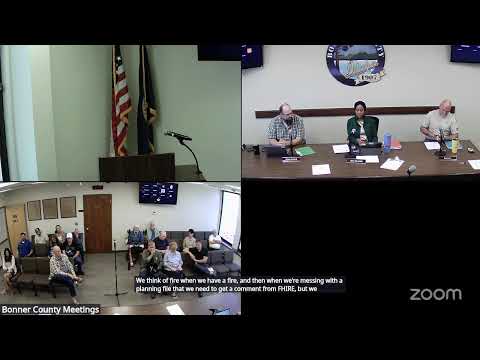
The Bonner County Board of Commissioners on Thursday approved Resolution 25‑53 to create and modify a part‑time, fully remote deputy prosecuting attorney position in the prosecutor’s office to retain a current deputy who will be studying abroad under a student visa.
The Bonner County Board of Commissioners on Thursday approved Resolution 25‑53 to create and modify a part‑time, fully remote deputy prosecuting attorney position in the prosecutor’s office to retain a current deputy who will be studying abroad under a student visa.
Prosecuting Attorney Lewis Marshall told the board the change is intended to retain institutional knowledge: the deputy, Sarah Hyde, will continue to perform administrative and case‑preparation work up to 20 hours per week while taking classes overseas. Marshall said the plan does not require a new position and is expected to reduce county costs because the position moves from full‑time to part‑time, removing health insurance costs tied to a full‑time role.
Marshall said the arrangement depends on two outstanding administrative questions — workers' compensation and unemployment insurance costs — that the county had not yet quantified. “If those things don't work out, if they don't pencil out, then we can't do it,” Marshall said. He added he expected those issues would be minor but said the county would not proceed if they proved otherwise.
Human Resources Director Jonathan Holmgren (identified at the meeting as Bonner County human resources director) told commissioners he did not see an immediate conflict with U.S. or Idaho employment law for a U.S.‑based employer to hire a student‑visa holder for up to 20 hours per week. “To my knowledge, I'm not seeing any impacts to United States or Idaho specific employment law,” Holmgren said. He and Marshall both recommended a county remote‑work policy be developed or updated to set expectations on hours, equipment, security, and responsibilities.
Deputy Prosecutor Sarah Hyde also addressed the board. She told commissioners she would remain an Idaho resident for the duration of her studies, that she is allowed to work up to 20 hours under her visa, and that she would personally bear her own internet costs while working remotely. “I will bear the cost of my own Internet,” Hyde said.
Technology staff and commissioners discussed information security and case‑management access. Marshall said the prosecutor’s office uses a web‑based case management system and that the office’s information‑technology staff had reviewed security and found no major barriers; the county’s technology department and the prosecutor’s office will need to document responsibilities should a remote arrangement be approved.
Commissioners pressed for clear office hours and written responsibilities for the part‑time remote position. Commissioner discussion emphasized the need for a countywide remote‑work policy rather than an ad hoc approach tied to a single employee. The board asked the prosecutor’s office to work with HR to expedite the remote‑work policy and to clarify workers’ compensation and unemployment impacts before broader implementation.
The board made the motion to approve Resolution 25‑53 and voted to adopt it. The approved resolution authorizes the creation/modification of a fully remote part‑time deputy prosecuting attorney position within the prosecutor’s office; the motion carried in a roll call vote with three affirmative votes.
The county record does not show final, itemized estimates for any additional employer costs (workers’ compensation or unemployment insurance) in the meeting transcript; staff told commissioners those figures were not yet available and would be returned to the board if they proved material to the decision.
The measure passed after the board discussed staffing trends and the prosecutor’s need to retain specialized case knowledge while filling other full‑time slots in the office.