Get Full Government Meeting Transcripts, Videos, & Alerts Forever!
Get email alerts on the General Government Operations And Appropriations topic
No spam. Unsubscribe anytime.
Guam Legislature shifts millions to Guam Memorial Hospital as lawmakers dispute $35 million funding source
Summary
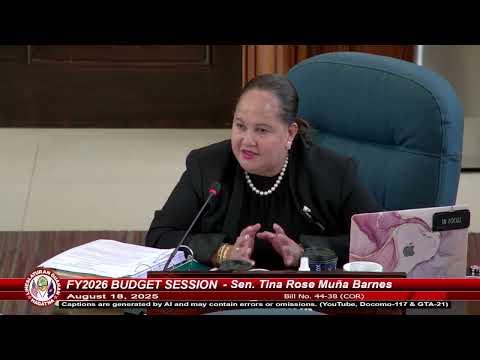
During an Aug. 18 Committee of the Whole session, lawmakers approved several amendments sending money to Guam Memorial Hospital (GMH) while officials and budget staff disputed whether a $35 million appropriation created in earlier law was ever deposited into the designated account.
The Committee of the Whole of the Guam Legislature on Aug. 18 approved multiple budget amendments to send additional funding to Guam Memorial Hospital (GMH), while budget and administration officials told legislators that a $35 million appropriation created in earlier public law does not appear in the named account.
Senator Sabrina Salas Montanani, who proffered several of the amendments on the GMH chapter, said the first adopted change redirected an existing appropriation so GMH would receive funds directly rather than routing the money through the Department of Corrections. "We're redirecting the 3,600,000 appropriation directly to GMH, to ensure that the funds are allocated efficiently and used specifically for the hospital needs," Montanani said on the floor.
The debate turned to a larger disputed item: public law language enacted in 2021 that lawmakers described as creating a "20‑first Century Healthcare Center of Excellence" appropriation of $35,000,000 for fiscal 2022. Revenue and budget witnesses and administration officials told the committee that, while the appropriation exists in law, the account that would hold those federal reimbursements or advances shows no balance.
Marie Lizama of the Department of Revenue and Taxation explained how the so‑called earned income tax credit (EITC) and child tax credit transfers are handled: data are transmitted to the U.S. Treasury and, if approved, funds are deposited directly into designated accounts. "It is predicated upon data that we provide to the Treasury and then the Treasury gives us the funds," Lizama said. She and other witnesses emphasized that the federal transfers are restricted for tax‑refund purposes and are not freely interchangeable with general‑fund appropriations.
Officials from the Office of Budget and Management (OFB) and the Department of Administration told the committee that the account established for the hospital appropriation does not have a deposited balance. OFB testified on the record that "there is no funding at [the 20‑first Century Health Excellence] account. Not in the account." DOA representatives said they did not establish or load the account because they believed the money had not been received or could not be used as an available funding source.
Lawmakers pressed on both sides. Some members argued that the language of the public law and previous budget documents showed an intent and an appropriation that should have been implemented; others urged caution, saying the committee could not appropriate money that does not actually exist in a fund or that is federally restricted.
Despite the dispute, the body approved the Montanani amendment that proffered reappropriation language tied to the earlier public law. The amendment passed on a roll call vote (9 yays, 6 nays). Separately, the committee adopted a different amendment that raises the withholding tax estimate and uses the change to appropriate roughly $7.0 million to GMH’s accounts‑payable and operating needs. A later amendment that sought to appropriate about $3.9 million from the committee’s estimate of FY‑2025 unobligated general‑fund balance failed on objection.
Committee members and administration witnesses repeatedly emphasized the hospital’s reported funding shortfalls: during floor discussion senators cited GMH estimates that included roughly $28 million needed to cover payroll, about $29.3 million for capital improvement projects (CIP) and roughly $25 million in accounts‑payable obligations. Legislators said those figures drove urgency to find available revenue sources within the fiscal bill.
Speakers on the floor asked the Attorney General’s office to review whether procedural or statutory requirements had been followed in earlier budget sessions and in the handling of the appropriation. The committee chair said he had requested legal guidance and described the question as one for a forensic review if necessary.
Votes at a glance - Amendment redirecting existing DOC‑pass‑through appropriation to GMH (proffered by Senator Sabrina Salas Montanani): approved (no recorded roll call on the floor; adopted by unanimous consent when put to the body). The amendment moves a $3,600,000 appropriation so GMH receives the funds directly for inmate health services rather than routing them through DOC.
- Amendment to reappropriate the $35,000,000 referenced in public law 36‑56 (proffered by Senator Montanani): approved on roll call (tally recorded in committee: 9 yes, 6 no). The amendment changed language in the budget document to reflect the public law appropriation and to direct it for GMH purposes; administration witnesses had testified that the account established by law shows no loaded balance.
- Withholding‑increase amendment to appropriate $7,014,994 for GMH accounts‑payable and operational expenses (proponent: member who introduced amendment on floor): approved (adopted by voice/consent during the chapter discussion). The amendment increases an FY‑2026 withholding tax estimate and ties the incremental amount to GMH.
- Amendment to appropriate $3,968,554 from FY‑2025 unobligated general‑fund balance to GMH: objected to and failed on the floor.
Why it matters Lawmakers framed the debate as a choice between identifying real, available revenue to maintain operations at the island’s only public hospital and relying on appropriations that officials say were never funded or that are federal monies restricted for tax‑refund purposes. GMH leaders and numerous senators said the hospital’s shortfalls — in payroll, capital projects and accounts payable — risked service interruptions and harm to patients and staff. Budget staff responded that federal rules and the actual cash position of the identified accounts constrain what the legislature can legally appropriate.
What’s next The committee chair said he had asked for a legal opinion and for further review by the Attorney General’s office regarding the status of the public‑law appropriation and whether required procedures for establishing and loading the account were followed. Lawmakers also revised other parts of the substitute budget during the same chapter; additional amendments and the full‑chamber votes are expected as the Legislature continues its budget process.
Ending For now, GMH will receive several millions in adjusted and reallocated appropriations approved by the Committee of the Whole, but the larger question of whether the $35 million cited in earlier law was legally and physically deposited into the account remains unresolved and under review by budget staff and legal counsel.