Get email alerts on the Industrial Development Authority Governance topic
No spam. Unsubscribe anytime.
Hardee County commissioners weigh plan to give BOCC voting control of Industrial Development Authority
Summary
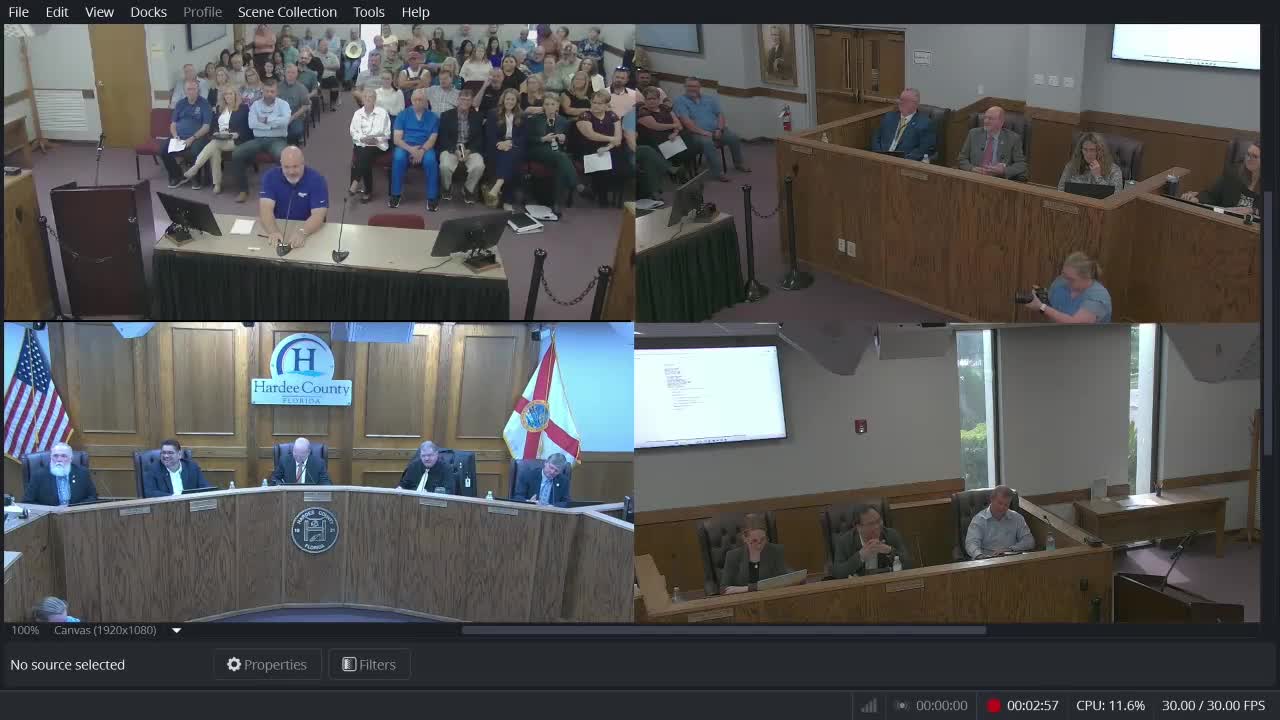
At a special workshop of the Hardee County Board of County Commissioners on Aug. 14, 2025, commissioners discussed a proposed resolution that would make all five county commissioners ex officio voting members of the Industrial Development Authority, drawing more than two hours of public comment and extended presentations from the IDA’s chief executive and Mosaic Fertilizer.
At a special workshop of the Hardee County Board of County Commissioners on Aug. 14, 2025, commissioners discussed a proposed resolution that would make all five county commissioners ex officio voting members of the Industrial Development Authority, drawing more than two hours of public comment and extended presentations from the IDA’s chief executive and Mosaic Fertilizer.
Supporters and critics agreed on one point: economic development in Hardee County is active and visible. Much of the meeting, however, focused on whether changing the IDA’s governance would improve accountability or would politicize economic development and deter private investment.
The proposal and why it matters
The resolution before the commission would alter the composition and voting authority of the IDA board so that county commissioners would serve as ex officio voting members, reducing the number of community-appointed seats and the industry-representation requirements the current IDA structure uses. Senator Denise Grimsley, CEO of the Development Group (the IDA’s operating 501(c)(3) partner), told commissioners the change would make the authority “inconsistent with how chapter 159 says IDA members must be seated,” and warned of legal and practical consequences if the county moves ahead without further study.
Grimsley described the IDA as a dependent special district created under Florida law “in 1975 under chapter 159 part 3” and said the IDA and the Development Group currently function as separate entities, with a small portion of funds (about 3 percent) used to support the Development Group’s operating costs while the IDA retains special revenue for projects. She said the Development Group has pursued a multi-year turnaround since 2022, secured more than $12 million in grants, and manages projects ranging from downtown rehabilitation to manufacturing recruitment.
Presentations and main arguments
Russell Schweiss of Mosaic Fertilizer addressed commissioners early in the meeting and urged caution. Schweiss said a core reason the IDA structure developed as it did was to preserve an appropriate separation between negotiators of local development agreements and the county body that ultimately issues quasi-judicial permits. "The governance of your special districts is the domain of the commission. That's that's for you all to decide," Schweiss said, but he warned that collapsing the present degrees of separation could create ethical questions and leave the county vulnerable when permit decisions are later considered by the commission.
Grimsley laid out the IDA’s history, its statutory role under chapter 159, and how the Development Group and IDA interact. She said the IDA currently owns 42 properties on roughly 60 parcels, reported that the organization has helped secure several manufacturing tenants and grants, and noted program details such as the Hardy Grove scholarship and BRIEFLY summarized LDA (local development agreement) terms with Mosaic (including prior payments and an 81-acre donation tied to housing programs). She acknowledged mistakes: speaking about a downtown purchase she said, "The purchase of that building ... was the biggest mistake the IDA ever made. And I'll own it."
Public comment and local reaction
More than two dozen residents, business owners and civic leaders addressed the commission. Speakers representing Main Street Huachula, the CRA, chamber-linked development groups, current and former IDA members and local appraisers urged the commission to withdraw or rethink the resolution. Common themes were that the IDA’s independence helps protect confidentiality needed to recruit businesses, that private-sector investors expect a neutral, apolitical development partner, and that repeated governance changes tied to election cycles could interrupt long-term strategy.
Representative comments included: - LaVonne (Levon) Cobb: "We trust those folks to manage that money properly." - Chris Esardi (IDA board member): "This resolution is clearly a disruptive style of change." - Benjamin Gibson (real estate appraiser): confidentiality losses deter prospects that want discretion while exploring relocation. - Sarah Evers (economic development staff veteran): "Do not let that small group of obstructionists determine the future of this community."
IDA leadership and supporters said the authority has shifted toward more standardized contracts, stricter reporting and professionalized financial controls since 2022, and they defended recent property acquisitions and grant activity. IDA chairman Lee Michael, who addressed the workshop, opposed the resolution and said its passage would "poison" the structure that currently governs the authority.
Commissioners’ position and next steps
Commissioner Tim Wells said he introduced the resolution out of concern about the amount of public money spent and the need for additional accountability. He apologized for how he brought the item forward and repeatedly said he intended the item to prompt discussion rather than signal a final decision. Commissioner Kenny Miller said he seconded the motion in order to force deliberation and requested additional briefings and budget detail before any vote.
No formal vote on the resolution was taken at the workshop. Commissioners agreed to continue the discussion and to bring additional financial detail and project-level explanations to the body before a final vote; the resolution was effectively tabled pending those follow-ups.
Other outcomes and directions
- The IDA’s CEO selection process, which had advanced to candidate interviews, was paused after commissioners asked for additional clarity about the IDA’s structure; Grimsley said interviews would be rescheduled once governance questions are decided. - Commissioners and IDA staff agreed to arrange more detailed budget briefings; Grimsley offered to walk commissioners through the multiple IDA/Development Group budgets and special-revenue accounts.
Why this matters locally
Hardee County officials and private development partners emphasized that the community is in an active phase of economic development: Mosaic-related local development agreements have generated multiple years of payments (Grimsley and others referenced roughly $80 million in contributions to date), the IDA and Development Group describe dozens of active projects and grant awards, and local leaders say the county is pursuing housing, health care, workforce and downtown revitalization projects tied to those revenues.
At the same time, speakers from both sides said governance and transparency questions deserve attention; residents urged more accessible reporting and clearer public briefings so citizens and elected officials alike can evaluate how public funds are spent.
The commission scheduled further consideration for its next regular meeting and asked staff and the Development Group to supply more detailed budget and contract-level materials beforehand.
AI generated
The text on this page is AI generated. Summaries, highlights, analysis, and video transcripts are all produced from the original source material.
AI can make mistakes, so if you spot one, and we will fix it for everyone.
Note: the source content is unaltered by us. Any content source we link to, be it a video, an audio recording, or a document, is presented exactly as its publisher released it. That publisher is usually a government body, sometimes an individual official or another organisation.