Get Full Government Meeting Transcripts, Videos, & Alerts Forever!
Get email alerts on the Solid Waste topic
No spam. Unsubscribe anytime.
Clute council narrows solid-waste options, asks staff to model mid-range rate increase without new trucks
Summary
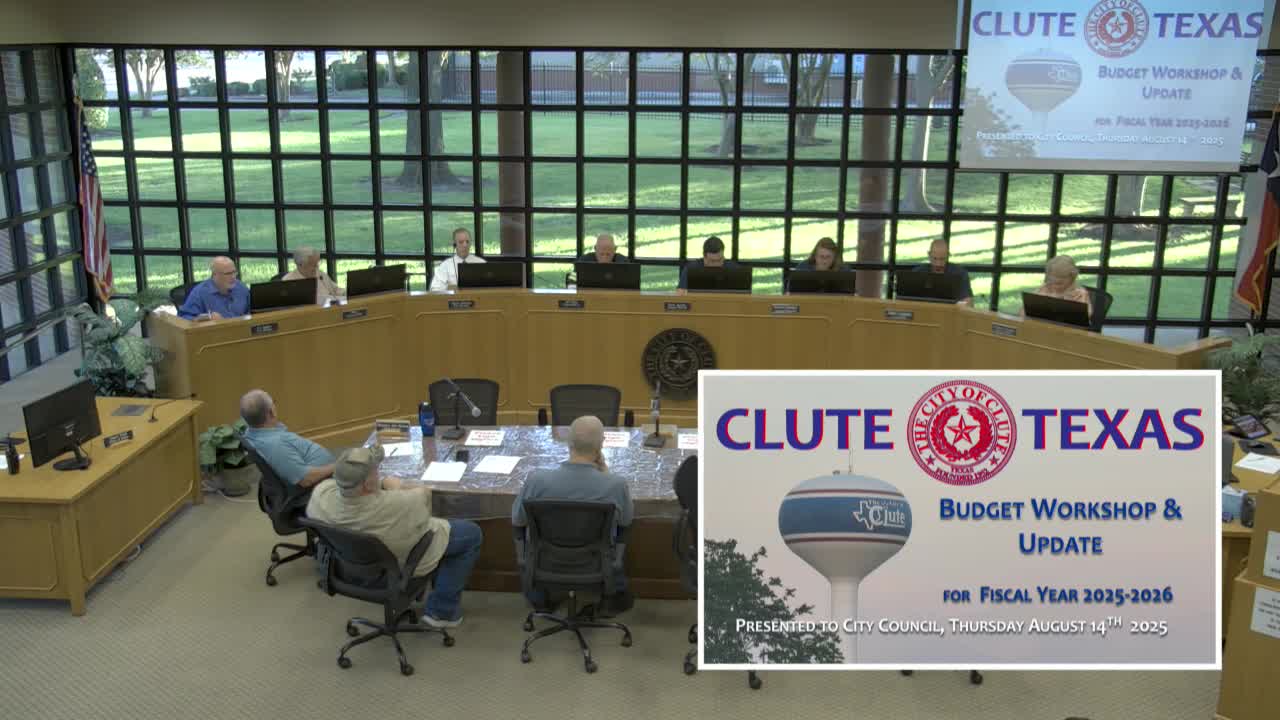
At an Aug. 14 budget workshop the Clute City Council directed staff to prepare budget numbers based on a mid-range solid-waste rate increase (staffOption 2) and to defer major capital purchases for at least one year while continuing current twice-weekly collection service.
At a City of Clute budget workshop on Aug. 14, council members and staff discussed four operational and rate options for the citysolid-waste program and directed staff to develop final budget figures based on "option 2" — a mid-range rate increase with no major capital purchases this fiscal year.
"As we've discussed throughout this process, starting back in July ... we'd like to present to you four possible alternatives," said John (staff member), who led the presentation on solid-waste operations and rates. He described the choices as: (1) modest changes to existing pricing to keep current service, (2) a larger rate increase to begin capital buildup while maintaining current operations, (3) a deeper overhaul including automation and new trucks (with higher upfront cost), and (4) outsourcing all collection to a private provider.
Councilmembers pushed staff for numbers and operational trade-offs. "What we kinda need direction on is what rate level is council comfortable going to, and what service level are you wanting to provide?" John said. After extensive discussion of tippage fees, heavy trash, enforcement and the city—s aging fleet, council members signaled a preference for the mid-range option, asking staff to return a budget based on option 2 with current twice-weekly collection and no capital purchase this fiscal year.
Why it matters: Solid-waste operations are run as an enterprise fund that should cover its costs; Clute is projecting a multi-hundred-thousand-dollar drawdown on reserves under current rates. Staff presented specific rate scenarios and draft financial impacts to show how different choices would affect the city—s reserves and ability to pay for repairs or new equipment.
Key details presented by staff
- Current average residential charge inside the city: $24.09 per month. - Rate Option 1 (low): aggregate ~31% revenue increase (residential roughly to about $34.10 depending on model), estimated to reduce the reserve draw but still require drawdown (staff estimated a $667,000 drawdown under one model if no operational changes are made). - Rate Option 2 (staffpreferred for modeling): a base increase of ~45% in revenue in draft scenario, with residential billing shown in presentation at $34.93 per month; staff said that option would reduce the net draw on reserves to a smaller amount (presentation cited a $4.27 million net draw in one summary line versus $6.68 million in a higher-draw scenario, reflecting general-fund interactions and enterprise adjustments). - Rate Option 3 (high): larger increases (presented as ~60% in some models) intended to fund automation and capital replacement sooner. - Outsourcing (Option 4): staff estimated a third-party contractor could cost the city approximately $1.5to $1.9 million annually in regional market rates; converting to a third party still showed a projected reserve draw in the current fiscal-year projection because of a decline in taxable valuations and other cost pressures.
Operational and enforcement points discussed
- Heavy-trash volumes are driven primarily by multifamily properties, hotels and storage facilities, staff said; staff proposed shifting more of that cost to heavy users through tiered commercial rates. - Tipping fees at regional landfills were described as a major cost driver; staff explained that private haulers can spread landfill ownership costs differently, putting the city at a competitive disadvantage. - Staff said an automated-cart model would reduce some labor costs but requires large capital outlay for trucks and standardized carts; an electric vehicle (EV) truck option (1B) was discussed as reducing certain maintenance costs but increasing upfront cost and road wear. - Enforcement options include stricter billing/account management, franchise enforcement, fines for noncompliant private haulers, and geotagging or cart-number systems to limit unauthorized use of commercial dumpsters.
Council direction and next steps
Council members did not take a formal vote on rates during the workshop. Staff said the council reached a working consensus to "develop numbers around option 2: no capital expenditure, current service level provision," and to return with final proposed budget figures in roughly 30 days for posting with the proposed budget. John and other staff were asked to refine the revenue projections, enforcement options for heavy-trash abuse, and updates to account management so the administration could present more precise numbers for adoption.
Quotes from the meeting
"We'd like to present to you four possible alternatives," John said when opening the solid-waste portion of the workshop.
"What we kinda need direction on is what rate level is council comfortable going to, and what service level are you wanting to provide?" John asked council members as he sought a policy direction to finalize budget numbers.
What remains unresolved
- Final adopted rate level and the precise monthly charge residents will pay; staff will return a proposed ordinance with exact rates. - Specific enforcement mechanics for heavy-trash abuse, mattress disposal and billing anomalies; staff proposed a mix of account audits, targeted fees and possible citations if the council chooses franchise enforcement. - Capital plan timing: council asked staff to defer major capital purchases for at least one year while repairing and managing the current fleet.
Ending: Staff will bring detailed budget spreadsheets and an ordinance for the proposed rates back to council in advance of the required public-posting deadline so the council can consider formal adoption at subsequent meetings.