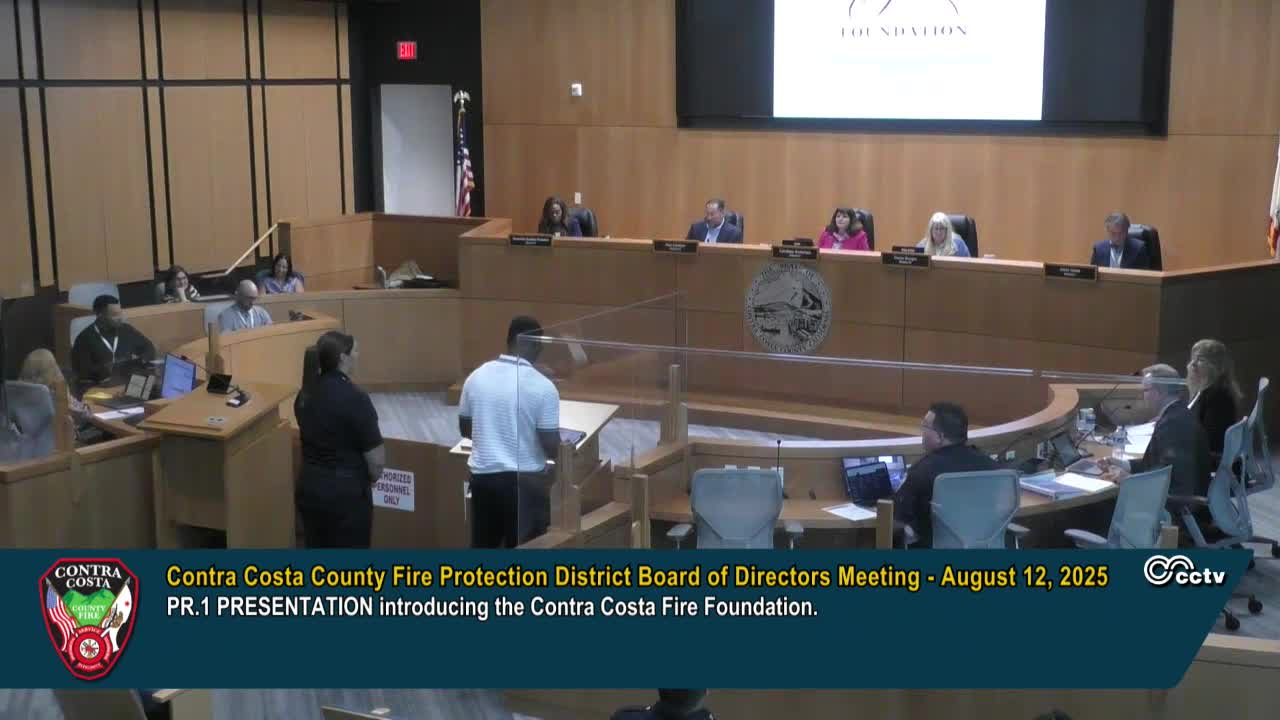
Contra Costa Fire Foundation highlights girls empowerment camp; chief reports new helicopter pods and ISO Class 2 rating
Loading...
Summary
The Contra Costa Fire Foundation on Aug. 12 presented its mission and recent programs, including a girls empowerment camp for teens, while the fire chief reported new Measure X–funded helicopter water pods and an improved ISO rating to Class 2.
The Contra Costa Fire Foundation on Aug. 12 described its goal of providing flexible funding to support Contra Costa Fire programs, equipment and community outreach, and highlighted a flagship girls empowerment camp held this May for teenagers.
Chris Toler, president of the Contra Costa Fire Foundation, said the foundation was established to “step in where traditional funding can't always keep up” and to provide “flexible, fast moving support” for equipment, training and program start-up costs. “One of our goals is to provide flexible, fast moving support to ensure the fire district has what it needs,” Toler said.
Firefighter Deandra Van Houten described the group's Girls Empowerment Camp, a two-day weekend program for girls ages 14 to 18 that gave participants hands-on experience wearing gear, using tools, climbing ladders and practicing medical skills such as CPR. “The GEC is basically a two-day weekend camp … meant to empower and inspire teenage girls ages 14 to 18 years old that they too can be a firefighter one day,” Van Houten said.
Board members praised the program and encouraged making the camp an annual event; several directors spoke of attending the weekend and of the value of outreach to expand recruitment pipelines.
In the chief's report, the fire chief said three of six Measure X–funded helicopter water pods are installed: at the Sheriff's detention facility in Morgan Territory, at the wildfire center in Byron and at a Phillips 66 facility in Rodeo. The chief described the pods as open-top tanks holding about 3,800 gallons that can refill at roughly 800 gallons a minute and are used for helicopter water pickups. As of July 31, the district's helicopter program had dropped more than 55,000 gallons of water — about 300 gallons per drop and roughly 200 drops by that date, the chief said.
The chief also reported a substantial improvement in the district's ISO (Insurance Services Office) rating after a multi-year effort on station placement, apparatus upgrades and training. The district moved from a split rating (Class 3 in closer, hydranted areas and Class 8 in more remote areas) to a Class 2 rating based on an improved score of 87.4 points, the chief said. He noted the district was fewer than three points from a Class 1 rating and said the change should help reduce insurance costs for some residents, particularly in areas that were previously rated much higher.
The board accepted the chief's report by motion and voted unanimously (5–0). No public comments were received on the chief's report.
The foundation said it does not fund salaries or ongoing employee benefits, except in rare, short-term consultant cases, and avoids political activity tied to campaigns or ballot measures. The foundation asked board members to help spread awareness and connect it to potential sponsors to sustain programs such as the girls empowerment camp.
Votes at a glance: The board accepted the chief's report (motion passed unanimously, 5–0) and approved consent calendar items C1–C8 (motion by Director Carlson, second by Director Bergus; passed 5–0).