Get Full Government Meeting Transcripts, Videos, & Alerts Forever!
Get email alerts on the Community Health Action Center topic
No spam. Unsubscribe anytime.
Los Alamos health council tables community health action center recommendations for rewrite and return in September
Summary
The Los Alamos County Health Council presented a working-group report proposing a co‑located Community Health Action Center with space for social services, nonprofits, food distribution and a clinic. Council members raised concerns about scope, cost and specificity; the council voted 6–1 to table the report for revision and return in September.
The Los Alamos County Health Council on a virtual meeting moved to table a working‑group report that outlines a proposed Community Health Action Center and asked staff and the working group to revise the recommendations and return the item to the council in September.
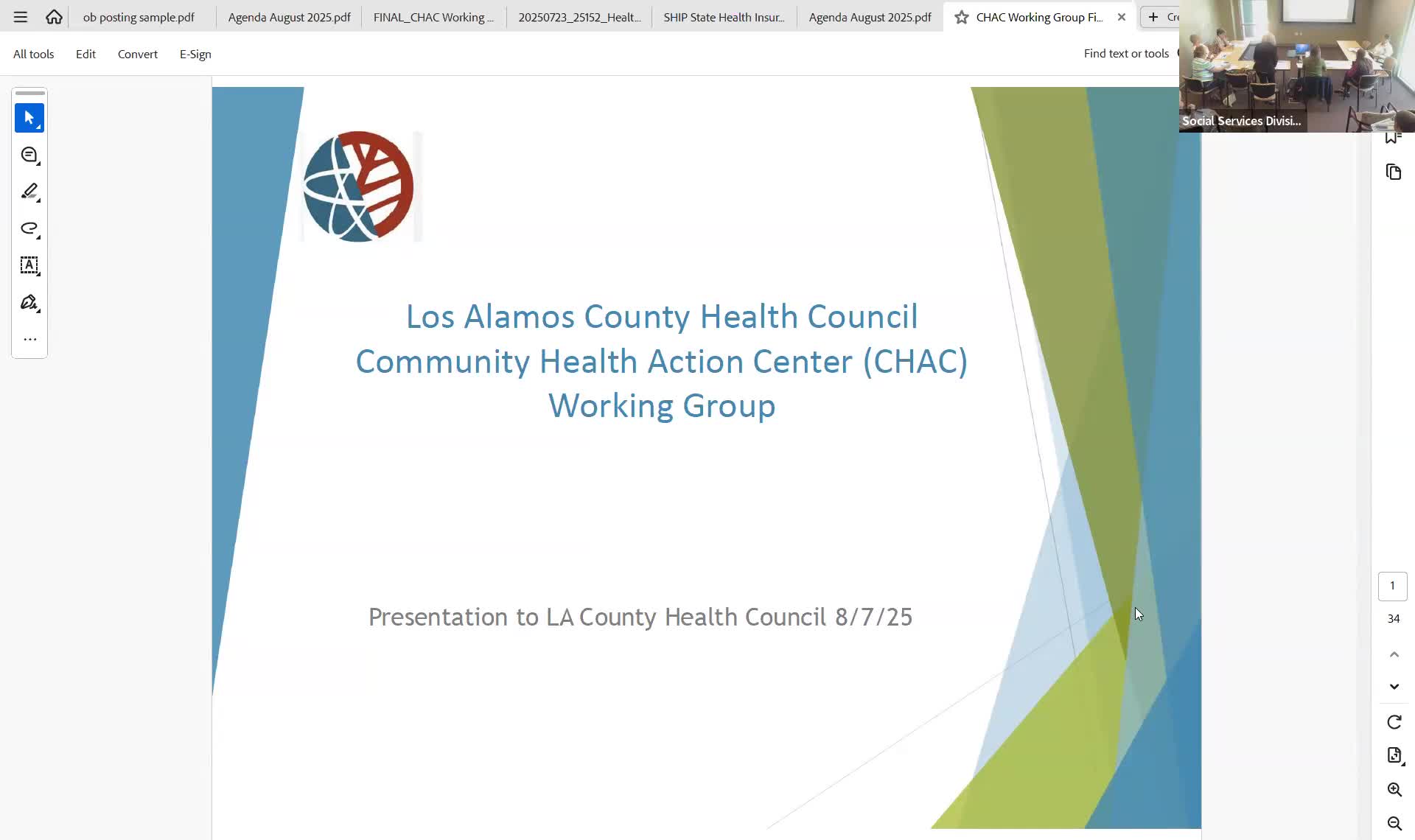
The working group presented a “complete” or idealized set of requirements for a co‑located facility intended to centralize social services, nonprofit partners, a food distribution storefront, shared conference/training rooms, laundry and shower facilities, an industrial kitchen and space for mobile clinic units. Lisa Hampton, chair of the Health Council, said the proposed center “would provide the infrastructure to implement many of the approved short and long term action items in a co‑located and sufficiently sized facility.”
Why it matters: Councilors and several members of the public said the document as written is too broad and lacks the minimums, cost justification and occupant commitments needed for County staff and the County Council to scope architecture, site selection and operating costs. The county has already placed a Community Health Action Center project in its Integrated Capital Improvement Plan (ICIP) with funds identified for planning and future buildout; the working group’s recommendations would be the next step in formalizing requirements for that project if the council and county staff proceed.
Most important facts - The working group recommended a multi‑function facility with four broad program areas: public reception and information, a family resource/intergenerational center, office/counseling space for social services and partners, plus food distribution and an industrial kitchen. The presenters described support spaces including computer kiosks, private charging for monitoring devices, shower/laundry facilities, storage for emergency supplies and a loading dock for food deliveries. - The county’s ICIP shows roughly $950,000 received so far for the project, $2,000,000 budgeted for the next fiscal year and $8,000,000 budgeted in a later fiscal year (the working group described those totals as an approximate $10,000,000 earmark to date for the hub project). Working‑group members said the county’s public works division would manage next steps including architectural scoping and site selection. - Statewide behavioral‑health funding (Senate Bill 3, referenced in the meeting) was cited by presenters as a related opportunity: speaker(s) noted the state allocated an initial $100,000,000 to support regional behavioral‑health development across judicial districts, which could influence regional planning. - After questions and public comment, the council voted to table the report, instructing the working group and staff to: remove or generalize organization names in the draft, clarify minimum vs. aspirational space needs (primary/secondary/tertiary occupants), include projected client volume/expected service impacts, and spell out the decision pathway once the item leaves the Health Council. The motion was made by Leslie Wallstrom and seconded by Celeste Raffin; the vote to table was 6–1.
Discussion details and council concerns Council members praised the concept of co‑location as a client‑centered approach but repeatedly urged realism about cost, staffing and long‑term maintenance. Multiple members said the draft read like a “Cadillac” or ideal buildout and recommended the working group produce clearer minimum and enhanced plans, and quantify expected client impact for any proposal the County Council would consider.
Several members flagged specific issues they said must be clarified before the county will be able to scope architecture or operating budgets: whether named nonprofits want or need permanent offices in a county facility; what rent or occupancy terms (if any) would apply; the number of staff and clients served; and how facility maintenance and utilities would be funded. A number of members also urged the working group to avoid promising space to particular organizations and instead recommend types of occupants (for example, “food distribution partner” or “housing navigation partner”) so the county can follow procurement or occupancy processes later.
Public comment reflected similar differences of view. Some speakers urged the council to advance the project and praised the working group’s effort and timeline; others said the draft was insufficiently specific and recommended waiting until the report included clearer minimums and realistic cost and staffing assumptions.
Next steps Councilors instructed the working group and staff to revise the draft and return the item in September for a possible vote on a revised recommendation. County public works and social services would be responsible for any subsequent architectural scoping, site selection and formal budget proposals to County Council. The working group said it would be available to consult or serve on a steering committee as the project proceeds.
Ending The motion to table carried on a 6–1 vote; council members set a target to bring a revised report and supporting clarifications back to the Health Council in September for further consideration.