Get Full Government Meeting Transcripts, Videos, & Alerts Forever!
Get email alerts on the Fiscal Year 2026 Budget topic
No spam. Unsubscribe anytime.
Missouri City staff present proposed fiscal 2026 budget; property tax rate held at 0.570825
Summary
City staff presented a $258 million proposed fiscal 2026 budget that keeps the city's property tax rate at 0.570825, allocates $11.2 million to streets and sidewalks, funds seven SAFER grant positions for fire, and schedules public hearings in September.
Bertha Alexander, the city's chief budget and performance officer, presented the proposed fiscal year 2026 budget to the Missouri City Council at a council workshop, saying the plan keeps the city's current property tax rate at 0.570825 while shifting about one cent from operations to debt service to cover principal and interest on a 2021 bond authorization.
"Our focus is transparency and ensuring everyone understands not just the numbers, but the why behind the numbers," Alexander said, describing a budget built around priority-based budgeting, a five-year plan and a 5 percent department-level reduction target used to reallocate about $1 million in efficiencies.
The proposed all-sources budget totals about $258 million, up 15.6 percent from $223 million the prior year, according to Alexander. General Fund revenue is projected to rise about 8 percent; property taxes would remain the largest single revenue source at roughly 61.9 percent of general-fund revenue. The presentation shows the increase reflects new growth and higher assessed values, with a 4.4 percent increase in property-tax revenue and double-digit growth in sales tax and permit revenue.
City Manager Shashi told the council the package was "scrubbed as much as possible" and that holding the overall tax rate steady required shifting the distribution between maintenance & operations and debt service. "We kept the rate the same, but you will see that our maintaining that current rate put us from 46 to 45," Shashi said, referring to the M&O component.
Key allocations and numbers in the proposed budget include: - $11,200,000 for traffic, street and sidewalk repairs (including street repairs, sidewalks, flood damage and street lights). - $745,000 for economic development incentives (a pool the presentation said could be used citywide rather than limited to a single corridor). - $890,000 to enhance or maintain services related to growth, including one new code-enforcement position in neighborhood services. - $2,100,000 for public safety (police staffing and pay, traffic enforcement) and a net of seven new positions for fire funded through a SAFER grant. - $1,500,000 for employee recruitment and retention/compensation to remain competitive. - A $1,000,000 budget reduction labeled "efficiencies" created by consolidating marketing, travel, swag and other items.
Alexander said the proposed staffing level is 458 full-time equivalents, up from requests for 25 additional FTEs; the city manager's recommended budget funds a net seven positions (SAFER grant-funded) and reallocates other positions across departments. Supplemental requests totaling $23.5 million were pared to $16.5 million in the manager's recommended package.
The presentation included a five-year capital improvement program and noted authorized but unissued debt from prior authorizations. Alexander said the city will issue the remainder of the 2021 bond authorization in 2026 to fund projects, including drainage, facilities, parks and mobility. Examples listed in the CIP and the presentation: - Pine Meadow drainage improvement: $1,000,000 (GLO reimbursement anticipated). - Gregory Lane drainage improvements: $1,000,000 (GLO reimbursement anticipated). - Northeast Oyster Creek detention improvements: $1,750,000. - Public safety headquarters: $200,000 to complete the project. - Parks projects including a multiuse conversion of a baseball/softball field ($3,977,000), concrete trail conversions at American Legion Park ($528,000) and McNaughton Park ($260,000), and a $400,000 match for potential park-development grants.
Alexander said utilities projects total about $10.1 million, with most proposed to be funded by a certificate-of-obligation issuance and fund balance. She also listed a set of currently unfunded projects totaling about $5.9 million (HVAC replacement, McNolton Park expansion, Meadow Creek pickleball court, among others); the Meadow Creek pickleball request of $500,000 was described in the meeting as unfunded and no agreements had been secured.
On community engagement, Alexander said the city issued a budget survey in June and received 112 responses. Alexander read the total: "We had a total of a 112 responders." Survey priorities ranked streets, sidewalks and traffic first, followed by police services and infrastructure (drainage, medians and bridges), then fire services, economic development, parks and code enforcement; council members pointed to that ranking as reflected in the draft allocations.
Council members asked questions about the budget's assumptions and details: how the city's general fund balance would be used to cover planned expenditures, the magnitude and timing of assessed-value increases (Alexander said those figures were available and were being used), which items are funded versus unfunded in the CIP, and how new revenue ideas and fee changes might be pursued. Alexander and the city manager said some new revenues under exploration include charging for records requests (based on staff time and media requested), potential fees for animal cremation, differentiated resident/nonresident park fees and reevaluation of alarm-permit fees.
Council members also raised operational issues and priorities: converting decorative or additional streetlights beyond CenterPoint's annual local allocation (CenterPoint provides an allocation of about 50 local lights per year, Alexander said; the proposed $500,000 street-light allocation is for areas beyond that allowance), whether concrete trails are required in every park or whether lower-maintenance alternatives suffice, and use of fund balance for one-time capital versus recurring operating needs. The city manager reiterated the city intends to preserve a fund-balance policy target (above 30 percent is projected after the recommended budget allocations) and to use one-time funds for one-time projects.
Schedule and next steps in the presentation: the city will present a high-level budget overview via video on Aug. 18, hold a community budget workshop on Aug. 23, file the proposed budget with the city secretary and post it online on Aug. 25, and hold public hearings on the budget and tax rate with proposed adoption on Sept. 15. Alexander said the presentation was intended to leave ample time for public review and input.
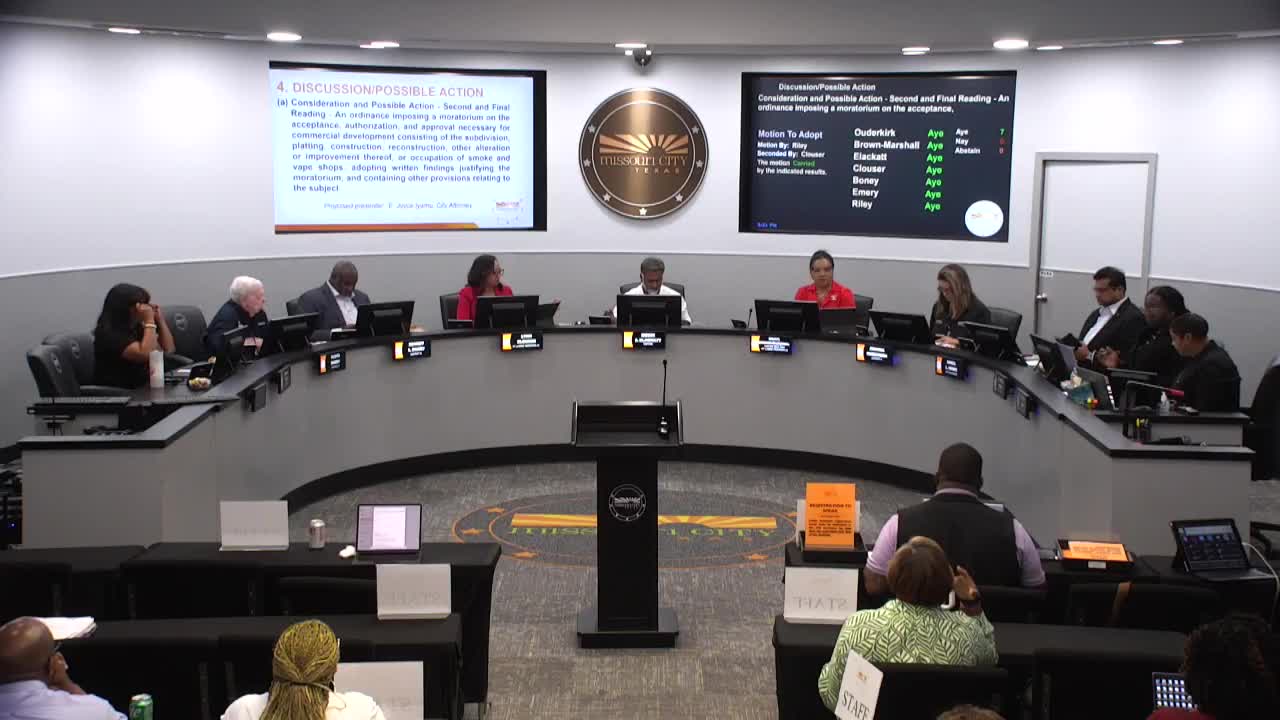
No formal council vote on the 2026 budget occurred during the workshop. An earlier vote recorded at the start of the transcript was taken on an item not specified in the presentation; the clerk recorded that "the motion carries unanimously." The council is scheduled to consider formal budget and tax-rate actions at upcoming public hearings.
The presentation and the council's questions underscored two recurring themes: the city is trying to balance growing, one-time capital needs and recurring operating costs while seeking additional recurring revenue sources; and council members want clearer district-level breakdowns of capital allocations and more detail on potential new revenues for future discussions.