Get Full Government Meeting Transcripts, Videos, & Alerts Forever!
Get email alerts on the County Budget Extension Office topic
No spam. Unsubscribe anytime.
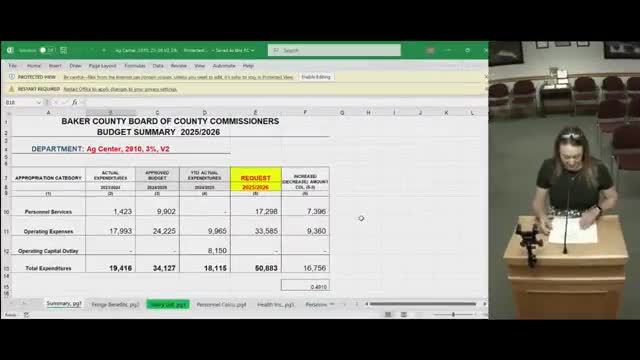
Extension office seeks $80,045 for vehicle, flags $35,000 insurance increase
Summary
At a Baker County budget workshop staff described a proposed Extension Office budget that includes $45,000 for a replacement van, an insurance budget jump largely tied to new hires and possible family coverage, and unresolved spreadsheet discrepancies commissioners asked staff to reconcile before final hearings.
Baker County Extension Office staff told the county commission during a budget workshop that the office is proposing $80,045 in additions to its fiscal-year request, driven mainly by a $45,000 request to replace an aging transport van and a large rise in health-insurance budget projections.
The proposal includes one capital purchase — a replacement vehicle to take the place of a 2008 Chevrolet Uplander the office described as 17 years old with about 86,000 miles — and personnel-cost increases from newly filled positions. Extension Office staff said the van has had recurring mechanical and drivability problems; staff said they have taken the vehicle to local shops and the county road department for diagnostics but that persistent faults remain and some drivers do not feel safe using it for long trips.
Commissioners pressed staff on the expanded health‑insurance figure, which staff said reflects two recently filled positions and a conservative assumption that new hires might select family coverage until open-enrollment choices are final. Staff said the insurance tab on a health-insurance worksheet shows roughly $41,078.85 when other insurance obligations are included; a related personnel summary line shows a $35,045 increase. Commissioners asked staff to confirm which lines reflect employer contribution assumptions and to verify the spreadsheet logic before the final public hearing in September.
Staff also described vehicle maintenance history and a recent roadside stall while traveling to a conference, which informed the decision to seek a replacement rather than repair. They estimated routine maintenance expenditures were low — roughly $250 year-to-date for oil and tires — but said several mechanics’ diagnostic codes had been difficult to interpret and that several shops had been unable to identify a single, durable fix.
Commissioners asked staff to provide receipts and repair-history documentation and to prioritize getting a thorough diagnostic from a passenger‑vehicle specialist before the county approves a new-vehicle purchase. Staff agreed to supply documentation and to return with revised figures after new employees complete benefits enrollment.
Ending: Commissioners did not take a formal vote at the workshop but asked staff to reconcile the insurance and personnel spreadsheets and to return with documentation of repairs and a clearer cost estimate for the van before the September final public hearing.