Get Full Government Meeting Transcripts, Videos, & Alerts Forever!
Get email alerts on the County Budget topic
No spam. Unsubscribe anytime.
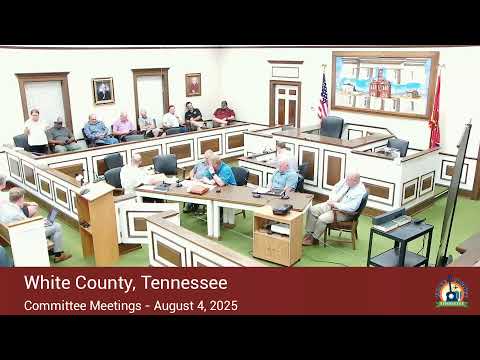
White County budget committee backs $1.41 levy, sends plan to full court amid heated debate over raises and services
Summary
After two hours of debate and public comment, the White County Budget Committee voted to forward a proposed fiscal 2026 budget to the full county commission that would set the countywide tax levy at $1.41 per $100 of assessed value, fund a countywide pay increase and carry a roughly $350,000 deficit to be covered from reserves or other sources.
The White County Budget Committee on Aug. 4 voted to send a fiscal 2026 budget proposal to the full county commission that would set the county tax levy at $1.41 per $100 of assessed value and include a countywide pay adjustment for employees, but the plan leaves an estimated $350,000 deficit.
The committee's decision followed more than four hours of discussion among commissioners, presentations from state officials and extended public comment. The committee majority voted 3–2 to advance the proposal to the full court for final consideration at the Aug. 18 meeting.
Why it matters: Commissioners said the package is an attempt to address long-standing pay shortfalls for county workers while preserving core services (ambulance remounts, highway operations, parks and recreation funding). Opponents warned the plan relies on depleting reserves and stretches the county's ability to respond to an unforeseen disaster, while some members and public speakers urged higher pay for emergency medical services and sheriff's deputies to retain staff.
The proposal forwarded to full court would: set the county levy at $1.41 per $100 of assessed value; allocate approximately $4,500 in additional pay for general‑fund employees (the committee agreed to roll previously budgeted longevity pay into the new raises for general‑fund staff); keep two pennies of dedicated levy in the highway fund; maintain a $3,500–$3,600 remount/remounting allocation for EMS equipment; and set the school portion of the levy at $0.33 and the highway portion at two pennies (as presented by staff). The committee recorded that adopting the package as proposed would leave a budget gap of about $350,000.
State comptroller Jason Mumpower, appearing by video, told the committee that Tennessee law requires a balanced budget by Aug. 31 (the legislature allows an extended deadline beyond the statutory June 30) and warned that, if the county fails to adopt a budget, his office may adopt one for the county. "If you choose not to pass a budget ... the law gives the comptroller the ability to make reductions in expenses or make increases in revenue," Mumpower said. He added that his office traditionally prefers cutting discretionary spending rather than raising new taxes and would eliminate discretionary items if forced to adopt a budget for the county.
Commissioners debated several specific elements at length. Key points of contention included:
- Employee pay and longevity: Commissioners explored multiple options — a flat $4,000 across the board raise (which had been discussed earlier), rolling longevity into raises to give a roughly $4,500 across‑the‑board increase, and smaller or larger alternatives. Supporters argued a dollar figure was fairer and that county pay has lagged neighboring jurisdictions; opponents said the levy increase needed to be smaller and warned of the cumulative effect on taxpayers. County finance staff repeatedly summarized how moving longevity into pay, adjusting remount funding and other line‑item changes affected the levy by fractions of a penny and tens of thousands of dollars.
- EMS and sheriff staffing: Commissioners and public speakers (including current EMS personnel) pressed for higher pay to retain paramedics and critical-care staff. Speakers described paramedic scope and the difficulty of recruiting and retaining certified personnel for rural EMS.
- Parks and recreation director position: Commissioners discussed funding a full‑time parks and recreation director and an associated grant. Some committee members said the dedicated parks funding (a multi‑decade resolution referred to as "two pennies") would cover a director's salary and that hiring a manager had produced private investment in county athletic facilities.
- Highway fund and dedicated pennies: The committee preserved two dedicated pennies for highway needs; commissioners discussed whether highway revenues could be used to support highway employee pay and whether that fund could absorb some increases without affecting the general fund.
- Long‑term revenue source: Several commissioners raised the idea of a wheel (sales) tax or other voter‑approved revenues as a longer‑term solution that could offset property tax pressure; commissioners noted that such a tax requires separate steps (two votes by the commission) and can be subject to a citizen petition and referendum.
Public comment: More than a dozen citizens addressed the committee during the public‑comment period. Jail and court office staff asked that clerical positions and courtroom employees not be excluded from raises; EMS personnel and community members urged higher compensation for paramedics. Several commenters urged greater transparency in budget documents and asked for an independent audit of budget accounting and line‑item accuracy.
Vote and next steps: The committee vote to forward the $1.41 proposal to full court passed 3–2. Commissioners recorded as voting "yes" in the roll call were Commissioner Kyle Goff, County Executive Robinson and Commissioner Derek Hutchings; Commissioners TK Austin and David Cranford voted "no." The full county commission will consider the proposal at its regularly scheduled meeting on Aug. 18. If the commission does not adopt a balanced budget by Aug. 31, Mumpower said state law authorizes the comptroller to adopt a budget for the county.
The committee also discussed scheduling additional meetings and public notices in the run‑up to the Aug. 18 full‑court session. Several commissioners urged staff to publish clear budget comparisons and to assemble a short set of figures so that commissioners and the public could verify line items before the full‑court vote.