Get Full Government Meeting Transcripts, Videos, & Alerts Forever!
Get email alerts on the Community Benefits Agreement topic
No spam. Unsubscribe anytime.
Jacksonville council, residents debate governance, guardrails for East Side CBA entity
Summary
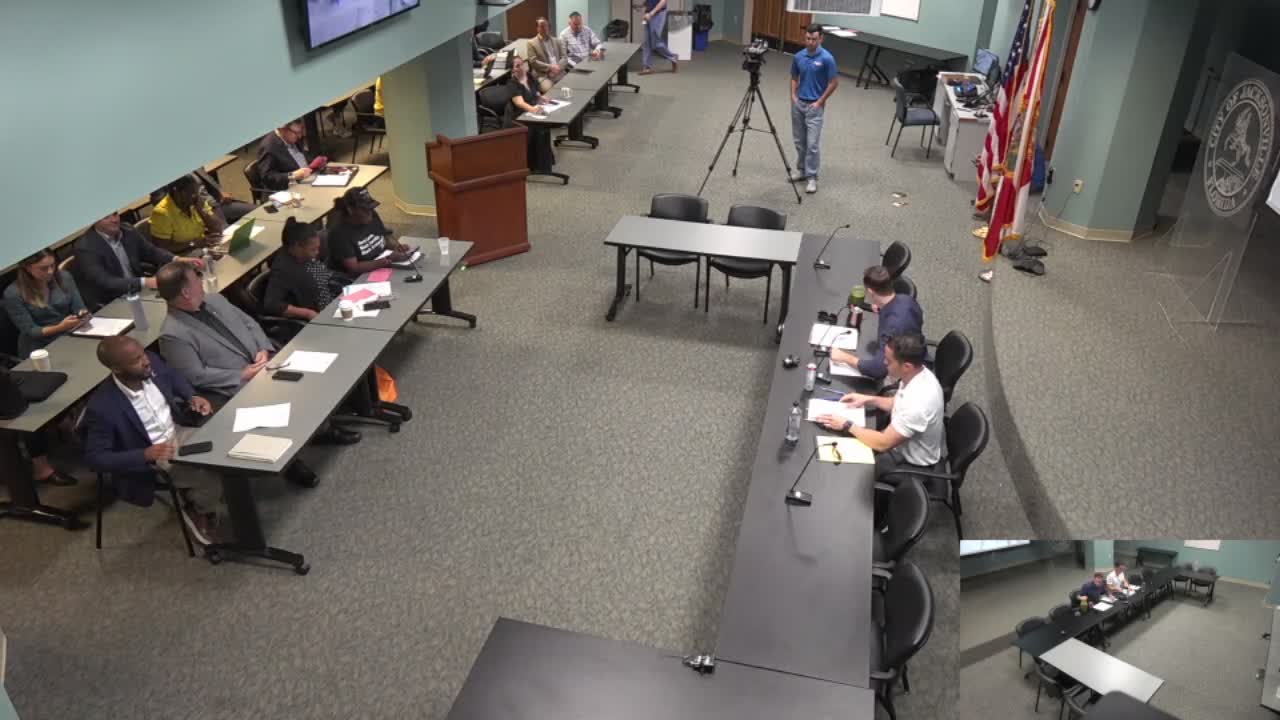
Jacksonville council members, legal staff and East Side residents met in a special notice session to discuss how a Community Benefits Agreement (CBA) fund for the East Side should be governed and how city dollars would be protected and spent.
Jacksonville council members, legal staff and East Side residents met in a special notice session to discuss how a Community Benefits Agreement (CBA) fund for the East Side should be governed and how city dollars would be protected and spent. The meeting was for discussion only; no votes or formal actions were taken.
The session focused on two governance options: creating an independent 501(c)(3) modeled on the city's Cultural Council to receive and distribute city and private dollars, or using a statutory vehicle such as a tax-increment-style revenue diversion or special-district model. Mary Stifopoulos, Office of General Counsel, summarized prior committee work and said staff would draft legislation based on the Cultural Council construct for the special committee's consideration.
Councilman Arias (District 11) and Councilman Paluso (City Council District 7) led the discussion. Councilman Paluso noted that the mayor's proposed budget includes "$4,000,000 allocation towards the East Side," and said the immediate question is which entity will receive and oversee those dollars. He described a draft board structure under discussion: nine members total, with five seats reserved for East Side community members and four appointees (one by the mayor, two by city council and one by the Jacksonville Jaguars). "That board would get funds distributed every year from city council," Paluso said, adding the board would present budgets annually, be audited and be bound by sunshine and ethics laws.
Office of General Counsel staff recommended staggered terms and described options for initial term lengths to avoid turnover of the entire board at once. Officials said the legislative draft would need to clarify appointment authority, term lengths, quorum rules and the process for selecting the five East Side community members, noting there had not been committee consensus on whether those seats must be residents or could include long-standing business owners or property owners with ties to the neighborhood.
Legal and implementation details drew sustained discussion. Stifopoulos and other legal staff explained differences among the Cultural Council 501(c)(3) model, a downtown-investment-authority (DIA)/CRA structure and a revenue-diversion or UIRA-like model. Staff warned CRA/TIF statutes limit eligible uses and that some community priorities (housing repairs, workforce development or some social services) may not fit CRA restrictions. They also flagged that state law and city code create different limits on permanence and local control depending on the vehicle chosen.
Attorney Daniel Nunn and counsel working on the nonprofit said drafts of articles of incorporation and bylaws for a 501(c)(3) were underway. Nunn and a legal adviser said some fiscal guardrails could be built into the nonprofit's charter and into the city legislation that would appropriate funds and contract with the entity. The Cultural Council model discussed would allow the nonprofit to receive city appropriations and private donations and run a competitive grants process; city staff noted the city typically caps administrative fees for the Cultural Council at about 13.5 percent of city funding.
Resident speakers urged stronger statutory protections or binding resident authority. Nikki Brunson, a fourth-generation East Side resident and policy analyst, urged the committee to rescind a May 12 vote and to compare models on a scored matrix. Brunson proposed an East Side "community benefits special district" modeled on statutory special-district and trust-accounting rules; she said such a model would require an independent annual CPA audit, segregated city trust accounts, dual-signature controls and explicit council approval thresholds. "Nothing here alters the stadium financing," Brunson said. "It simply is there to protect the community's portion of the money."
Other public commenters, including representatives of the Together Eastside Coalition and long-time neighborhood residents, urged timely creation of a governance body while pressing for transparent, resident-centered decision-making. Some speakers expressed distrust of intermediary organizations and asked that resident seats be binding and that appointment processes be open. Angus Williams and other coalition members described two years of public meetings that produced the coalition's recommendations and said the coalition is open to additional participants.
Council staff said next steps would include drafting legislation that reflects the Cultural Council grant/board model, drawing specific guardrails for city dollars (eligible program areas, residency or service-area requirements, audit and reporting obligations), and returning to the special committee after the council budget process. A tentative next committee meeting was proposed for Aug. 13 to consider the CBA board and to discuss tax-increment/revenue-diversion options; staff said the date would be confirmed and the committee would follow the city's formal notice and appointment processes.
Because this was a notice meeting, no motions were made and no formal appointments or appropriations were approved. Officials said appointments to any eventual board would follow the city's standard appointment process (committee reviews, first and second readings and final confirmation), and that some initial appointees would be needed to incorporate and form a 501(c)(3) so the organization could begin work once incorporated.
The committee and staff agreed to return with a draft ordinance and bylaws informed by the Cultural Council model, plus options and legal analysis on revenue-diversion/TIF alternatives and statutory special-district limits. The meeting closed with repeated assurances from council members that the intent is to create a durable structure that preserves community voice and annual city oversight through the budget and audit cycle.