
Indianapolis advances phased Copilot pilot, posts generative AI policy and expands training
Get AI-powered insights, summaries, and transcripts
Sign Up Free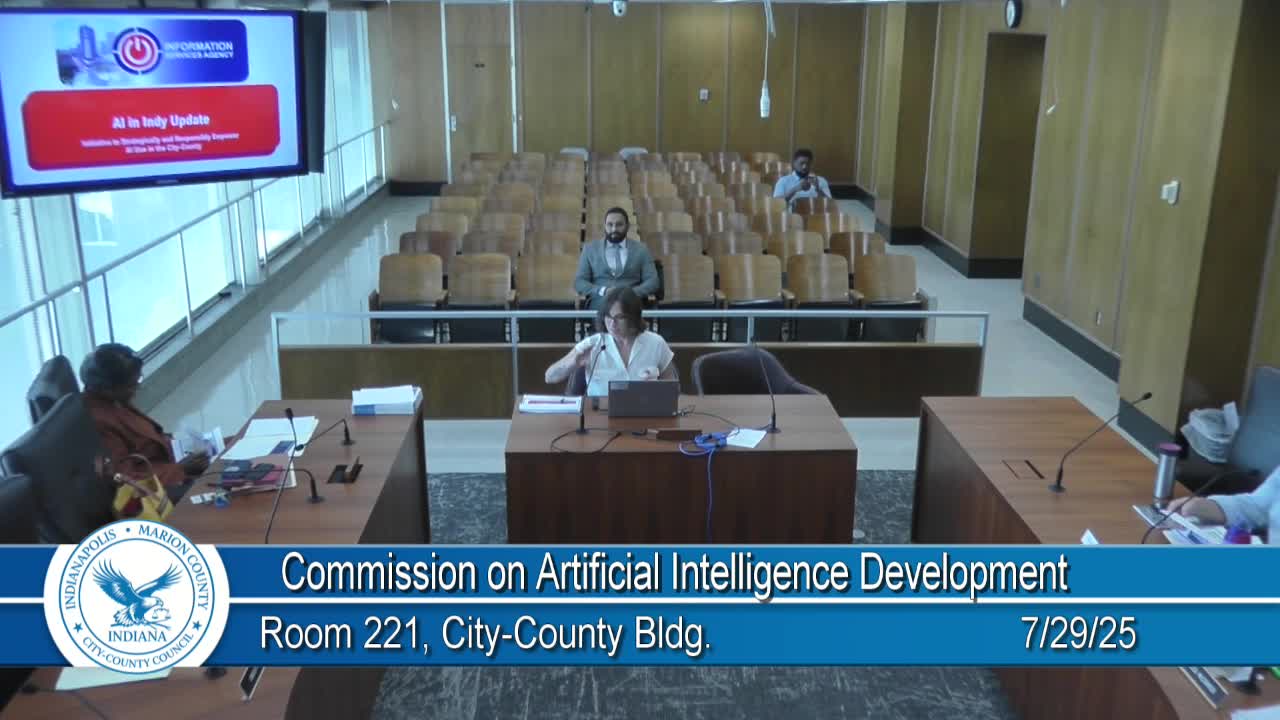
Summary
Indianapolis and Marion County officials on July 29 told the AI Commission they have launched a phased deployment of Microsoft Copilot across the city‑county enterprise, published a generative AI policy and are expanding staff training and data‑security testing ahead of broader rollouts.
Indianapolis and Marion County officials on July 29 told the AI Commission they have launched a phased deployment of Microsoft Copilot across the city‑county enterprise, published a generative AI policy and are expanding staff training and data‑security testing ahead of broader rollouts.
Chief Digital Officer Kate Coaten, who leads the initiative inside the Information Services Agency, said an ISA pre‑pilot of Microsoft 365 (M365) Copilot is underway and slated to wrap on Aug. 1, with wider deployment to eligible enterprise users targeted for late August. Coaten said the city posted its generative AI policy after the IT board signed it earlier this month and that ISA is testing Microsoft Purview data‑loss‑prevention (DLP) tools in a multi‑week proof‑of‑concept with Microsoft.
The initiative matters because the city estimates roughly 7,700 Office 365 license holders could access Copilot chat and related features; officials said they expect enterprise use of generative tools to increase data storage and records‑management needs, with budgetary implications for long‑term data retention and audit logging.
Coaten said ISA has focused first on governance, training and a controlled pilot model rather than broad rollouts. "Microsoft Copilot doesn't use any data that's put in it to train its models, and it doesn't leave our tenant," Coaten said, summarizing a security point ISA has emphasized; she added the generative AI policy lays out recommended, not‑recommended and prohibited tools and guidance on data classification and records retention.
Pilot, training and license counts ISA purchased 200 Copilot‑cohort licenses for an initial enterprise rollout, Coaten said, and described a staged approach that begins with a cohort of early adopters who will act as internal champions. As of the meeting ISA reported 126 city‑county employees had completed InnovateUS's "Responsible Use of Generative AI" course; 119 of those were eligible for the Copilot pilot under ISA's prerequisites. ISA also reported 284 employees had completed a separate data‑classification training, with 37 in progress and 20 required to retake the short assessment.
Coaten described a separate training partnership capitalizing on a Google grant secured by InnovateUS that provided 150 Coursera licenses for three certificate tracks (data analysis, cybersecurity and project management). The certificates typically cost about $300 each; Coaten said the grant represents roughly a $47,000 training value and that all 150 seats were filled quickly with a wait list forming.
Security, privacy and records retention On security, Coaten said ISA's security team is working with Microsoft on a Purview DLP proof of concept expected to run about five weeks; ISA is also preparing sensitivity‑label training for technical staff. Commissioners and other attendees raised concerns about how generative and agentic AI affects public‑records retention, cross‑pollination of protected data, and whether uploaded documents could be used beyond intended scopes. Coaten said the generative AI policy addresses records retention for tools inside the city tenant and that use of external or “not recommended” tools presents more uncertainty.
Professor Frank Emmett and other participants warned about agentic AI that can re‑use uploaded data; Coaten and others said policy will need ongoing revision as features and government‑tenant clearances evolve. Coaten noted agentic Copilot is not currently cleared for Microsoft’s GCC (government tenant) and that the city must wait for security and procurement work before adopting that capability.
Staffing, governance and budgets Director Colin Hill and Coaten described a staffing plan that keeps a chief data and privacy officer on the road map but proposes hiring an interim data manager and a governance, risk and compliance (GRC) analyst first to maintain DLP and SharePoint hygiene. Hill said the city has already overhauled permissioning on ISA SharePoint sites as part of the Copilot readiness work and that a dedicated data manager would help sustain that effort across dozens of departments.
Several commissioners pressed for clearer budget estimates and a way to finance ongoing storage, security and procurement costs as use expands. Hill and other members suggested building a dedicated innovation or emerging‑technology fund (modeled on existing enhanced access funds) and a governance committee — a subcommittee of the IT board — to vet procurement, guide priorities and approve funded pilots.
Report, public input and next steps After the presentation the commission reviewed a draft final report on the AI initiative. Director Hill recommended a two‑week review period for commission members to send edits; members requested an executive summary and clearer budgeting language for the council. Commissioners agreed not to open the draft to broad public comment at this stage and asked staff to circulate a version for review by email. The commission intends at least one additional in‑person meeting to consider and formally approve a final report.
No formal votes on ordinances, budgets or contracts were recorded during the meeting. The discussion focused on implementation sequencing, training and governance rather than immediate procurement approvals.
What remains open Officials listed several dependencies before wider agentic deployments: Microsoft GCC clearance for agentic Copilot, completion of the Purview DLP pilot, completion of enterprise‑wide training, a clearer procurement risk matrix, and resourcing (staff and budget) to support growing storage and audit needs. Coaten and Hill said ISA will continue cohorts, broaden Copilot chat training to more license holders in the fall and pursue additional training and partner events into 2026.
The commission set a near‑term expectation for members to provide written feedback on the draft report within about two weeks and sign off at a subsequent in‑person meeting.